Stanford CS105: Introduction to Computers | 2021 | Lecture 8.3 Linking Webpages: Formatting Links
TL;DR
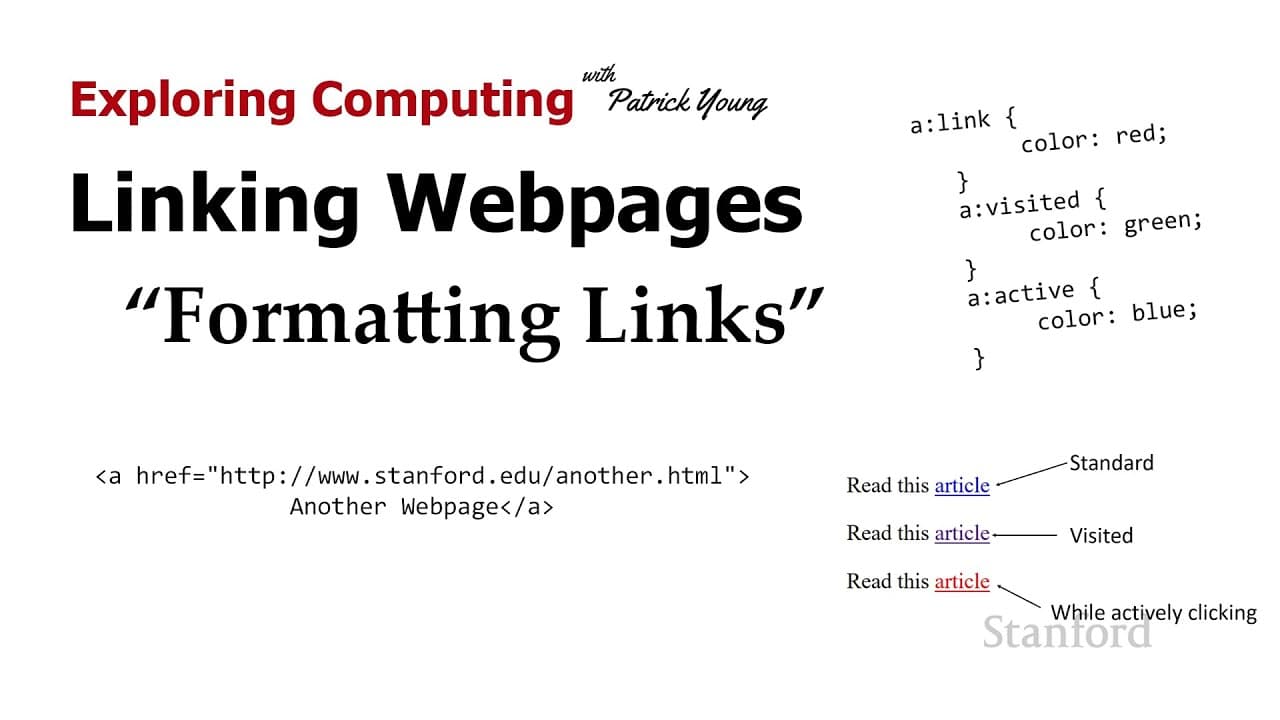
Learn how to format links on web pages using pseudo classes and understand the importance of affordances in user interfaces.
Transcript
welcome to exploring computing today's video is linking web pages part two formatting links so in the last video we took a look at linking different web pages and what our options are when using links in this video we're going to take a look at how you can format your links and along the way we'll learn about pseudo classes which can be used for qu... Read More
Key Insights
- 💟 Link formatting involves controlling text decoration, such as removing the default underline or adding visual effects like overlines and underlines simultaneously.
- 👤 Affordances in user interfaces help users understand interaction possibilities, and for links, the underline serves as an affordance indicating clickability.
- 👻 Pseudo classes, introduced with a colon, allow for styling different link states, such as visited or active, and can be applied to various elements, not just anchor tags.
- 🍻 Removing underlines from links might lead to a loss of the affordance that signifies a clickable link, potentially confusing users.
- 👶 Pseudo classes extend beyond link styling and can be used for applying styles to the first or last child element or selecting specific elements within a group based on their position or other criteria.
- 🤨 Zebra striping on tables, where odd and even rows have different styling, can be achieved using the nth child pseudo class.
Install to Summarize YouTube Videos and Get Transcripts
Explore YouTube Video Summarizer or Get YouTube Transcript Extractor
Questions & Answers
Q: Why is it important to remove the underline from links?
Removing the underline from links can help prevent confusion for users who might mistake non-link text for clickable elements, maintaining user expectations and preventing frustration.
Q: How does the web browser differentiate between visited and non-visited links?
The web browser dynamically adds a pseudo class, "visited," to anchor tags when it recognizes that a user has visited a specific link. This allows for distinct styles to be applied to visited and non-visited links.
Q: What is the purpose of pseudo classes in styling links?
Pseudo classes, such as "active," "link," and "visited," enable developers to style different states of links, providing visual cues to users and enhancing the overall user experience.
Q: Can pseudo classes be used on elements other than anchor tags?
Yes, pseudo classes can be used on various elements, such as buttons or list items, to apply specific styles to different states or positions within a group of elements.
Summary & Key Takeaways
-
Formatting links involves controlling text decoration, such as removing the default underline, to improve the visual appearance of the links.
-
Affordances in user interfaces are essential to guide users towards understanding and interacting with clickable links.
-
Pseudo classes, denoted with a colon in front, allow for different styles to be applied to links based on their visited, active, or other states.
Read in Other Languages (beta)
Share This Summary 📚
Summarize YouTube Videos and Get Video Transcripts with 1-Click
Try YouTube Summary with ChatGPT & Claude or YouTube Transcript Generator
Explore More Summaries from Stanford Online 📚



Summarize YouTube Videos and Get Video Transcripts with 1-Click
Try YouTube Summary with ChatGPT & Claude or YouTube Transcript Generator