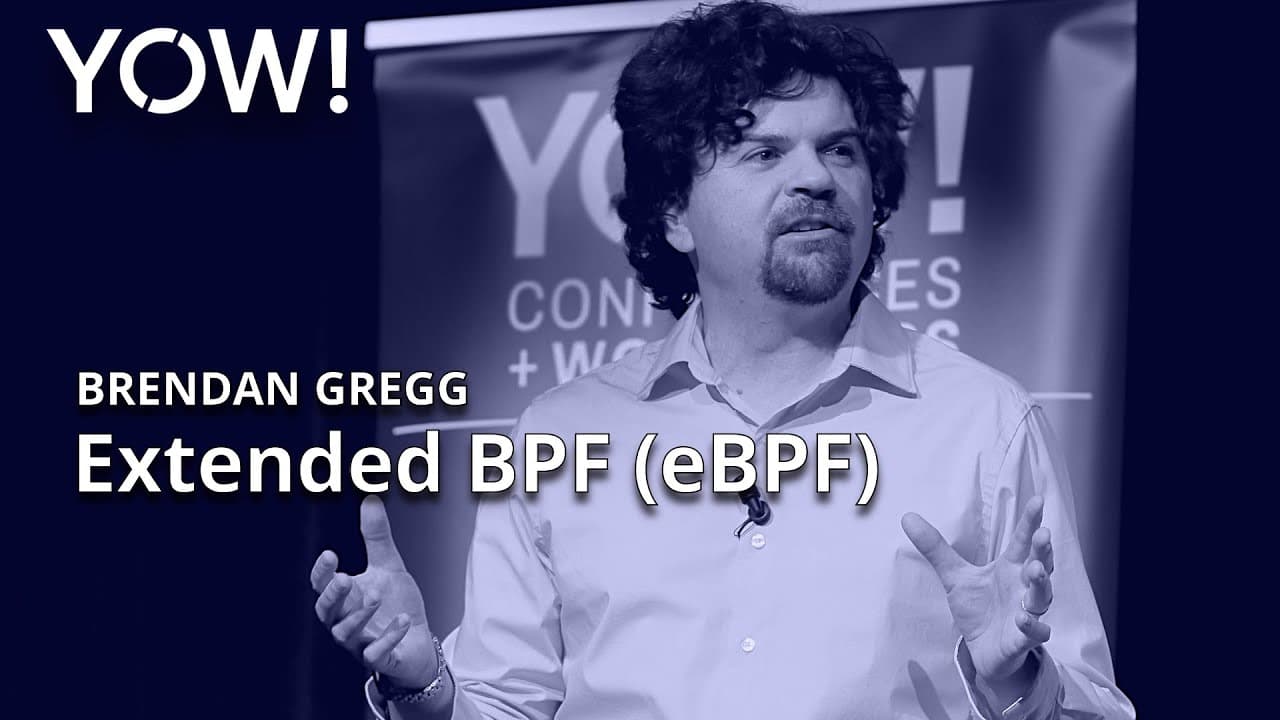
eBPF: Fueling New Flame Graphs & more • Brendan Gregg • YOW! 2022
TL;DR
Brendan introduces eBPF (extended Berkeley Packet Filter) and demonstrates how flame graphs can be used for CPU profiling and performance analysis in complex systems.
Transcript
thanks Dave g'day my name is Brendan and I'd like to thank the Yale organizers especially Dave and I know for inviting me back I'd like to thank you for attending both present and online and I'd like to acknowledge the traditional owners of the land and pay my respects to the elders past and present in the past five weeks I've learned about five ne... Read More
Key Insights
- 🤔 The industry of BPF and flame graphs is rapidly growing and expanding, similar to the emergence of JavaScript in the past.
- 🔥 Flame graphs are a powerful tool for CPU profiling, providing a visual representation of the CPU profile and stack trace. ⏰ Time sampling is a practical method for CPU profiling, as it captures stack traces at regular intervals to understand software behavior.
- 📊 Flame graphs allow for better visualization and understanding of complex profiles, making it easier to analyze and optimize performance.
- 🌐 Flame graphs can be used for various purposes, including performance analysis, debugging, and improving software efficiency.
- 🔬 BPF (Berkeley Packet Filter) is an abstract and versatile technology that allows for the definition and execution of programs within the kernel.
- 🐚 BFP allows for custom and efficient development of tools and applications, enabling new possibilities in observability, performance monitoring, and security.
- 📈 Continuous profiling using flame graphs can provide valuable insights into system performance and help identify potential issues or regressions.
- 🔄 BPF and flame graphs have the potential to revolutionize the field of software design, offering new ways to analyze and optimize performance.
Install to Summarize YouTube Videos and Get Transcripts
Explore YouTube Video Summarizer or Get YouTube Transcript Extractor
Questions & Answers
Q: How does eBPF work in the context of performance analysis and network monitoring?
eBPF allows the creation of programs that run in the kernel, enabling efficient performance analysis, network monitoring, and custom tools. By accessing kernel events and using specific hooks, developers can collect data and perform analysis at a low overhead.
Q: How do flame graphs help in identifying performance issues?
Flame graphs provide a visual representation of CPU profiling, allowing developers to quickly identify areas of high CPU usage in their applications. By analyzing the stack traces and comparing the width of different function calls, they can pinpoint performance bottlenecks and focus on optimizing those areas.
Q: What are the benefits of using flame graphs over traditional profiling methods?
Flame graphs offer several advantages over traditional profiling methods. They provide a comprehensive view of CPU usage, including nested function calls, which is difficult to achieve with traditional profiling tools. Flame graphs are also more intuitive and easier to interpret, even for complex and distributed systems.
Q: Can flame graphs be used for applications running on different platforms and languages?
Yes, flame graphs can be used for applications running on various platforms and languages. The underlying technology is language-agnostic and works by analyzing stack traces, which are available in most programming languages. The key is to collect the necessary data and generate a flame graph for analysis.
Summary & Key Takeaways
-
Brendan explains the concept of eBPF and how it allows the creation of programs that run in the kernel to improve performance analysis and network monitoring.
-
He introduces flame graphs as a visual representation of CPU profiling, showing the execution stack and time distribution of an application.
-
Brendan highlights the practical applications of flame graphs, including performance analysis, troubleshooting, and identifying areas of optimization in software.
Read in Other Languages (beta)
Share This Summary 📚
Summarize YouTube Videos and Get Video Transcripts with 1-Click
Try YouTube Summary with ChatGPT & Claude or YouTube Transcript Generator
Explore More Summaries from GOTO Conferences 📚
Summarize YouTube Videos and Get Video Transcripts with 1-Click
Try YouTube Summary with ChatGPT & Claude or YouTube Transcript Generator