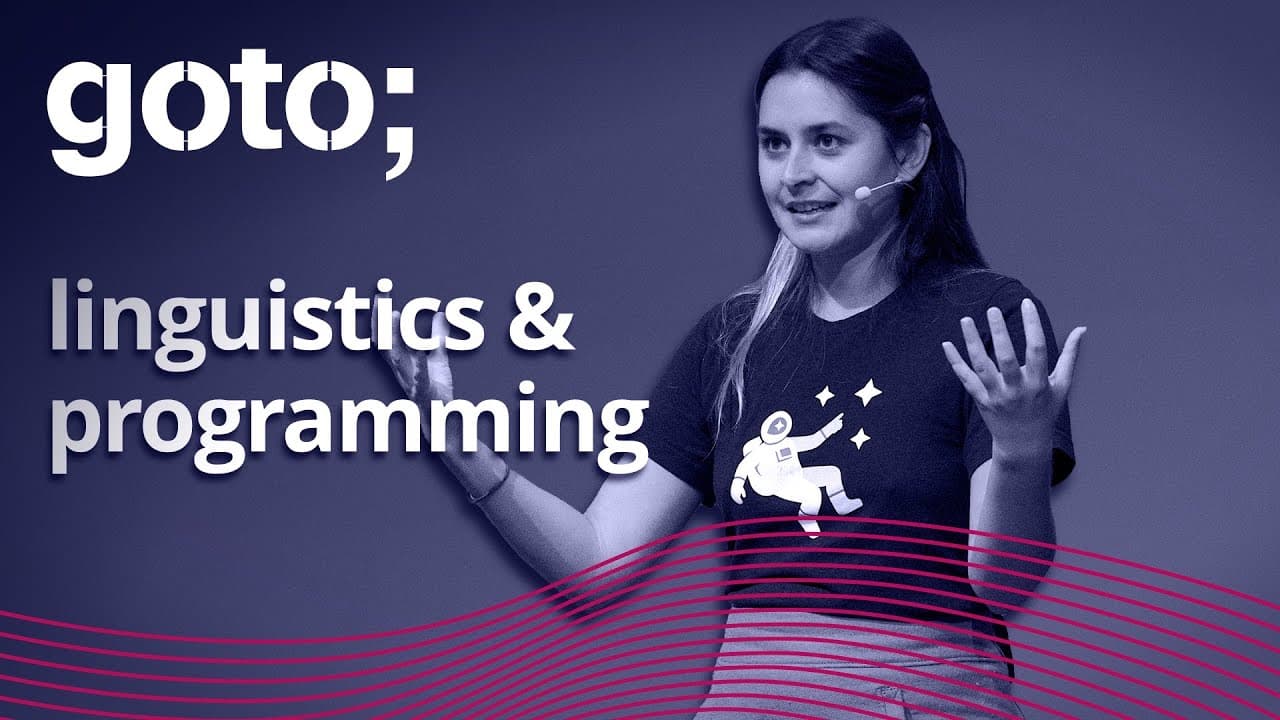
Functional Programming Through the Lens of a Philosopher & Linguist • Anjana Vakil • GOTO 2021
TL;DR
Functional programming is about predictability and human readability.
Transcript
Read and summarize the transcript of this video on Glasp Reader (beta).
Key Insights
- Anjana Vakil transitioned from linguistics and philosophy to computer science, finding parallels in the big-picture thinking required in both fields.
- Functional programming emphasizes pure functions and data transformation, avoiding state changes and side effects for predictability and easier debugging.
- Vakil advocates for code readability and human-centric programming, suggesting that code should be written for people to understand, not just for machines to execute.
- Functional programming is gaining traction due to its predictability and maintainability, with more languages adopting functional features.
- The human performance factor in programming involves considering how easily humans can read, understand, and maintain code, not just its computational efficiency.
- Vakil emphasizes the importance of community and collaboration in learning programming, advocating for a more inclusive and supportive environment.
- Making functional programming approachable involves simplifying complex concepts and avoiding gatekeeping, allowing more people to benefit from its advantages.
- Languages like Elixir and Elm have made functional programming more accessible by focusing on user-friendly syntax and helpful error messages.
Install to Summarize YouTube Videos and Get Transcripts
Explore YouTube Video Summarizer or Get YouTube Transcript Extractor
Questions & Answers
Q: How did Anjana Vakil transition from linguistics and philosophy to programming?
Anjana Vakil had a wandering path, starting with a major in philosophy and a fascination with languages. She taught English as a foreign language, which led her to linguistics and eventually computational linguistics. This field required programming skills, and through her studies, she discovered a passion for software development, particularly in helping others learn programming paradigms.
Q: What is the main benefit of functional programming according to Anjana Vakil?
Vakil highlights predictability as the main benefit of functional programming. Pure functions, which always produce the same output for a given input, make programs easier to test, debug, and maintain. This predictability reduces the mental burden on programmers, allowing them to focus on the inputs and outputs without worrying about changing states or side effects.
Q: Why is code readability important in programming?
Code readability is crucial because it ensures that programs can be easily understood and maintained by humans. Vakil argues that code should be written for people to read, as it facilitates collaboration, onboarding, and long-term maintenance. Readable code allows developers to understand and modify it without extensive context, enhancing the overall human performance factor in programming.
Q: How has functional programming become more accessible over time?
Functional programming has become more accessible as languages have adopted features that simplify its concepts. Languages like Elixir and Elm focus on user-friendly syntax and helpful error messages, making it easier for newcomers to learn. This shift away from academic jargon and towards practical, approachable programming has allowed more people to benefit from functional programming's advantages.
Q: What is the human performance factor in programming?
The human performance factor considers how easily humans can read, understand, and maintain code, beyond its computational efficiency. Vakil emphasizes that programming is about communicating with people, not just machines. Code should be written to be understandable and modifiable by humans, ensuring that it remains useful and adaptable over time.
Q: Why is community important in learning programming?
Community is vital in learning programming because it provides support, shared knowledge, and collaboration opportunities. Vakil stresses the importance of finding a community where individuals can ask questions, share experiences, and learn from each other. This collective learning approach helps overcome challenges and fosters a more inclusive and supportive programming environment.
Q: What role does inclusivity play in the programming community?
Inclusivity is crucial in the programming community to ensure diverse perspectives and backgrounds are represented. Vakil advocates for breaking down barriers and gatekeeping, making programming accessible to everyone. By welcoming more people from different backgrounds, the community can benefit from a wider range of ideas and solutions, ultimately leading to better software development.
Q: How can one start learning functional programming effectively?
To start learning functional programming, Vakil suggests focusing on the concept of data transformation rather than complex jargon. Understanding how to frame problems in terms of inputs and outputs is key. Additionally, finding a supportive community and engaging in collaborative learning can significantly enhance the learning process, making it more enjoyable and effective.
Summary & Key Takeaways
-
Anjana Vakil discusses her journey from linguistics and philosophy to programming, highlighting the influence of her background on her approach to software development.
-
Vakil emphasizes the importance of functional programming for its predictability and maintainability, advocating for code that is easy to read and understand.
-
The conversation explores the growing adoption of functional programming, the benefits of community support in learning, and the need for inclusivity and accessibility in the programming world.
Read in Other Languages (beta)
Share This Summary 📚
Summarize YouTube Videos and Get Video Transcripts with 1-Click
Try YouTube Summary with ChatGPT & Claude or YouTube Transcript Generator
Explore More Summaries from GOTO Conferences 📚
Summarize YouTube Videos and Get Video Transcripts with 1-Click
Try YouTube Summary with ChatGPT & Claude or YouTube Transcript Generator