Federalism and Its Alternatives | American Government
TL;DR
Federalism divides political power between national and sub-unit governments, ensuring a balance of authority.
Transcript
federalism is a system in which political power is shared between the national government and sub unit governments such as States or provinces the federal system created by the US Constitution established a more powerful central government than had existed under the Articles of Confederation the first Constitution of the United States however to av... Read More
Key Insights
- ✊ Federalism divides political power to prevent abuse and promote cooperation.
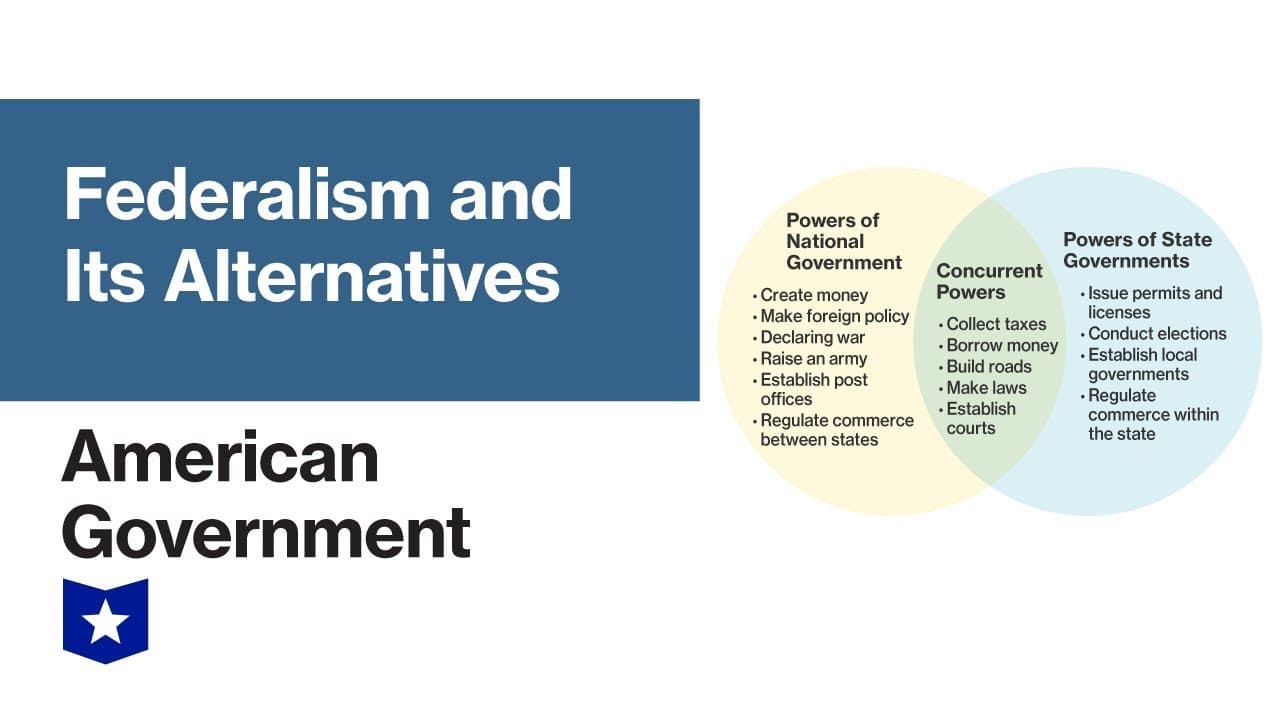
- ✊ Concurrent powers enable shared responsibilities between federal and state governments.
- ✊ Delegated powers are specific authorities granted to the federal government by the Constitution.
- ✊ Reserved powers belong to state governments for regulating local affairs.
- 🖤 Unitary systems centralize political power, lacking regional autonomy.
- 🇨🇫 Confederal systems grant limited authority to the central government.
- ❓ The US shifted from a confederal to a federal system for greater effectiveness.
Install to Summarize YouTube Videos and Get Transcripts
Explore YouTube Video Summarizer or Get YouTube Transcript Extractor
Questions & Answers
Q: What is federalism and why was it established in the US?
Federalism is a system dividing political power between national and state governments to prevent abuse of authority. It was established in the US to balance centralized and localized governance.
Q: What are concurrent powers in a federal system?
Concurrent powers are those shared by both federal and state governments, such as collecting taxes, establishing courts, and regulating trade. This distribution of authority ensures cooperation and checks and balances.
Q: How do delegated powers differ from reserved powers in federalism?
Delegated powers are specific authorities granted to the federal government by the US Constitution, including defense, currency control, and foreign policy. Reserved powers belong to states, like regulating commerce within state boundaries and conducting elections.
Q: Why did the US move from a confederal system to a federal system?
The US shifted from a confederal system, where states retained significant autonomy, to a federal structure due to the weakness and ineffectiveness of the Articles of Confederation. The Constitutional Convention deemed a stronger central government necessary for unity and effectiveness.
Summary & Key Takeaways
-
Federalism divides power between national and state governments, preventing abuse of authority.
-
Concurrent powers allow both federal and state governments to collect taxes, make laws, and enforce regulations independently.
-
The US Constitution delegates specific powers to the federal government, while states have reserved powers like regulating commerce and conducting elections.
Read in Other Languages (beta)
Share This Summary 📚
Summarize YouTube Videos and Get Video Transcripts with 1-Click
Try YouTube Summary with ChatGPT & Claude or YouTube Transcript Generator
Explore More Summaries from Course Hero 📚




Summarize YouTube Videos and Get Video Transcripts with 1-Click
Try YouTube Summary with ChatGPT & Claude or YouTube Transcript Generator