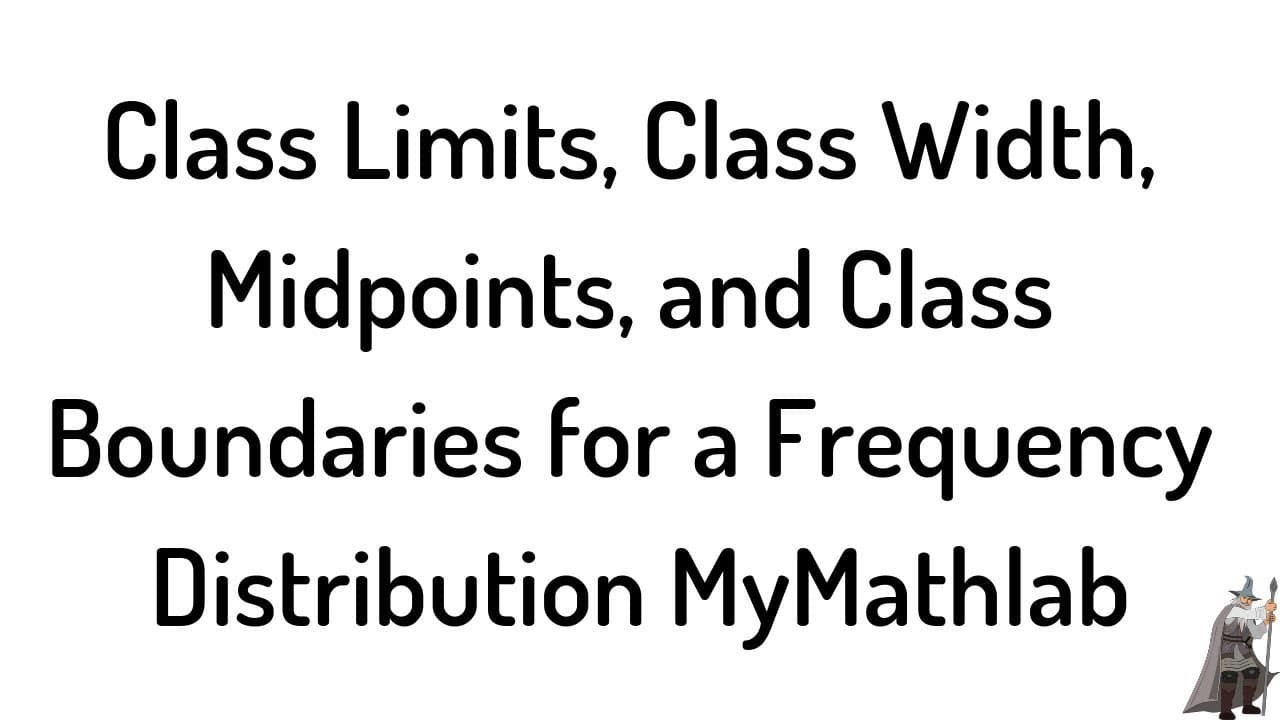
Class Limits, Class Width, Midpoints, and Class Boundaries for Frequency Distribution MyMathlab
TL;DR
Answering questions related to frequency table analysis by identifying class limits, widths, midpoints, boundaries, and total individuals.
Transcript
okay we're given a frequency table and we have to answer various questions so first says identified the lower class limits so the lower class limits are these numbers here 20 30 40 50 60 etc so they're the smallest numbers that fit in each class so 20 30 40 50 60 I'll have to scroll down here let's see 70 and 80 let's click check answer good stuff ... Read More
Key Insights
- 😘 Identifying lower and upper class limits is crucial in constructing a frequency table.
- 🏛️ The class width provides information about the range of values within each class interval.
- 🏛️ Class midpoints aid in understanding the central representative value of each class.
- 🏛️ Calculating class boundaries helps define the edges of class intervals accurately.
- 🪜 Total individuals can be determined by adding up all the frequencies provided in the frequency table.
- 🎭 Paying attention to precision and accuracy is essential when performing frequency table analysis.
- 🥺 Mistakes in calculations can lead to errors in identifying class midpoints and boundaries.
Install to Summarize YouTube Videos and Get Transcripts
Explore YouTube Video Summarizer or Get YouTube Transcript Extractor
Questions & Answers
Q: How are lower class limits identified in a frequency table?
Lower class limits in a frequency table are the smallest numbers within each class, such as 20, 30, 40, etc., which define the starting points for each interval.
Q: What is the class width in a frequency table?
Class width is calculated by subtracting consecutive lower class limits, providing the range of values covered by each class interval.
Q: How are class midpoints determined in a frequency table?
Class midpoints are found by adding the lower and upper class limits of each interval and then dividing by 2 to locate the average value representing that class.
Q: How are class boundaries calculated in a frequency table?
Class boundaries are obtained by averaging the upper and lower class limits of each interval, with the midpoint value serving as the primary reference point for further boundary calculations.
Summary & Key Takeaways
-
Identifying lower and upper class limits involves finding the smallest and largest numbers within classes.
-
Class width is determined by subtracting consecutive lower class limits.
-
Class midpoints are obtained by adding lower and upper class limits, then dividing by 2.
Read in Other Languages (beta)
Share This Summary 📚
Summarize YouTube Videos and Get Video Transcripts with 1-Click
Try YouTube Summary with ChatGPT & Claude or YouTube Transcript Generator
Explore More Summaries from The Math Sorcerer 📚

Summarize YouTube Videos and Get Video Transcripts with 1-Click
Try YouTube Summary with ChatGPT & Claude or YouTube Transcript Generator