Numerical Part 1 - Measurement of High Voltage and High Current - High Voltage Engineering
TL;DR
This lecture discusses numerical examples related to high voltage and high current measurement techniques.
Transcript
hello friends welcome back to the lecture series on high voltage engineering we are discussing measurement of high voltage and high current in this particular lecture i will be discussing the numericals on high voltage and high current measurement techniques so let us begin with the first numerical the numerical goes like this are generating voltme... Read More
Key Insights
- 🥰 Designing a generating voltmeter requires considering the equation i_rms = v * cm * omega / sqrt(2) and rearranging the terms to determine the capacitance of the voltmeter.
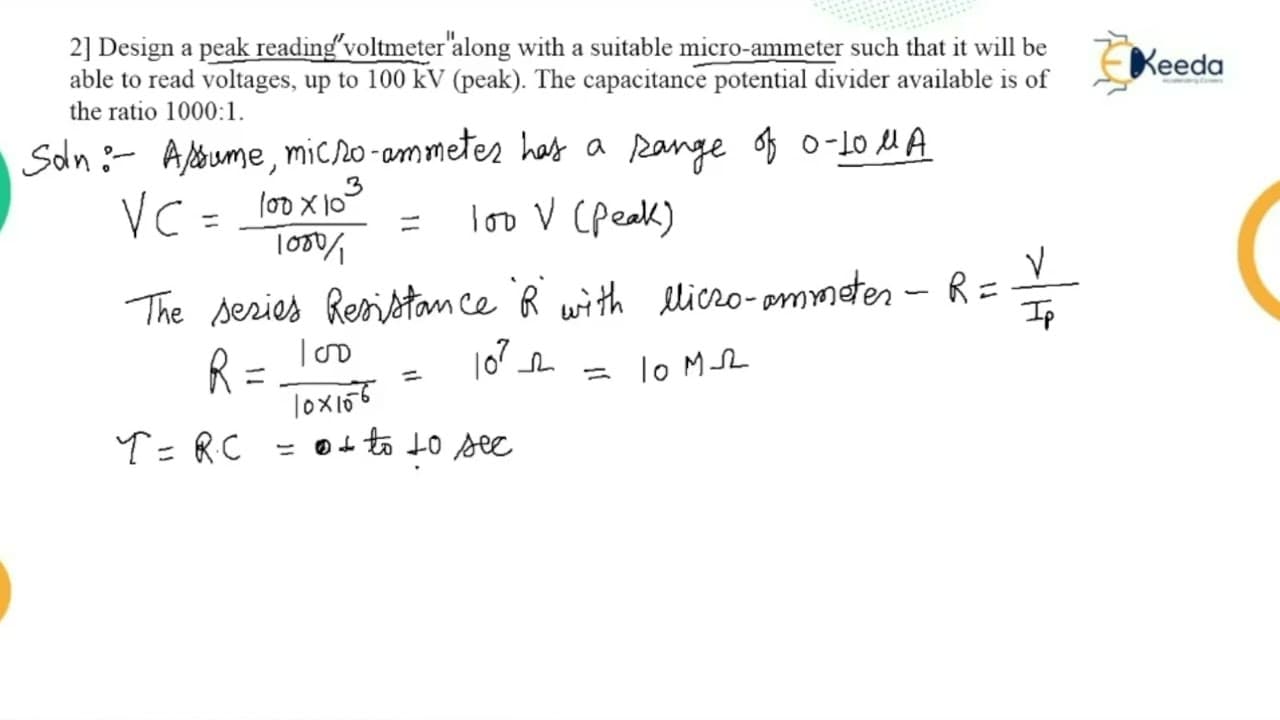
- 🙊 A peak reading voltmeter can be designed by using a microammeter in combination with a potential divider, with specific resistance and capacitance values.
- 🧑🦳 The correction factor for atmospheric conditions accounts for air density and is calculated using the equation delta = 3.92 * p / (273 + t), where p is the pressure and t is the temperature.
Install to Summarize YouTube Videos and Get Transcripts
Explore YouTube Video Summarizer or Get YouTube Transcript Extractor
Questions & Answers
Q: How can a generating voltmeter be designed to have a range from 20 to 200 kilovolt DC?
To design a generating voltmeter with this range, the equation i_rms = v * cm * omega / sqrt(2) is used. By rearranging the terms and substituting the given values, the capacitance of the generating voltmeter can be calculated as approximately 0.9 picofarad.
Q: How can a peak reading voltmeter be designed to measure voltages up to 100 kilovolt peak?
To design a peak reading voltmeter, a microammeter is used in conjunction with a potential divider. Considering the given range of the microammeter (0 to 10 microampere), the required resistance and capacitance values are calculated as 10 megaohms and 1 microfarad, respectively.
Q: What is the correction factor for atmospheric conditions and how is it calculated?
The correction factor, which accounts for air density, is calculated using the equation delta = 3.92 * p / (273 + t), where p is the pressure in centimeters of mercury and t is the temperature in degrees Celsius. For a given atmospheric pressure of 750 mm Hg and temperature of 27 degrees Celsius, the correction factor is approximately 0.98.
Q: How can the breakdown voltage be determined for air gaps of different lengths under standard atmospheric conditions?
The breakdown voltage for air gaps can be determined using the equation vb = 24.22 * s + 6.08 * sqrt(s), where s is the length of the air gap in centimeters. By substituting the given lengths (2 mm and 15 mm) and performing the calculations, the breakdown voltages are found to be approximately 7.56 kilovolt and 43.777 kilovolt, respectively.
Summary & Key Takeaways
-
This lecture discusses the design of a generating voltmeter with a range from 20 to 200 kilovolt DC, based on given current readings.
-
The lecture also covers the design of a peak reading voltmeter that can measure voltages up to 100 kilovolt peak, using a microammeter and a potential divider.
-
The calculation of the correction factor for atmospheric conditions is explained, which is important in determining the breakdown voltage for air gaps under standard atmospheric conditions.
-
The breakdown voltage is calculated for air gaps of 2 mm and 15 mm lengths, considering the given atmospheric pressure and temperature.
Read in Other Languages (beta)
Share This Summary 📚
Summarize YouTube Videos and Get Video Transcripts with 1-Click
Try YouTube Summary with ChatGPT & Claude or YouTube Transcript Generator
Explore More Summaries from Ekeeda 📚





Summarize YouTube Videos and Get Video Transcripts with 1-Click
Try YouTube Summary with ChatGPT & Claude or YouTube Transcript Generator