Introduction to lipids | Biology foundations | High school biology | Khan Academy
TL;DR
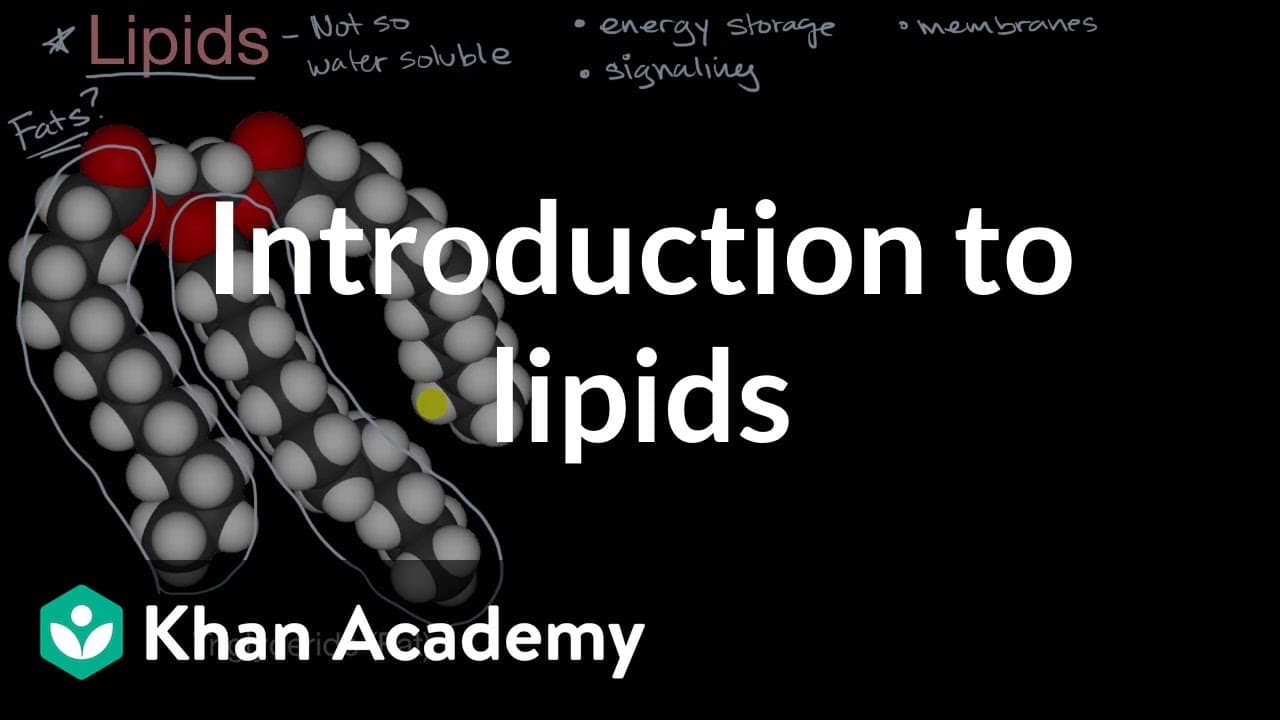
Lipids are a class of molecules found in biological systems that are involved in energy storage, signaling, and the formation of cell membranes.
Transcript
- [Instructor] What we are going to do in this video is talk a little bit about lipids. Now, a lot of times, lipids are strongly associated with fats, and that's not incorrect. Fats are lipids, but not all lipids are fats. A better definition or a better association for lipids would be a class of molecules that you often see in biological systems t... Read More
Key Insights
- 🏛️ Lipids are a diverse class of molecules that can be hydrophobic or hydrophilic.
- 🖐️ They play roles in energy storage, hormone signaling, and membrane formation.
- 👨 Fats are a type of lipid, specifically triglycerides.
- 🥳 Molecules like sphingomyelin have both hydrophobic and hydrophilic parts, making them ideal for membrane formation.
- 👨 Without lipids, proper absorption of fat-soluble vitamins would be hindered.
- 💦 The structure of lipids determines their solubility in water.
- 👨 Saturated and unsaturated fats differ in terms of their hydrogen bonding capacity.
Install to Summarize YouTube Videos and Get Transcripts
Explore YouTube Video Summarizer or Get YouTube Transcript Extractor
Questions & Answers
Q: What is the difference between lipids and fats?
Fats are a type of lipid, but not all lipids are fats. Lipids are a class of molecules that are generally not very soluble in water, whereas fats specifically refer to lipids that consist of three fatty acids bonded to a glycerol molecule.
Q: How do lipids contribute to energy storage?
Lipids, especially fats, serve as a concentrated source of energy in the body. When the body needs energy, these stored lipids can be broken down and used as fuel.
Q: What role do lipids play in hormone signaling?
Many hormones in the body are lipids that help transmit signals between different parts of the body. Lipids are involved in the synthesis, release, transportation, and reception of hormones.
Q: Why are lipids important for membrane formation?
Lipids, particularly phospholipids, are crucial components of cell membranes. The hydrophobic and hydrophilic parts of lipids allow them to form a lipid bilayer, which makes up the structure of cell membranes.
Summary & Key Takeaways
-
Lipids are a class of molecules that are not very soluble in water and can be hydrophobic or hydrophilic.
-
They play important roles in the body, including energy storage, hormone signaling, and membrane formation.
-
Fats, triglycerides, and sphingolipids are examples of lipids with different structures and functions.
Read in Other Languages (beta)
Share This Summary 📚
Summarize YouTube Videos and Get Video Transcripts with 1-Click
Try YouTube Summary with ChatGPT & Claude or YouTube Transcript Generator
Explore More Summaries from Khan Academy 📚



Summarize YouTube Videos and Get Video Transcripts with 1-Click
Try YouTube Summary with ChatGPT & Claude or YouTube Transcript Generator