Magnetism and Magnetic Fields | Types of Interactions | High School Physics | Khan Academy
TL;DR
Magnets and magnetic fields have been studied for thousands of years, with observations of various properties and their relationships to magnetite, compasses, and electricity.
Transcript
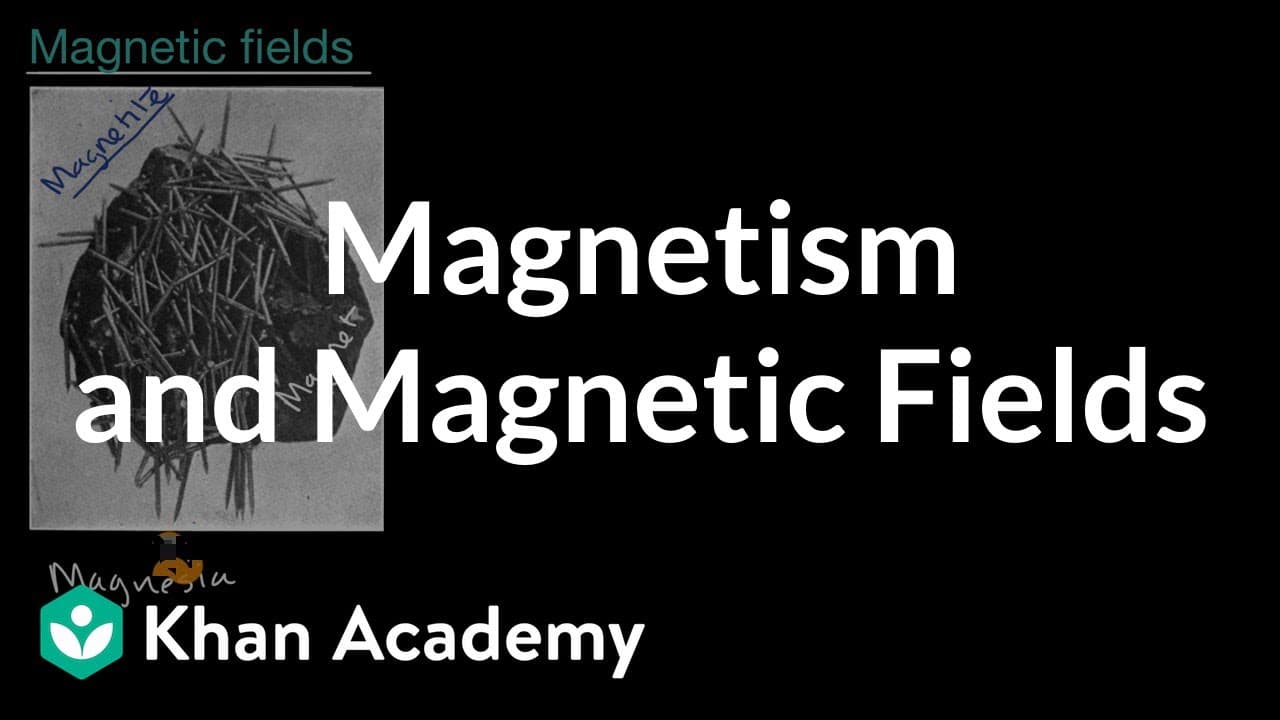
- [Instructor] Let's talk a little bit about magnets and magnetic fields and right over here we have a picture of what today we would call a magnet where we have these metal nails all being attracted to the stone and the stone, the modern name for it is magnetite, and human beings have known about magnetite for thousands of years in fact the name c... Read More
Key Insights
- 🧲 Magnetite, also known as magnet, has been known for thousands of years and was named by the Ancient Greeks.
- ⛈️ Lightning strikes may naturally magnetize magnetite, and its orientation affects its interactions with other magnetized magnetite.
- 🧭 Ancient Han China invented the compass using magnetized magnetite, providing insight into the Earth's magnetism.
- 🏑 The concept of magnetic field, introduced by Michael Faraday, helps explain the force between magnets at a distance.
- 🏑 Field lines can be visualized using metal filings, representing the direction and density of the magnetic field.
- 🧲 Breaking a magnet in half results in two magnets with their own North and South Poles, suggesting magnetism exists at the molecular level.
- 🫥 Magnetism and electricity are related, with the observation of field lines forming around a current-carrying wire.
Install to Summarize YouTube Videos and Get Transcripts
Explore YouTube Video Summarizer or Get YouTube Transcript Extractor
Questions & Answers
Q: How does a magnet attract or repel other objects without touching them?
A magnet interacts with objects at a distance through the concept of a magnetic field. The region of space around a magnet has an influence on other objects due to this field.
Q: How was the concept of a magnetic field introduced?
Michael Faraday introduced the concept of a magnetic field in the 19th century to provide a framework for understanding the force between magnets at a distance. The field lines can be visualized using metal filings on a paper placed over a magnet.
Q: Can a magnet be separated into pure North and South Poles?
When a magnet is broken in half, each piece becomes a magnet with its own North and South Poles. This process can be repeated, suggesting that magnetism exists at the molecular level.
Q: How are magnetism and electricity related?
The observation of field lines forming around a current-carrying wire demonstrated the connection between magnetism and electricity. This relationship is the basis for phenomena such as electric motors and generating electricity from wind or water turbines.
Summary & Key Takeaways
-
Human beings have known about magnetite and its attractive properties for thousands of years, with the name "magnet" originating from Ancient Greece.
-
Magnetite can be naturally magnetized, likely through lightning strikes, and its orientation affects its attractive or repulsive properties with other magnetite.
-
Ancient Han China invented the first compass using magnetized magnetite, which led to the understanding that the Earth itself acts as a magnet with North and South Poles.
Read in Other Languages (beta)
Share This Summary 📚
Summarize YouTube Videos and Get Video Transcripts with 1-Click
Try YouTube Summary with ChatGPT & Claude or YouTube Transcript Generator
Explore More Summaries from Khan Academy 📚



Summarize YouTube Videos and Get Video Transcripts with 1-Click
Try YouTube Summary with ChatGPT & Claude or YouTube Transcript Generator