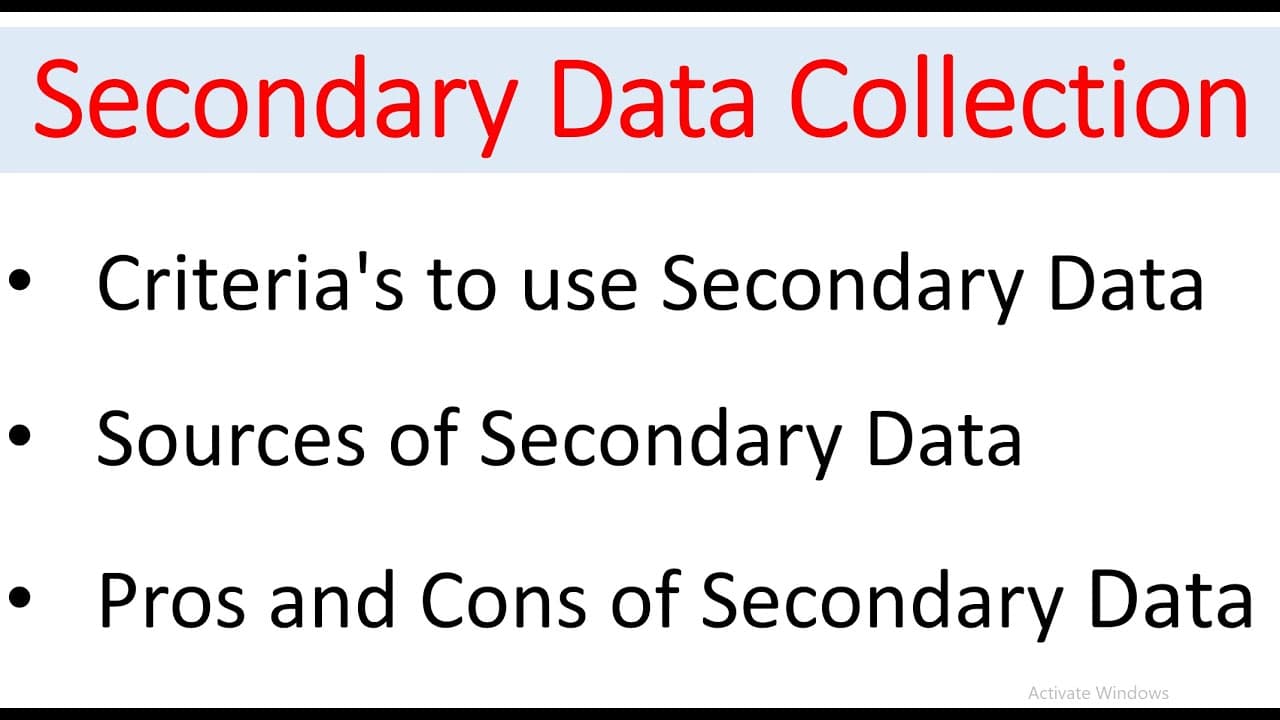
What Are the Pros and Cons of Secondary Data Collection?
TL;DR
Secondary data collection is a method that uses pre-existing data, offering cost savings and time efficiency. However, it poses challenges related to reliability, specificity, and the relevance of the data to current research needs.
Transcript
hello everybody and welcome to lesson 22 secondary data collection methods data collection method is a systematic approach used to collect data for our research purpose and data collection method can be categorized into primary data collection method and secondary data collection method by primary data we means that it is a firsthand data which is ... Read More
Key Insights
- ℹ️ Secondary data collection methods are categorized into primary and external sources.
- 🪈 Internal sources, such as sales records and financial data, provide easy access to data within an organization.
- 🔉 External sources, such as news reports and social media, can be challenging to obtain data from.
- ℹ️ Published and unpublished sources of secondary data can both be utilized.
- 😊 Pros of secondary data collection include cost efficiency, time-saving, large sample sizes, and background information.
- 🎮 Cons of secondary data collection include limitations in control, credibility, specificity, relevance, and availability of key variables.
- 👨🔬 Researchers must ensure the reliability, suitability, and adequacy of secondary data before using it for research purposes.
Install to Summarize YouTube Videos and Get Transcripts
Explore YouTube Video Summarizer or Get YouTube Transcript Extractor
Questions & Answers
Q: What is the difference between primary and secondary data collection methods?
Primary data collection involves gathering firsthand data directly from respondents or research participants, while secondary data collection uses data that has been previously collected by someone else.
Q: Why is secondary data collection often the starting point for research?
Secondary data collection is often the starting point because it is easy to use, takes less time and resources, and provides background information for the research.
Q: What criteria should secondary data fulfill before being used for research purposes?
Secondary data should fulfill criteria such as reliability (credibility of the source), suitability (alignment with the nature or scope of the research), and adequacy (sufficient volume of data).
Q: What are the advantages of using secondary data?
The benefits of using secondary data include cost efficiency, time-saving, large sample size availability, and the ability to obtain background information.
Q: What are the disadvantages of using secondary data?
Limitations of secondary data include limited control over data collection and sampling methods, potential credibility issues with the data source, lack of specificity, outdated information, missing key variables, and contextual limitations.
Summary & Key Takeaways
-
Secondary data collection involves using data that has already been collected for a different purpose.
-
It is a cost-efficient and time-saving method, as the data is readily available for use.
-
However, there may be limitations in terms of the reliability, specificity, and contextual relevance of the data.
Read in Other Languages (beta)
Share This Summary 📚
Summarize YouTube Videos and Get Video Transcripts with 1-Click
Try YouTube Summary with ChatGPT & Claude or YouTube Transcript Generator
Explore More Summaries from Solomon Getachew 📚



Summarize YouTube Videos and Get Video Transcripts with 1-Click
Try YouTube Summary with ChatGPT & Claude or YouTube Transcript Generator