A Conversation With Alan Greenspan
TL;DR
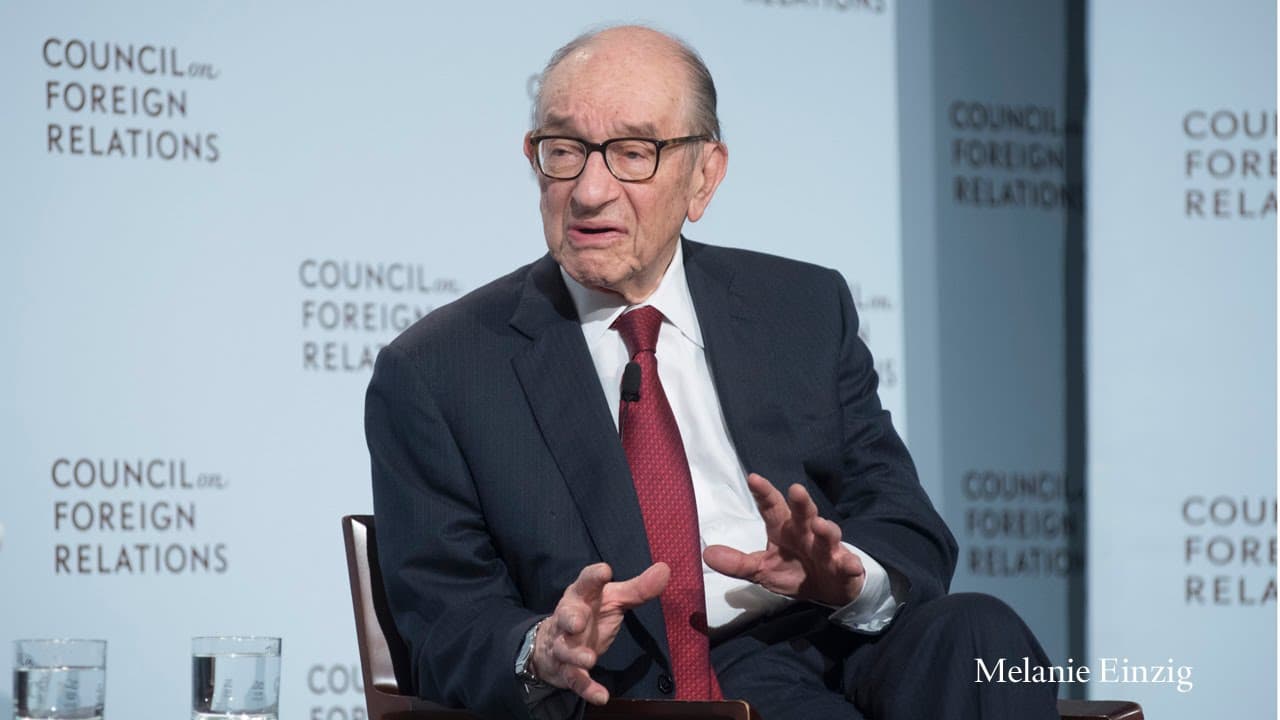
Alan Greenspan discusses U.S. economic growth and entitlements.
Transcript
LIESMAN: Welcome, folks. Thanks to the Council on� GREENSPAN: Welcome to you. LIESMAN: Yeah. I�ve got a little work to do. Thanks to the Council on Foreign Relations for asking me to be in this great spot here, moderating a panel with Dr. Greenspan after the historic decision yesterday by the Federal Reserve. Alan Greenspan needs no introduction; w... Read More
Key Insights
- The Federal Reserve's recent decision to raise interest rates was anticipated by markets, removing uncertainty and boosting market confidence.
- Greenspan emphasizes the importance of balancing risk in the financial system to avoid creating economic bubbles or stifling growth.
- Leverage, rather than bubbles, is identified as a key factor in financial crises, as seen in 2008 and 1929.
- The current low productivity growth in the U.S. and globally is linked to rising entitlements and insufficient investment in capital.
- Greenspan argues that the growth of entitlements is displacing private savings, reducing capital investment and, consequently, productivity growth.
- Technological advancements, while valuable, are not necessarily reflected in productivity statistics, complicating economic measurements.
- Greenspan suggests that a smarter immigration and education policy could enhance economic growth by increasing the workforce and productivity.
- He expresses concern that the political discourse is not addressing the fundamental economic issues, particularly the need to reform entitlements.
Install to Summarize YouTube Videos and Get Transcripts
Explore YouTube Video Summarizer or Get YouTube Transcript Extractor
Questions & Answers
Q: What was the market's reaction to the Federal Reserve's recent decision?
The market reacted positively to the Federal Reserve's decision to raise interest rates because it was anticipated, removing uncertainty. This predictability allowed income-earning assets to rise, reflecting market confidence in the Fed's clear communication and policy direction.
Q: How does Greenspan view the role of leverage in financial crises?
Greenspan views leverage as a critical factor in financial crises, more so than bubbles themselves. He explains that leverage can lead to defaults and widespread financial instability, as seen in the 2008 crisis, whereas bubbles without leverage, like the 2000 dot-com bubble, do not necessarily result in systemic failures.
Q: What is Greenspan's perspective on the current productivity growth?
Greenspan highlights the stagnation in productivity growth, attributing it to the growth of entitlements that displace private savings and reduce capital investment. This lack of investment in productive capital is a significant barrier to improving productivity and achieving higher economic growth rates.
Q: What does Greenspan suggest to address low economic growth?
To address low economic growth, Greenspan suggests reforming entitlements to reduce their fiscal burden, thereby freeing up resources for capital investment. Additionally, he advocates for smarter immigration and education policies to increase the skilled workforce and enhance productivity.
Q: How does technology impact productivity according to Greenspan?
While acknowledging the value of technological advancements, Greenspan notes that their impact on productivity is not always reflected in economic statistics. He explains that many technological benefits are direct consumption rather than productivity improvements, complicating traditional economic measurements.
Q: What is Greenspan's view on the political discourse around economic issues?
Greenspan is critical of the current political discourse, which he believes fails to address fundamental economic challenges, particularly the need to reform entitlements. He emphasizes that without addressing these issues, achieving significant economic growth will be difficult.
Q: What historical perspective does Greenspan provide on interest rates?
Greenspan provides a historical perspective, noting that interest rates have remained relatively stable over centuries due to human time preference, which reflects a consistent discounting of future claims. This stability suggests that current low rates are an anomaly and may not persist.
Q: How does Greenspan propose dealing with financial regulation?
Greenspan proposes increasing capital requirements for financial institutions to reduce the need for complex regulations like Dodd-Frank. By ensuring that institutions have sufficient capital, the risks of defaults and systemic crises can be mitigated, simplifying the regulatory framework.
Summary & Key Takeaways
-
Alan Greenspan discusses the Federal Reserve's recent interest rate decision and its impact on market confidence, emphasizing the importance of managing economic risk to avoid bubbles and promote growth.
-
He highlights the challenge of low productivity growth in the U.S. and globally, linking it to the rise in entitlements and the displacement of private savings, which reduces capital investment.
-
Greenspan advocates for smarter immigration and education policies to enhance economic growth and criticizes the lack of political focus on fundamental economic reforms, particularly regarding entitlements.
Read in Other Languages (beta)
Share This Summary 📚
Summarize YouTube Videos and Get Video Transcripts with 1-Click
Try YouTube Summary with ChatGPT & Claude or YouTube Transcript Generator
Explore More Summaries from Council on Foreign Relations 📚


Summarize YouTube Videos and Get Video Transcripts with 1-Click
Try YouTube Summary with ChatGPT & Claude or YouTube Transcript Generator