01 - Intro B - Python for Everybody Course
TL;DR
This content provides a basic understanding of hardware architecture, including components like the CPU, memory, and secondary storage.
Transcript
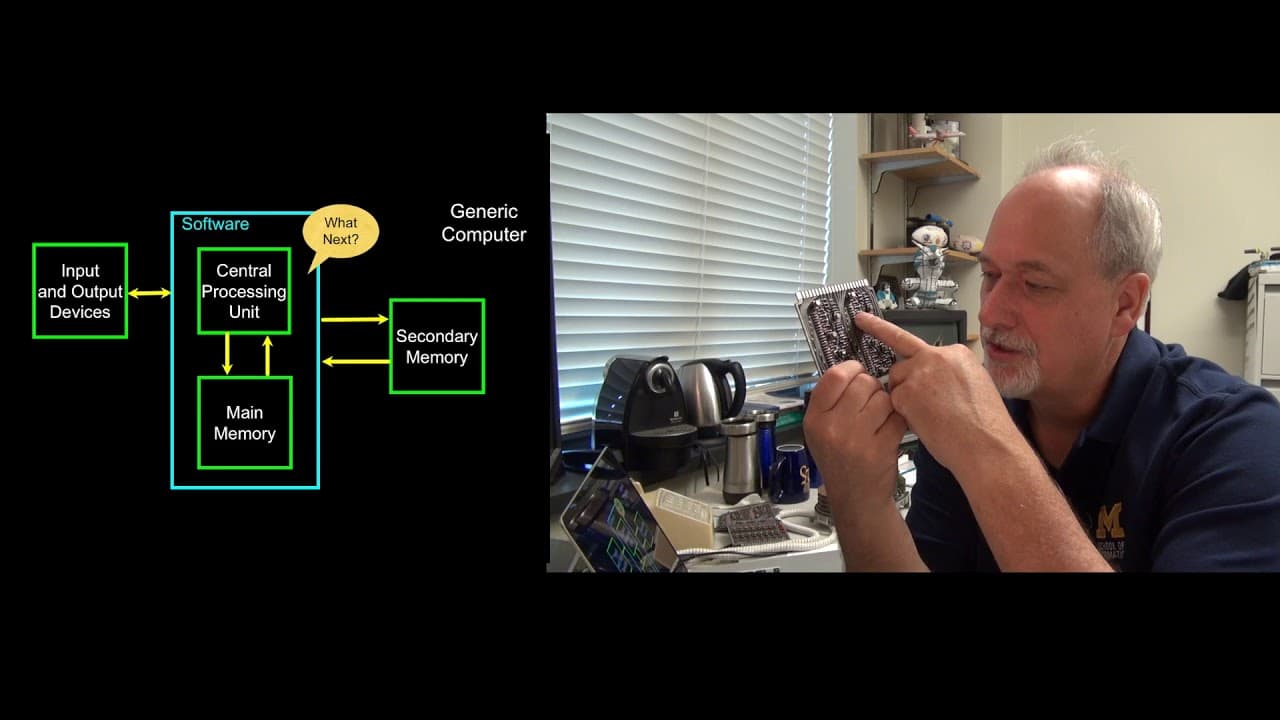
- Hello, and welcome back to Hardware Architecture. Now you might ask, why do I tell you about hardware architecture? Probably you're not gonna build any hardware, although it's fun stuff to do and if you're gonna become a computer scientist, which most of you won't want to be, it's a great thing to study. Those who build our hardware are amazingly... Read More
Key Insights
- 🏢 The content discusses hardware architecture and the importance of understanding it, even for non-hardware builders.
- 📱 The Raspberry Pi is introduced as a compact single-board computer with a consistent architecture that reduces the number of components.
- 🖥️ The basic block diagram of a computer is explained, with the microprocessing unit (CPU) being the closest thing to a brain.
- 💽 Secondary storage, such as hard drives, is necessary for storing files for a longer duration when power is off, while main memory stores instructions for the CPU to execute.
- 🌟 The evolution of hardware is highlighted, from older circuitry with capacitors and resistors to modern microprocessors that are much smaller and more powerful.
- 🔬 The miniaturization of components, including CPUs, memory, and storage, has allowed for smaller devices such as the Raspberry Pi and smartphones.
- ️ Input devices like keyboards and mice, as well as output devices like screens, are mentioned.
- 📝 Python code acts as a translator, converting code written by users into machine language instructions that the CPU can understand and execute.
Install to Summarize YouTube Videos and Get Transcripts
Explore YouTube Video Summarizer or Get YouTube Transcript Extractor
Questions & Answers
Q: What is the purpose of secondary storage in a computer?
Secondary storage is necessary because it provides a permanent storage solution that lasts even when the power is turned off. It is used to store files and programs that need to be accessed over a longer period of time.
Q: How does a CPU process instructions?
A CPU, or central processing unit, processes instructions by receiving them from the main memory. These instructions are sent to the CPU at a rate of three billion times per second, and the CPU executes them one at a time to perform various tasks.
Q: What is the role of the motherboard in a computer?
The motherboard acts as a connector for all the components of a computer. It allows components like memory, microprocessors, and hard drives to be plugged in, enabling them to work together and communicate.
Q: How has hardware architecture evolved over time?
The circuitry in hardware components like microprocessors has become smaller and more advanced over time. Millions of capacitors, resistors, and transistors have been miniaturized and integrated into a single chip, allowing for more powerful and compact computers.
Q: What is the difference between main memory and secondary storage?
Main memory, also known as RAM, is fast but temporary storage used by the CPU to store and retrieve instructions. Secondary storage, such as hard drives or flash memory, is slower but provides permanent storage for files and programs even when the power is off.
Summary & Key Takeaways
-
The content introduces the Raspberry Pi, a single-board computer, and explains that even as hardware gets smaller, its architecture remains the same.
-
It discusses the major parts of a generic computer, including the CPU, main memory, and secondary storage.
-
The content compares old and new hardware, and emphasizes the importance of software in programming and utilizing hardware components.
Read in Other Languages (beta)
Share This Summary 📚
Summarize YouTube Videos and Get Video Transcripts with 1-Click
Try YouTube Summary with ChatGPT & Claude or YouTube Transcript Generator
Explore More Summaries from freeCodeCamp Concepts 📚



Summarize YouTube Videos and Get Video Transcripts with 1-Click
Try YouTube Summary with ChatGPT & Claude or YouTube Transcript Generator