Transitive Property of Congruence & Substitution Property of Equality
TL;DR
Learn about the transitive property, substitution property, and vertical angles in geometry.
Transcript
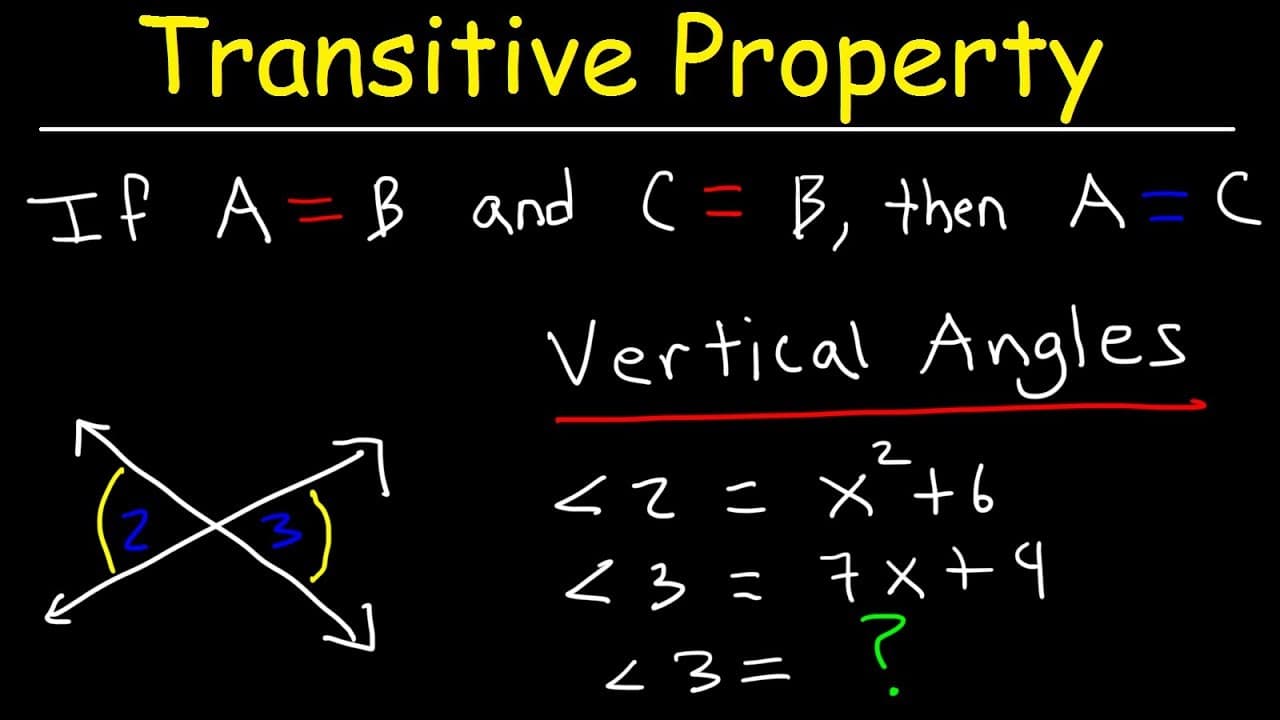
in this video we're going to talk about the transitive property the substitution property and also vertical angles so here's the general idea of the transitive property if angles are congruent to the same angle then they're congruent to each other so for instance let's say if angle one is congruent to angle two and if angle three is congruent to an... Read More
Key Insights
- 🔺 The transitive property states that if angles are congruent to the same angle, they are congruent to each other.
- 🤑 The substitution property allows the replacement of variables or angles with equivalent ones.
- 🫥 Vertical angles are formed when two lines intersect and have opposite rays.
- 🚦 Vertical angles are always congruent to each other.
- 🙌 Vertical angles are formed by rays that are collinear but extend in opposite directions.
- 🔺 Vertical angles can be used to find the measure of other angles.
- 🚦 The measure of vertical angles is equal.
Install to Summarize YouTube Videos and Get Transcripts
Explore YouTube Video Summarizer or Get YouTube Transcript Extractor
Questions & Answers
Q: What is the transitive property?
The transitive property states that if two angles are congruent to the same angle, then they are congruent to each other. For example, if angle one is congruent to angle two and angle three is congruent to angle two, then angle one is congruent to angle three.
Q: What is the substitution property?
The substitution property allows the replacement of variables or angles with equivalent ones. For example, if a is equal to b and b is equal to c, we can substitute b with a to conclude that a is equal to c.
Q: What are vertical angles?
Vertical angles are formed when two lines intersect, creating four angles. The first pair of vertical angles are angle one and angle three, which are congruent. The second pair is angle two and angle four, also congruent. Vertical angles have opposite rays.
Q: How do you find the measure of an angle using vertical angles?
You can find the measure of an angle using vertical angles by setting one angle equal to the other. For example, if angle two is equal to x squared plus six, and angle three is equal to seven x plus fourteen, you can set them equal to each other and solve for x to find the measure of angle two.
Summary & Key Takeaways
-
The transitive property states that if two angles are congruent to the same angle, then they are congruent to each other.
-
The substitution property allows the replacement of variables or angles with equivalent ones.
-
Vertical angles are formed when two lines intersect and have opposite rays. Vertical angles are congruent.
Read in Other Languages (beta)
Share This Summary 📚
Summarize YouTube Videos and Get Video Transcripts with 1-Click
Try YouTube Summary with ChatGPT & Claude or YouTube Transcript Generator
Explore More Summaries from The Organic Chemistry Tutor 📚





Summarize YouTube Videos and Get Video Transcripts with 1-Click
Try YouTube Summary with ChatGPT & Claude or YouTube Transcript Generator