How to make resilient web applications with retries
TL;DR
Exponential backoff helps manage API retries and prevent overwhelming services during network failures.
Transcript
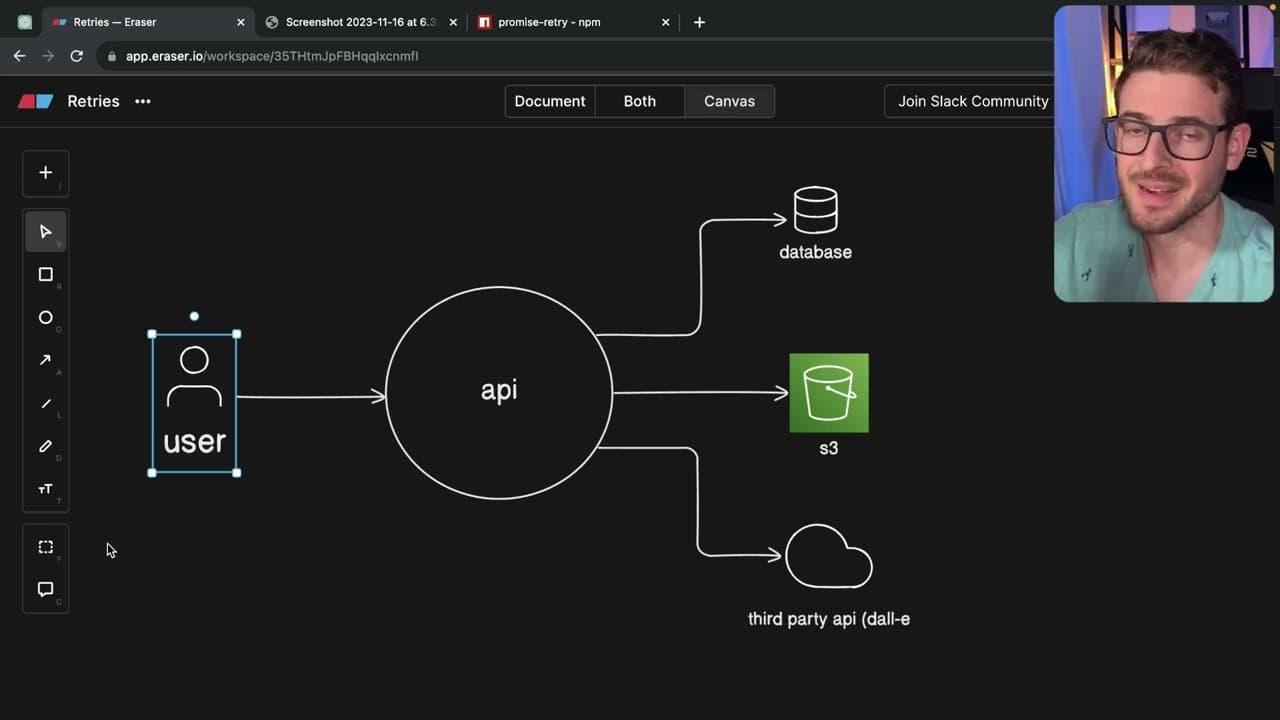
so in this day and age when you're building a software system often your API Services have to talk to variety of thirdparty services maybe a database in my case I have an icon generator application that needs to talk to Dolly so there's a lot of network requests that need to happen and because of that there's a lot of stuff that could go wrong so o... Read More
Key Insights
- 🥳 The integration of multiple third-party services into API systems increases the complexity and potential for network-related failures.
- ✳️ Adopting an exponential backoff strategy for retries not only enhances system resilience but also minimizes the risk of overwhelming external APIs.
- 👋 A good user experience during transient failures can be achieved by proactively managing retries and displaying visual feedback, such as loading spinners.
- 😒 Traditional retry mechanisms can lead to negative consequences if they do not account for the nature of the failure, prompting the use of strategies like exponential backoff.
- 📦 The node promis retry package offers an accessible method for implementing robust retry logic within Node.js applications.
- 👤 Monitoring and adjusting the parameters of retry mechanisms is essential to balance system performance and user experience effectively.
- 👤 Properly handling failures and retries contributes to the reliability of an API, fostering trust with users who depend on its functionality.
Install to Summarize YouTube Videos and Get Transcripts
Explore YouTube Video Summarizer or Get YouTube Transcript Extractor
Questions & Answers
Q: What is the main purpose of implementing retries in API services?
The primary purpose of implementing retries in API services is to ensure resilience and reliability during network failures. When an API request fails due to temporary issues, such as rate limiting or server overload, retrying the request allows for a chance of successful completion without requiring user intervention, improving the overall user experience.
Q: How does exponential backoff differ from standard retries?
Exponential backoff differs from standard retries in that it increases the wait time between each subsequent retry exponentially. For example, rather than retrying immediately after a failure, the first retry might occur after 2 seconds, the next after 4 seconds, then 8, and so on. This approach reduces the risk of overwhelming a service while allowing time for temporary issues to resolve.
Q: Can you explain a scenario where exponential backoff would be beneficial?
A beneficial scenario for exponential backoff occurs when an API communicates with a service that enforces rate limits, such as OpenAI’s API for generating images. When multiple users are generating requests and the API exceeds its rate limit, exponential backoff allows the request to pause and retry automatically without bombarding the server with requests continuously.
Q: What challenges might arise if retries are not managed properly?
If retries are not managed properly, certain challenges may arise, including overwhelming the target server with continuous requests, leading to denial of service issues or blocking by the API due to perceived malicious behavior. Additionally, poorly managed retries could contribute to increased latency, negatively affecting user experience and application performance.
Q: What role does user experience play in handling retries and failures?
User experience is critical when handling retries and failures in API interactions. Implementing mechanisms like exponential backoff allows the user to see a loading indicator rather than error messages or having to re-initiate actions. By abstracting error handling, users perceive a smoother experience even when backend failures occur.
Q: What tools or packages can assist in implementing exponential backoff in JavaScript?
In JavaScript, the node promis retry package is a popular choice for implementing exponential backoff. This package allows developers to configure retry attempts with adjustable parameters like maximum retries and delay times, making it easy to handle asynchronous operations and improve resilience in applications.
Summary & Key Takeaways
-
API services often interact with multiple third-party services, leading to network requests that can fail. Implementing retry mechanisms is crucial for maintaining resilience in these systems.
-
Exponential backoff is an effective strategy for managing retries, where the delay between each consecutive retry increases exponentially to reduce the risk of overwhelming the server.
-
Tools like the node promis retry package simplify the implementation of exponential backoff, streamlining error handling and improving user experience during slow network conditions.
Read in Other Languages (beta)
Share This Summary 📚
Summarize YouTube Videos and Get Video Transcripts with 1-Click
Try YouTube Summary with ChatGPT & Claude or YouTube Transcript Generator
Explore More Summaries from Web Dev Cody 📚




Summarize YouTube Videos and Get Video Transcripts with 1-Click
Try YouTube Summary with ChatGPT & Claude or YouTube Transcript Generator