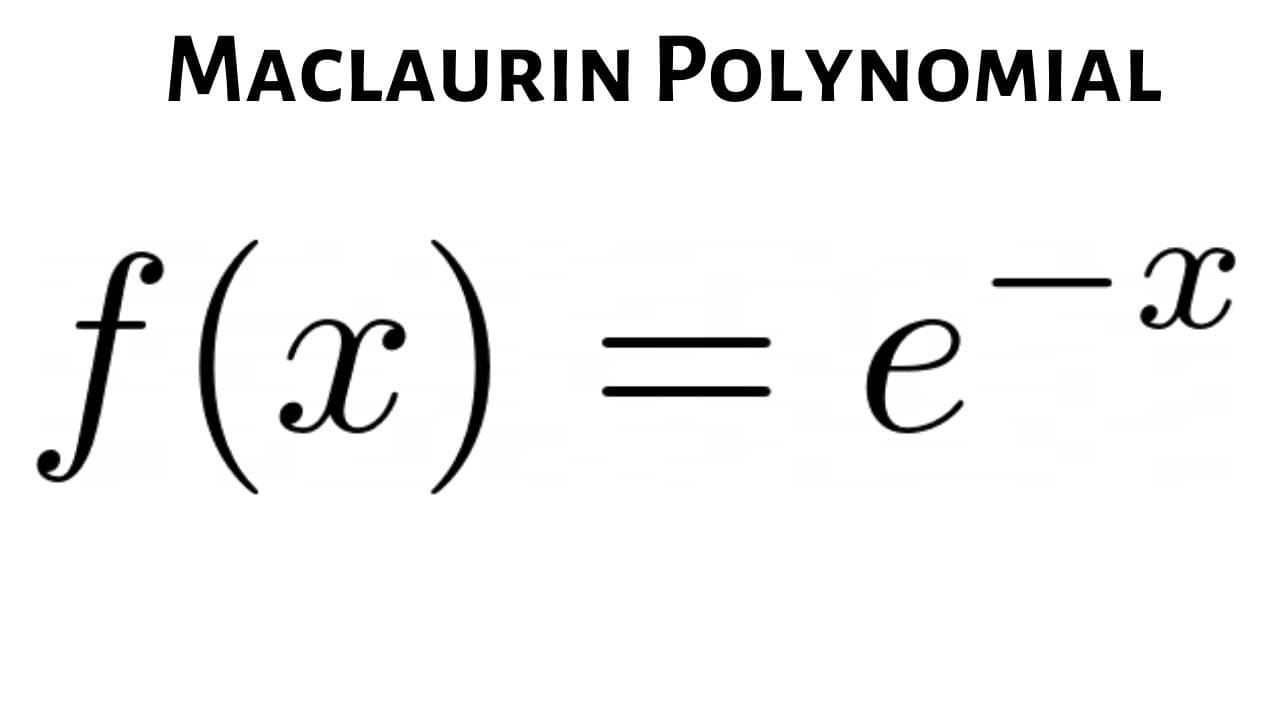
Find the nth Maclaurin Polynomial for f(x) = e^(-x) where n = 5
TL;DR
Calculating the 5th Maclaurin polynomial approximation for e^(-x) function.
Transcript
in this problem we have to find the anthemic Lauren polynomial for this function at n equals five it's the formula for the nth Maclaurin polynomial is the following so it's P sub n of X and it's equal to so the first term is f of 0 then it's plus F prime of zero times X that's plus F double prime of 0 times x squared and then it's over 2 factorial ... Read More
Key Insights
- 💨 Maclaurin polynomials offer a simple way to approximate functions locally using polynomials.
- 🍉 Calculating derivatives of a function is crucial for determining Maclaurin polynomial terms.
- 🍉 The Maclaurin polynomial formula involves successive terms based on derivatives and factorial values.
- 🔨 Maclaurin polynomials are efficient tools for approximating complex functions in mathematical analysis.
- 📏 Understanding the chain rule is essential for finding derivatives of functions like e^(-x) accurately.
- 🔌 Plugging derivative values at 0 into the Maclaurin formula yields the polynomial approximation.
- 🔨 Maclaurin polynomials are a valuable tool in calculus for simplifying function approximations.
Install to Summarize YouTube Videos and Get Transcripts
Explore YouTube Video Summarizer or Get YouTube Transcript Extractor
Questions & Answers
Q: What is the purpose of a Maclaurin polynomial?
Maclaurin polynomials approximate functions near a specific value (usually 0) using derivatives, providing a polynomial representation of the function for easier calculations in that vicinity.
Q: How is the nth Maclaurin polynomial formula structured?
The nth Maclaurin polynomial formula includes terms involving the function value at 0, its derivatives up to the nth order at 0, and corresponding factorial values, all multiplied by powers of X.
Q: How are derivatives calculated for the e^(-x) function?
Derivatives of e^(-x) are computed by applying the chain rule, gradually reducing the exponent and changing signs, with the 5th derivative resulting in -e^(-x).
Q: Explain the process of finding the 5th Maclaurin polynomial for e^(-x).
By plugging derivatives of e^(-x) at 0 into the Maclaurin polynomial formula, the 5th order polynomial is obtained, approximating e^(-x) near 0 through a series of terms.
Summary & Key Takeaways
-
Maclaurin polynomials approximate functions near 0 using derivatives and factorials.
-
Derivatives of e^(-x) up to the 5th order are calculated.
-
The 5th Maclaurin polynomial for e^(-x) is derived step by step to approximate the function near 0.
Read in Other Languages (beta)
Share This Summary 📚
Summarize YouTube Videos and Get Video Transcripts with 1-Click
Try YouTube Summary with ChatGPT & Claude or YouTube Transcript Generator
Explore More Summaries from The Math Sorcerer 📚


Summarize YouTube Videos and Get Video Transcripts with 1-Click
Try YouTube Summary with ChatGPT & Claude or YouTube Transcript Generator