How to Properly Prepare a Dilution in AP Chemistry
TL;DR
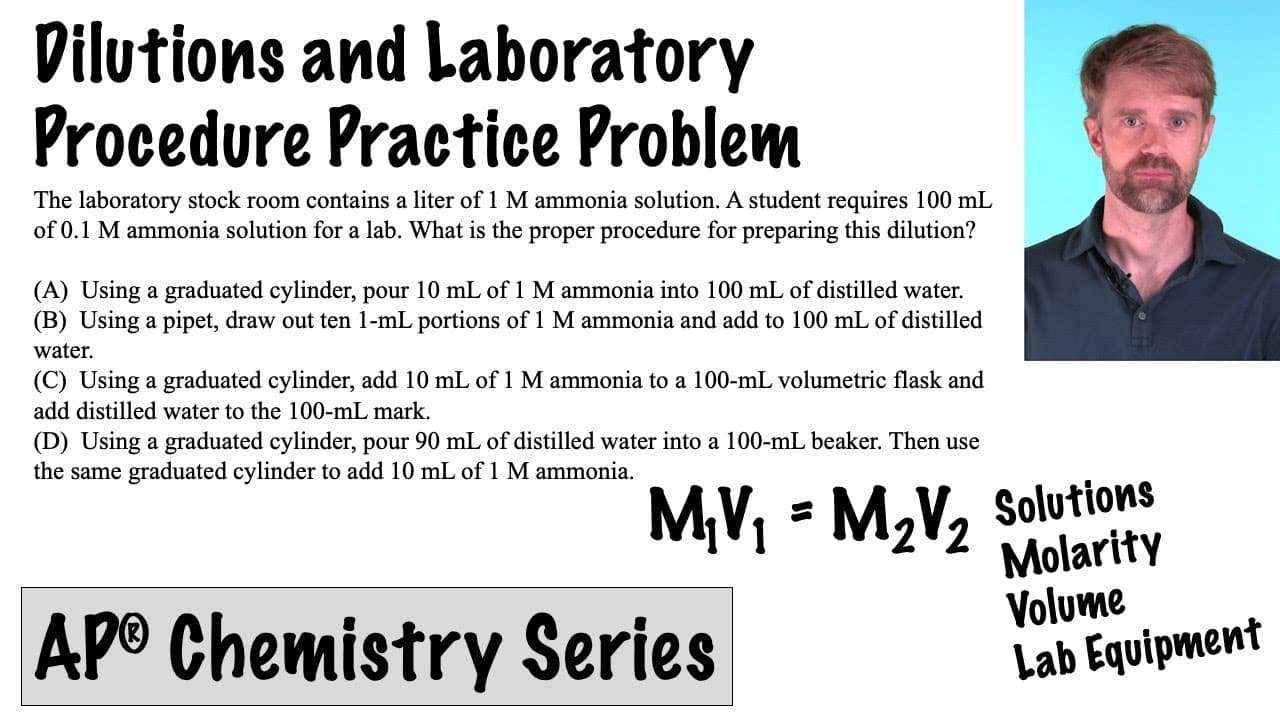
To prepare a 0.1 molar ammonia solution from a 1 molar stock solution, measure 10 milliliters of the stock and add distilled water to reach a total volume of 100 milliliters. Use a volumetric flask for accuracy, as V1 represents the stock solution volume and V2 is the final volume — they are not the same.
Transcript
here we're going to do a problem that focuses on dilutions and laboratory procedure you can find more AP chem resources right here okay this is a long one the laboratory stockroom contains a liter of one molar ammonia solution student requires 100 milliliters of 0.1 molar ammonia solution for a lab what is the proper procedure for preparing this di... Read More
Key Insights
- 🔬 Dilution problems involve both understanding the dilution equation (M1V1 = M2V2) and applying correct laboratory procedure.
- 🔇 It is crucial to differentiate between the volume of the stock solution (V1) and the final volume of the diluted solution (V2).
- 😒 The use of volumetric flasks ensures accurate volume measurement in dilution procedures.
- ❓ The dilution equation is a fundamental concept in AP Chemistry and should be memorized.
- 🫠 Paying attention to details and reading answer choices carefully helps avoid common mistakes like confusing V1 and V2.
- 🏆 The AP test often combines multiple concepts in a single question, emphasizing the need for comprehensive understanding.
- 🔬 Understanding correct laboratory procedure is essential, even if the math behind dilutions is correctly solved.
Install to Summarize YouTube Videos and Get Transcripts
Explore YouTube Video Summarizer or Get YouTube Transcript Extractor
Questions & Answers
Q: What is the equation for making dilutions?
The equation is M1V1 = M2V2, where M1 and V1 represent the molarity and volume of the stock solution, and M2 and V2 represent the desired dilution's molarity and volume.
Q: How do you solve for V1 in the dilution equation?
Rearranging the equation, V1 can be calculated by dividing M2V2 by M1. In this specific problem, V1 is found to be 10 milliliters.
Q: What is the purpose of V2 in the dilution equation?
V2 represents the final volume of the diluted solution. It is the sum of V1 (the volume of the stock solution) and the amount of distilled water added to achieve the desired final volume.
Q: Why is it important to use a volumetric flask for making dilutions?
A volumetric flask is the preferred glassware for making dilutions because it allows for accurate measurement of precise volumes. Graduated cylinders and beakers are not as precise and can lead to errors in the dilution process.
Summary & Key Takeaways
-
The video focuses on dilutions and laboratory procedure in AP Chemistry.
-
The problem involves preparing a 0.1 molar ammonia solution from a stock solution of 1 molar concentration.
-
The video explains the dilution equation (M1V1 = M2V2) and emphasizes the importance of understanding correct lab procedure.
Read in Other Languages (beta)
Share This Summary 📚
Summarize YouTube Videos and Get Video Transcripts with 1-Click
Try YouTube Summary with ChatGPT & Claude or YouTube Transcript Generator
Explore More Summaries from Tyler DeWitt 📚

Summarize YouTube Videos and Get Video Transcripts with 1-Click
Try YouTube Summary with ChatGPT & Claude or YouTube Transcript Generator