Solving a proportion with an unknown variable (example) | 7th grade | Khan Academy
TL;DR
Learn various ways to solve proportions, including multiplying, dividing, and cross-multiplying.
Transcript
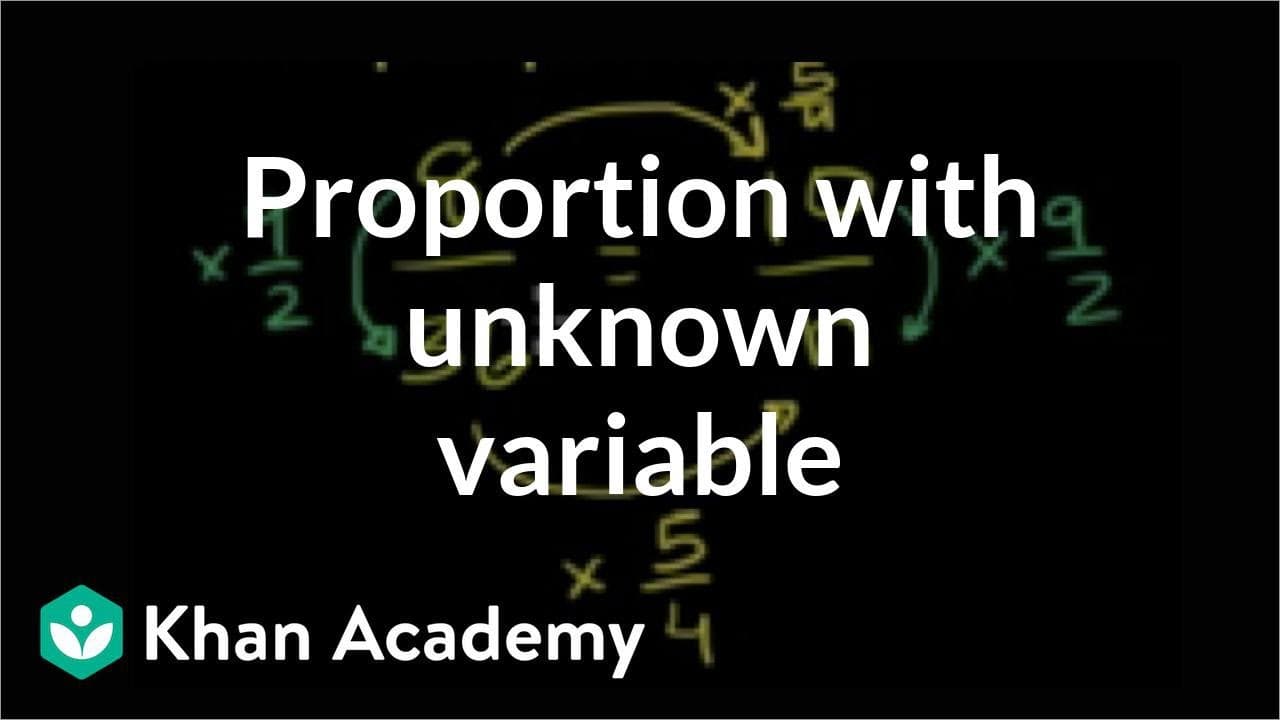
We're asked to solve the proportion. We have 8 36ths is equal to 10 over what. Or the ratio of 8/36 is equal to the ratio of 10 to what. And there's a bunch of different ways to solve this. And I'll explore really all of them, or a good selection of them. So one way to think about it is, these two need to be equivalent ratios, or really, equivalent... Read More
Key Insights
- 🥳 Proportions involve equivalent ratios or fractions.
- 🥳 Multiplying or dividing both parts of a proportion by the same factor maintains the proportionality.
- 😵 Cross-multiplication can be a quick method for solving proportions.
- 😫 Algebraic methods can also be used, such as setting up an equation and simplifying it.
- ❓ Understanding the concept behind the methods is important, rather than relying solely on memorization.
- ❓ Proportions can have multiple valid solutions.
- 🕴️ Different methods suit different learning styles and preferences.
Install to Summarize YouTube Videos and Get Transcripts
Explore YouTube Video Summarizer or Get YouTube Transcript Extractor
Questions & Answers
Q: What are some different ways to solve proportions?
There are several methods, including multiplying the numerator and denominator by the same factor, dividing the numerator and denominator, and cross-multiplying.
Q: How can proportions be solved by multiplying?
To solve a proportion like 8/36 = 10/n, you can multiply the numerator by a factor (such as 10/8) to get the desired value and then multiply the denominator by the same factor (in this case, 5/4).
Q: What is cross-multiplication and how does it work?
Cross-multiplication involves multiplying the numerator of one ratio by the denominator of the other ratio, and vice versa. This allows you to set up an equation and solve for the unknown value.
Q: Can algebra be used to solve proportions?
Yes, algebraic methods can also be used to solve proportions. You can set up an equation by multiplying both sides by the same factor, cancel out terms, and solve for the unknown variable.
Summary & Key Takeaways
-
Proportions can be solved by multiplying the numerator and denominator by the same factor.
-
Another method is to divide the numerator and denominator to determine the factor needed to go from one to the other.
-
Cross-multiplication can also be used to solve proportions by multiplying the numerator and denominator diagonally.
Read in Other Languages (beta)
Share This Summary 📚
Summarize YouTube Videos and Get Video Transcripts with 1-Click
Try YouTube Summary with ChatGPT & Claude or YouTube Transcript Generator
Explore More Summaries from Khan Academy 📚



Summarize YouTube Videos and Get Video Transcripts with 1-Click
Try YouTube Summary with ChatGPT & Claude or YouTube Transcript Generator