What Is Thermodynamic Equilibrium and How Does It Work?
TL;DR
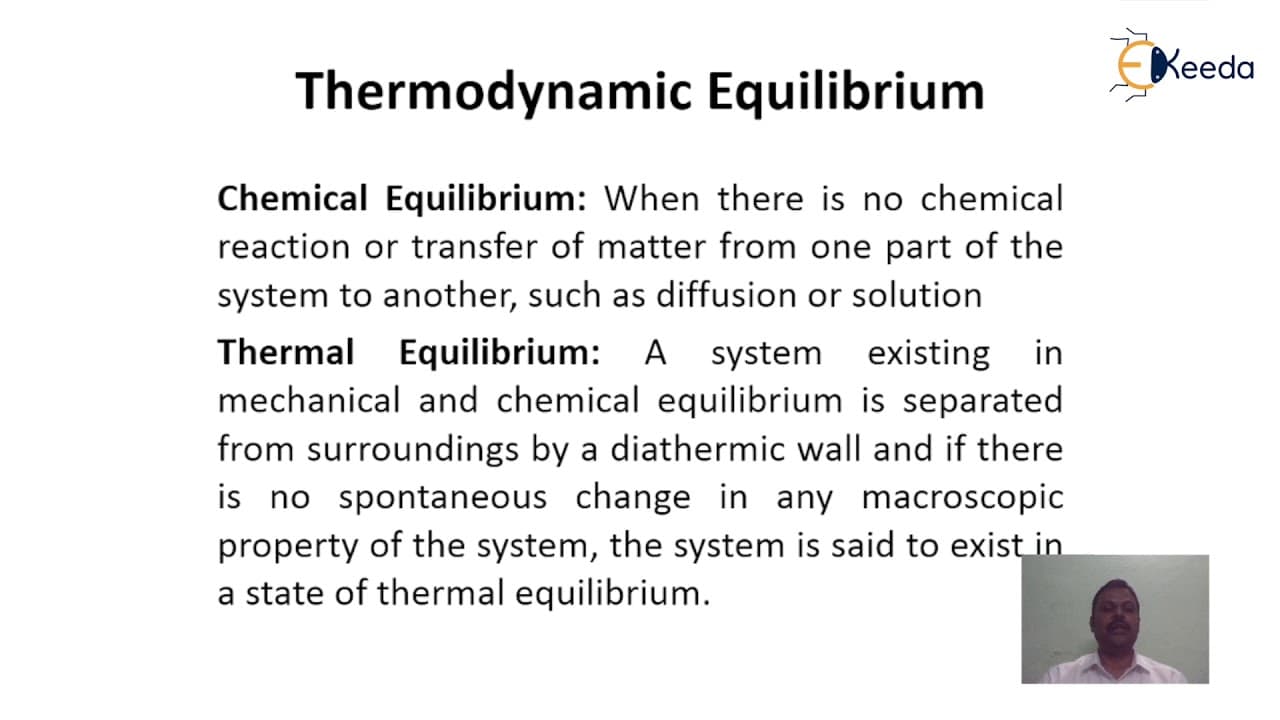
A system is in thermodynamic equilibrium when its microscopic properties remain unchanged while isolated from its surroundings. This state requires mechanical equilibrium (no unbalanced forces), chemical equilibrium (no chemical reactions), and thermal equilibrium (no temperature differences). Pure substances maintain a constant chemical composition, and examples include air, steam, and water.
Transcript
hello friends in this video i am going to discuss about thermal chemical mechanical and thermodynamic equilibrium and pure substance the system is said to be in a state of thermodynamic equilibrium when no change in any microscopic property is registered when the system is isolated from its surroundings a system is in thermodynamic equilibrium when... Read More
Key Insights
- 😆 Thermodynamic equilibrium requires mechanical, chemical, and thermal equilibrium conditions to be satisfied.
- ❓ Non-equilibrium states can result from the presence of unbalanced forces or temperature differences.
- 💆 Pure substances have homogeneous and constant chemical compositions throughout their mass.
- 😤 Examples of pure substances include atmospheric air, steam, water, and combustion products of fuel.
Install to Summarize YouTube Videos and Get Transcripts
Explore YouTube Video Summarizer or Get YouTube Transcript Extractor
Questions & Answers
Q: What is thermodynamic equilibrium?
Thermodynamic equilibrium is a state in which there are no changes in microscopic properties when a system is isolated from its surroundings and satisfies mechanical, chemical, and thermal equilibrium conditions.
Q: How is mechanical equilibrium defined?
Mechanical equilibrium is achieved when there are no unbalanced forces within the system or between the system and surroundings. Any presence of unbalanced forces will cause a change in the system's state until mechanical equilibrium is attained.
Q: What characterizes chemical equilibrium?
Chemical equilibrium refers to a system in which there are no chemical reactions or transfers of matter between different parts of the system. This includes the absence of diffusion for solutions.
Q: How is thermal equilibrium related to the system's state?
Thermal equilibrium exists when there are no spontaneous changes in any macroscopic property of the system. If the system is not in thermal equilibrium, it will undergo a change of state until thermal equilibrium is reached.
Summary & Key Takeaways
-
A system is in thermodynamic equilibrium when there is no change in any microscopic property while isolated from its surroundings.
-
Mechanical equilibrium is achieved when there are no unbalanced forces within or between the system and surroundings.
-
Chemical equilibrium occurs when there are no chemical reactions or transfers of matter within the system.
Read in Other Languages (beta)
Share This Summary 📚
Summarize YouTube Videos and Get Video Transcripts with 1-Click
Try YouTube Summary with ChatGPT & Claude or YouTube Transcript Generator
Explore More Summaries from Ekeeda 📚



Summarize YouTube Videos and Get Video Transcripts with 1-Click
Try YouTube Summary with ChatGPT & Claude or YouTube Transcript Generator