GTC 2015: The Big Bang of Deep Learning (part 5)
TL;DR
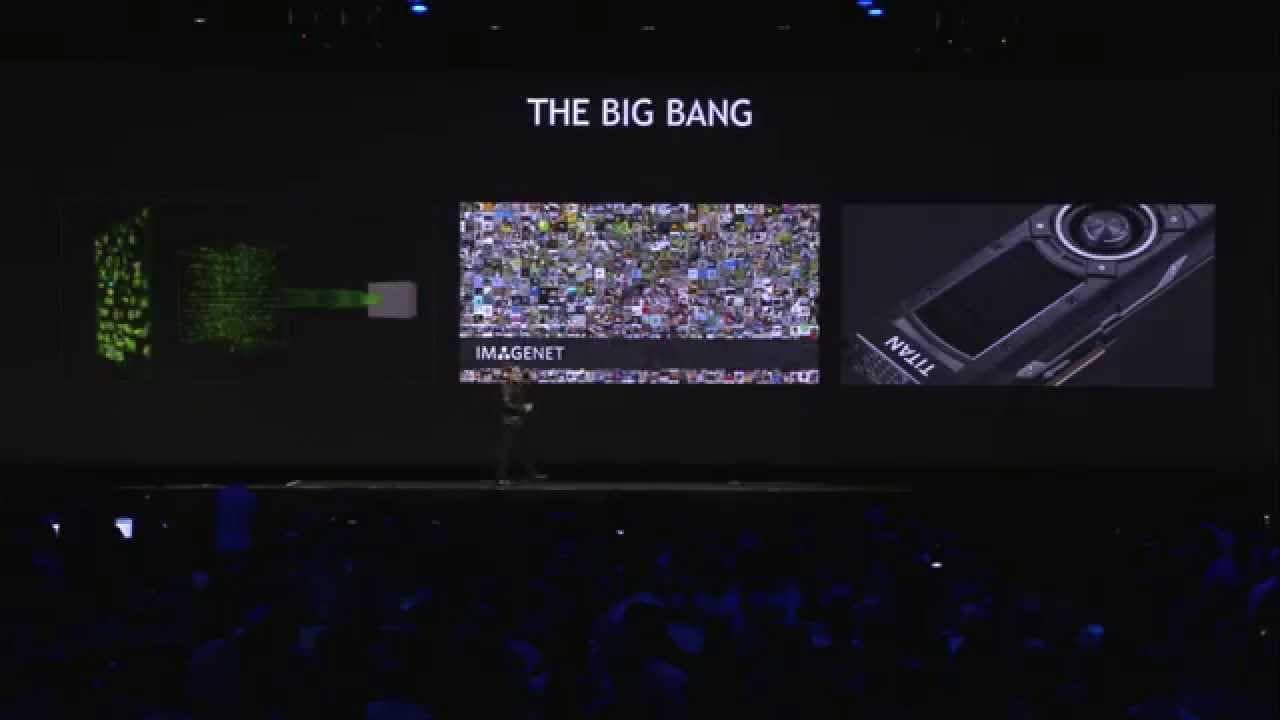
The invention of neural networks, the availability of large data sets, and the democratization of supercomputing have led to the Big Bang of computer perception in 2012.
Transcript
now why did this happen you know this is why did this happen this is the Big Bang if you will the Big Bang of computer perception the Big Bang of computer perception why did it happen now well three things of course the invention of this if you will general unprogrammed and i will go way too far and say simple approach and yon would always say this... Read More
Key Insights
- 😫 The invention of neural networks inspired by biology, the availability of large labeled data sets, and the democratization of supercomputing contributed to the Big Bang of computer perception in 2012.
- 😫 Neural networks offer a simple and programmable approach to computer perception, allowing for training on diverse data sets.
- 😫 The emergence of large data sets, like ImageNet, with millions of labeled images enabled advancements in computer perception.
- ❓ The democratization of supercomputing through CUDA and GPGPU made deep learning accessible to researchers worldwide.
- 🆘 The visualization of neural networks helps understand their complex computations and feature recognition capabilities.
- 👨🔬 Deep neural networks, like VGG, have become the basis for modern research and offer significant improvements in accuracy compared to earlier models.
- 🏋️ The training of neural networks involves iteratively adjusting weights based on computed errors, making it computationally intensive.
Install to Summarize YouTube Videos and Get Transcripts
Explore YouTube Video Summarizer or Get YouTube Transcript Extractor
Questions & Answers
Q: How did the invention of neural networks contribute to the Big Bang of computer perception?
Neural networks provided a simple and programmable approach to computer perception, allowing networks to be trained on a wide range of data sets.
Q: What role did large data sets play in the development of computer perception?
Large data sets, like ImageNet, provided researchers with a hierarchical database of labeled images, enabling training of neural networks on diverse visual data.
Q: How did the democratization of supercomputing contribute to the Big Bang of computer perception?
The availability of supercomputing power through technologies like CUDA and GPGPU allowed researchers worldwide to perform deep learning experiments and advance the field of computer perception.
Q: What are the key components of a neural network?
Neural networks consist of interconnected processors, or neurons, modeled after the human brain. These neurons are organized in layers and connected by weighted connections, with each layer performing specific tasks in pattern recognition.
Summary & Key Takeaways
-
The Big Bang of computer perception occurred in 2012, driven by the invention of neural networks, the availability of large data sets, and the democratization of supercomputing.
-
The invention of neural networks allowed for a simple and programmable approach to computer perception, making it possible to train networks on diverse data sets.
-
The emergence of large data sets, such as ImageNet with 15 million labeled images, contributed to the development of computer perception technologies.
Read in Other Languages (beta)
Share This Summary 📚
Summarize YouTube Videos and Get Video Transcripts with 1-Click
Try YouTube Summary with ChatGPT & Claude or YouTube Transcript Generator
Explore More Summaries from NVIDIA 📚

Summarize YouTube Videos and Get Video Transcripts with 1-Click
Try YouTube Summary with ChatGPT & Claude or YouTube Transcript Generator