IIT JEE Position Vectors
TL;DR
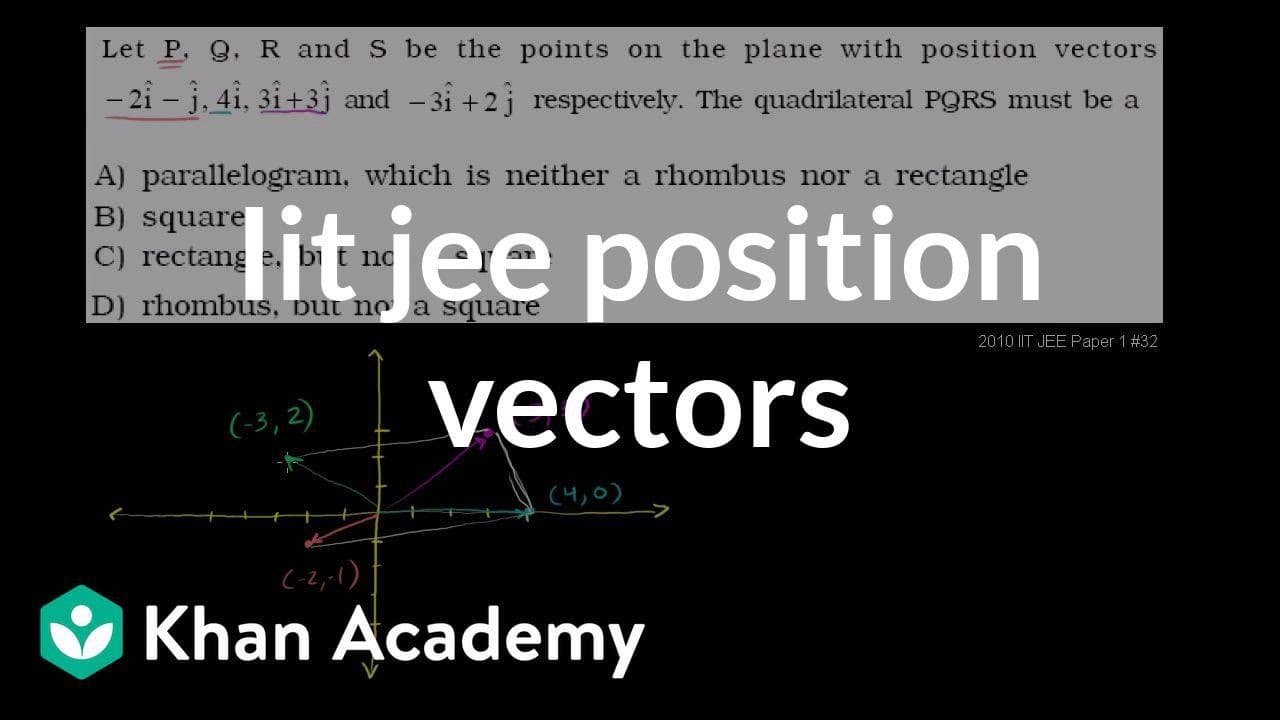
In this video, the content explains how to determine the shape of a quadrilateral based on the position vectors of its points.
Transcript
Let P, Q, R, and S be the points on the plane with position vectors negative 2i minus j, 4i, 3i plus 3j, and negative 3i plus 2j, respectively. The quadrilateral PQRS must be a-- So let's just graph each of these positions vectors, or graph the points that they're specifying. So let me draw my coordinate axes right over here. So this is my vertical... Read More
Key Insights
- 😥 Position vectors allow for precise representation of points on a plane.
- 😥 The shape of a quadrilateral can be determined by analyzing the position vectors of its points.
- 💠 Slopes of lines formed by sides of a quadrilateral are essential in determining its shape.
- 🙃 Parallelograms have opposite sides that are parallel.
Install to Summarize YouTube Videos and Get Transcripts
Explore YouTube Video Summarizer or Get YouTube Transcript Extractor
Questions & Answers
Q: What is the significance of position vectors in determining the shape of a quadrilateral?
Position vectors provide coordinates for points on a plane, allowing us to graph and analyze the shape of a quadrilateral based on the lines formed between these points.
Q: How can we determine whether a quadrilateral is a parallelogram?
To determine if a quadrilateral is a parallelogram, we need to check if opposite sides are parallel. This can be done by finding the slopes of the lines formed by these sides and verifying that they are equal.
Q: What are the characteristics of a rhombus and a rectangle?
A rhombus is a parallelogram with all sides of equal length, while a rectangle is a parallelogram with four right angles. The quadrilateral in this video does not exhibit these characteristics.
Q: How can position vectors be converted to standard form?
To convert a position vector to standard form, start with its base at the origin and graph the vector accordingly. The resulting point represents the coordinates specified by the position vector.
Summary & Key Takeaways
-
The video discusses the concept of position vectors and their relation to specific points on a plane.
-
It demonstrates how to graph position vectors using coordinates and how to convert them to standard form.
-
Using four points defined by position vectors P, Q, R, and S, the video determines that the quadrilateral formed is a parallelogram.
Read in Other Languages (beta)
Share This Summary 📚
Summarize YouTube Videos and Get Video Transcripts with 1-Click
Try YouTube Summary with ChatGPT & Claude or YouTube Transcript Generator
Explore More Summaries from Khan Academy 📚



Summarize YouTube Videos and Get Video Transcripts with 1-Click
Try YouTube Summary with ChatGPT & Claude or YouTube Transcript Generator