Regression line example | Regression | Probability and Statistics | Khan Academy
TL;DR
This video explains how to find the slope and y-intercept of the best fitting regression line using formulas, and demonstrates with an example.
Transcript
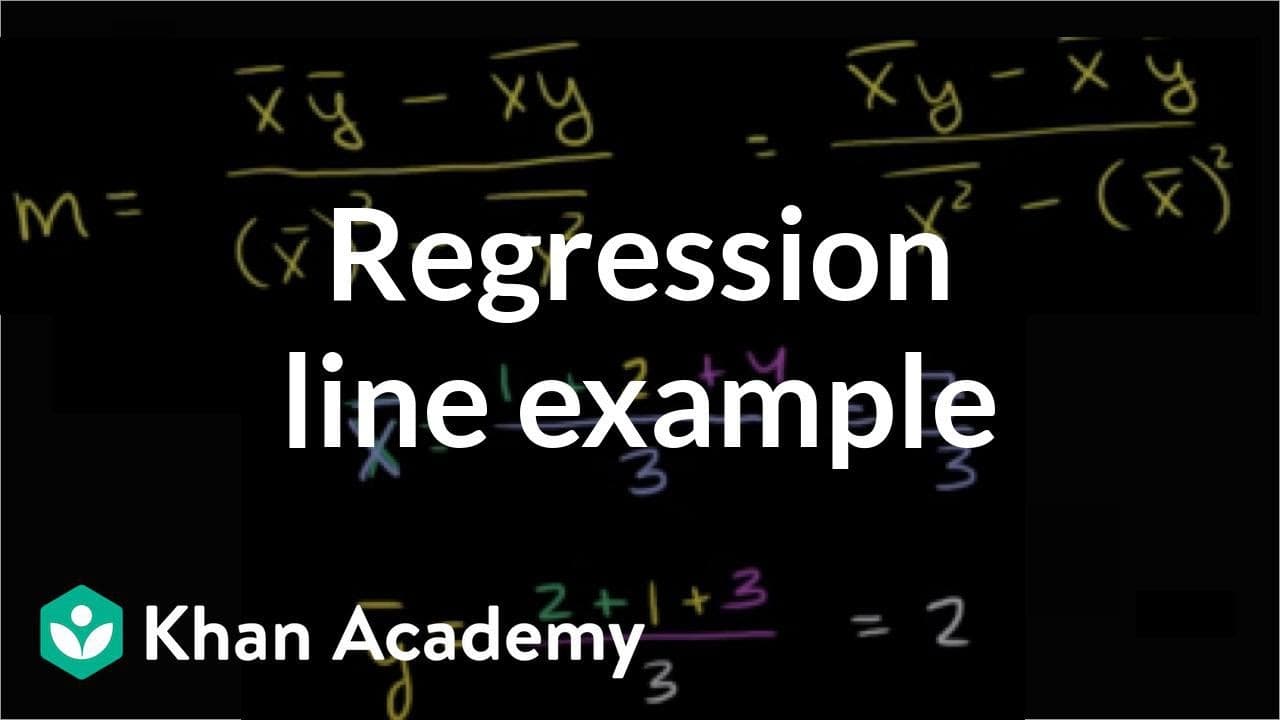
In the last several videos, we did some fairly hairy mathematics. And you might have even skipped them. But we got to a pretty neat result. We got to a formula for the slope and y-intercept of the best fitting regression line when you measure the error by the squared distance to that line. And our formula is, and I'll just rewrite it here just so w... Read More
Key Insights
- ❣️ The formula for finding the slope and y-intercept of the best fitting regression line involves calculating means of x's, y's, xy's, and x squareds.
- 👈 The mean of x's is the sum of all x values divided by the number of data points.
- ➗ The mean of y's is the sum of all y values divided by the number of data points.
- ✖️ The mean of xy's is calculated by multiplying each x value with its corresponding y value, summing them up, and dividing by the number of data points.
- 👈 The mean of x squareds is calculated by squaring each x value, summing them up, and dividing by the number of data points.
- ❣️ The slope is obtained by substituting the calculated means into the formula, and the y-intercept is found by subtracting the slope times the mean of x's from the mean of y's.
- 🫥 The best fitting regression line is the line that minimizes the squared distances from each data point to the line.
Install to Summarize YouTube Videos and Get Transcripts
Explore YouTube Video Summarizer or Get YouTube Transcript Extractor
Questions & Answers
Q: What is the formula for finding the slope and y-intercept of the best fitting regression line?
The formula is: slope = (mean of x's * mean of y's - mean of xy's) / (mean of x squareds - mean of x's squared). The y-intercept can be found by subtracting the slope times the mean of x's from the mean of y's.
Q: How do you calculate the mean of x's, y's, xy's, and x squareds?
To calculate the mean of x's and y's, add up all the values and divide by the number of data points. To calculate the mean of xy's, multiply each x value with its corresponding y value, add them up, and divide by the number of data points. To calculate the mean of x squareds, square each x value, add them up, and divide by the number of data points.
Q: What does the best fitting regression line represent?
The best fitting regression line represents the line that minimizes the squared distances from each data point to the line. It is a line that best fits the overall trend of the data.
Q: Can the formula be used for any set of data?
Yes, the formula can be used for any set of data to find the best fitting regression line. It relies on calculating the means of x's, y's, xy's, and x squareds, which can be done for any data set.
Summary & Key Takeaways
-
The video explains a formula for finding the slope and y-intercept of the best fitting regression line when measuring the error by the squared distance to that line.
-
An example is provided to demonstrate how to calculate the mean of x's, y's, xy's, and x squareds, and then substitute them into the formula.
-
The video concludes by graphing the regression line with the calculated slope and y-intercept.
Read in Other Languages (beta)
Share This Summary 📚
Summarize YouTube Videos and Get Video Transcripts with 1-Click
Try YouTube Summary with ChatGPT & Claude or YouTube Transcript Generator
Explore More Summaries from Khan Academy 📚



Summarize YouTube Videos and Get Video Transcripts with 1-Click
Try YouTube Summary with ChatGPT & Claude or YouTube Transcript Generator