Why understanding interfaces is important (with useReducer example)
TL;DR
The video clarifies the correct parameter order for the useReducer hook in React.
Transcript
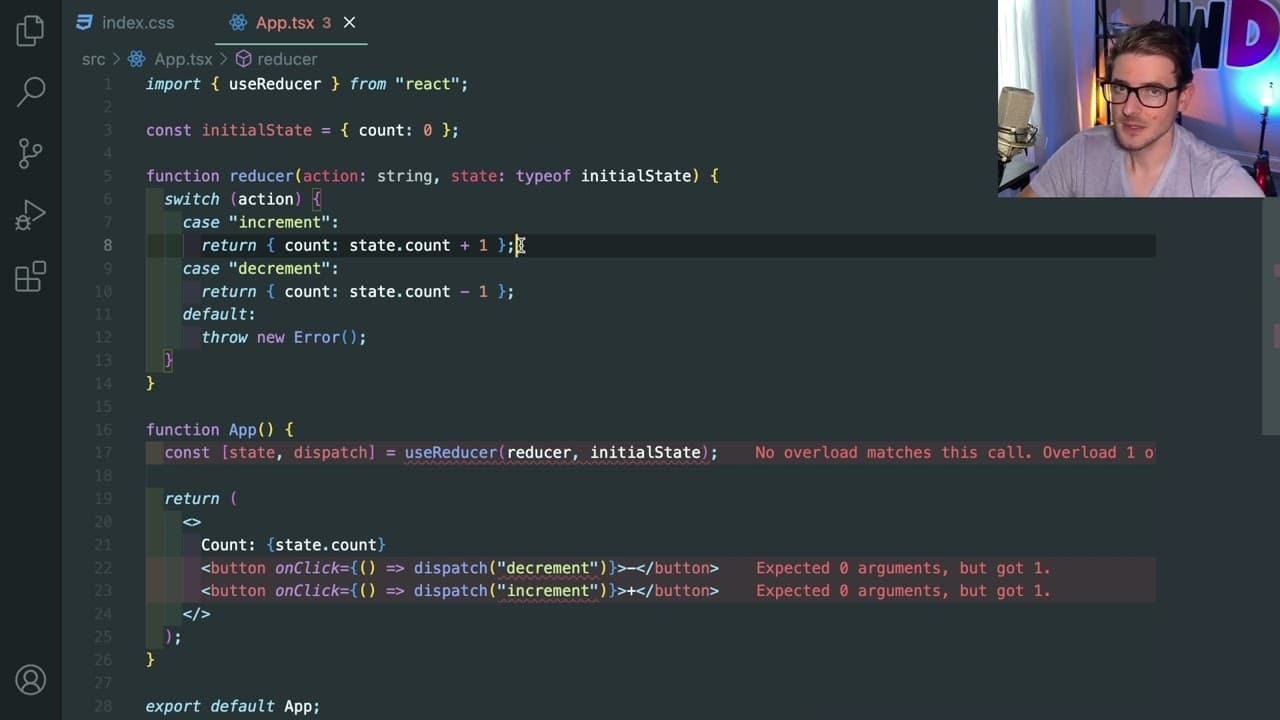
all right so this video is going to be a little bit different I'm going to talk about the use reducer hook a little bit but I'm really trying to address a question that one of my Discord users had and he was really confused as to why if you look at the reducer that we're declaring here it's a function that takes in state as the first argument and a... Read More
Key Insights
- 🪝 The useReducer hook is ideal for managing complex state transitions in React applications.
- 🪈 Adhering to the defined parameter order in functions is critical for maintaining functional integrity.
- ⌛ TypeScript enhances the development experience by providing type enforcement that catches errors at compile time.
- 👨💻 Understanding function interfaces—both in JavaScript and TypeScript—is essential for successful coding practices.
- 😒 The conventional use of action types allows developers to manage more granular state updates, like passing payloads.
- 🥺 Improper parameter ordering can lead to runtime errors and unpredictable application behavior.
- 🕸️ Community support, like Discord channels, can be invaluable for learning and problem-solving in web development.
Install to Summarize YouTube Videos and Get Transcripts
Explore YouTube Video Summarizer or Get YouTube Transcript Extractor
Questions & Answers
Q: Why do we need to use the useReducer hook in React?
The useReducer hook is crucial for managing complex state logic in React applications. It allows developers to encapsulate state and handling logic, especially in situations where state transitions are interdependent or complex. By using reducers, developers can ensure a predictable state change based on specified actions, leading to more maintainable code.
Q: What happens if you swap the order of parameters in a reducer function?
Swapping the order of parameters in a reducer function will lead to errors, as the expected interface dictates that the first parameter is always the current state. This parameter order is integral for maintaining the integrity of state transitions. A mismatch will cause unexpected behavior, potentially breaking the application when actions attempt to resolve incorrectly.
Q: How do TypeScript interfaces help in using the useReducer hook correctly?
TypeScript interfaces provide a way to enforce consistency in function parameter types, ensuring that the correct arguments are passed in the proper order. If a developer tries to call a reducer function with incorrectly ordered or typed parameters, TypeScript will produce a compilation error, allowing for early detection of such mistakes and preventing runtime bugs.
Q: Can you describe a typical implementation of a reducer function in React?
A typical reducer function takes two parameters: the current state and an action. The function uses a switch statement to determine how to update the state based on the action type. For example, if the action is 'INCREMENT', the reducer might return a new state object with the count increased, and if it’s 'DECREMENT', decrease the count. This design encapsulates state management logic in a predictable way.
Summary & Key Takeaways
-
The video discusses the useReducer hook in React, explaining how it's used to manage state and why the first parameter must be 'state' and not 'action'.
-
It emphasizes the significance of adhering to function interfaces and how TypeScript aids in ensuring correct parameter orders.
-
Through examples, the speaker illustrates common errors in parameter usage and the consequences of not complying with expected interfaces.
Read in Other Languages (beta)
Share This Summary 📚
Summarize YouTube Videos and Get Video Transcripts with 1-Click
Try YouTube Summary with ChatGPT & Claude or YouTube Transcript Generator
Explore More Summaries from Web Dev Cody 📚


Summarize YouTube Videos and Get Video Transcripts with 1-Click
Try YouTube Summary with ChatGPT & Claude or YouTube Transcript Generator