GMAT: Math 3 | Problem solving | GMAT | Khan Academy
TL;DR
This video teaches problem-solving techniques for arithmetic problems, such as multiplying decimals and calculating ratios.
Transcript
We're on problem 12. 0.1 plus 0.1 squared plus 0.1 to the third. So that's the same thing as 0.1. What's 0.1 squared? It's 1 times 1 with 2 numbers to the right of the decimal, so it's 0.01. And then to the third power. You're just going to end up 1/10 of that, right? 0.01 times 0.1. Well that's 1 with 3 numbers to the right of the decimal point. I... Read More
Key Insights
- ✖️ Multiplying decimals can be used to solve addition problems involving decimals.
- ❓ Khan Academy is a recommended resource for practicing basic arithmetic skills.
- 🆘 Visualizing dimensions can help solve problems involving geometric objects.
- 😑 Some expressions may be undefined if the numerator cannot equal zero.
- ❓ Proportions can be used to find missing values or calculate percentages.
Install to Summarize YouTube Videos and Get Transcripts
Explore YouTube Video Summarizer or Get YouTube Transcript Extractor
Questions & Answers
Q: How can you add decimals by multiplying them?
To add decimals, you can multiply the decimals together and sum up the products. For example, 0.1 + 0.1 squared + 0.1 cubed equals 1 + 0.01 + 0.001, resulting in a sum of 1.011.
Q: What is the capacity of a sandbox that is twice the size of the original sandbox?
To determine the capacity, visualize how many of the original sandboxes can fit into the new one. In this case, the new sandbox can fit 8 of the original sandboxes, resulting in a capacity of 80 cubic feet.
Q: Why can't the expression 1/x - 1 equal zero?
The expression can never equal zero because the numerator can never equal zero. The expression becomes undefined when the denominator approaches infinity, resulting in a very small fraction but never equaling zero.
Q: How can you calculate the number of rolls not sold at the end of the day at a bakery?
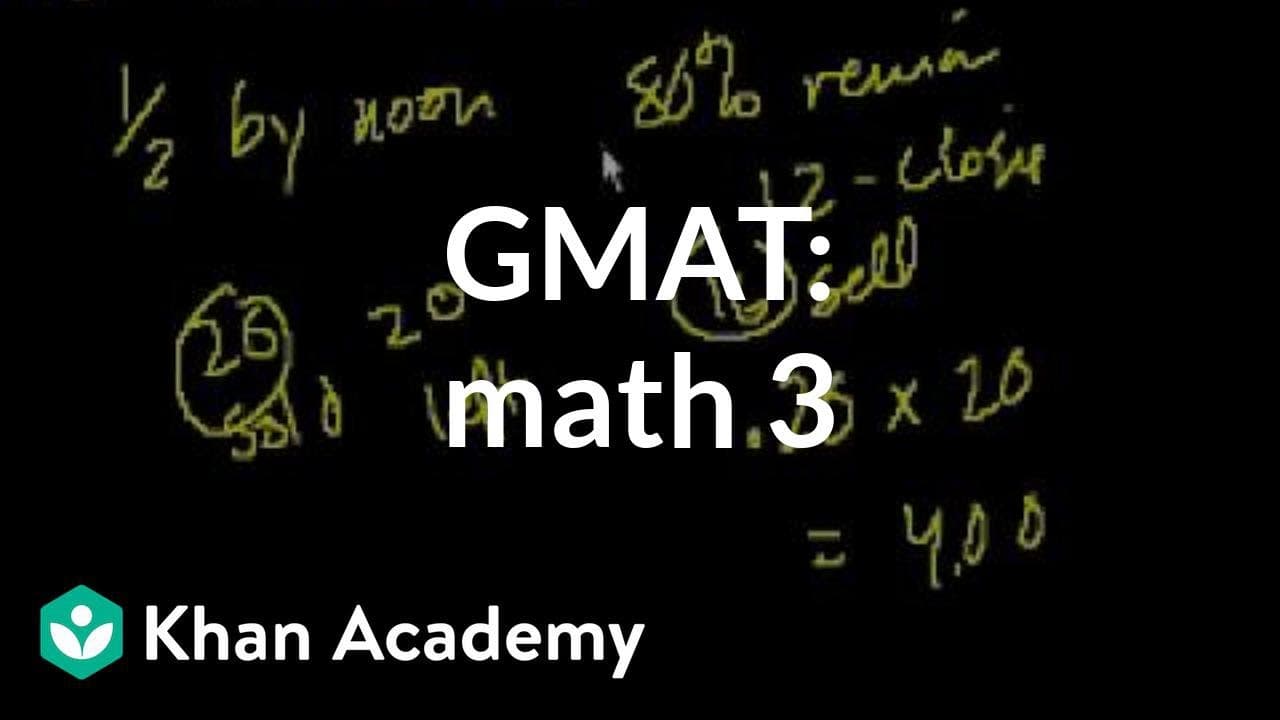
By using proportions, you can determine that if 80% of the remaining rolls were sold, then 20% were not sold. Therefore, if 20 rolls remained, 4 rolls were not sold.
Q: How do you find the combined area of a rectangular sheet of paper?
Multiply the length by the width to find the area of one side. Then multiply that result by 2 to find the combined area of the front and back of the paper.
Summary & Key Takeaways
-
The video starts by explaining how to solve a problem involving adding decimals by multiplying the decimals together. It then emphasizes the importance of learning basic arithmetic skills and recommends using the Khan Academy application for practice.
-
The next problem involves finding the capacity of a rectangular sandbox that is twice the size of the original sandbox. By visualizing the dimensions, it is determined that the new sandbox can fit 8 of the original sandboxes, resulting in a capacity of 80 cubic feet.
-
The video then presents a problem related to the values of a fraction and asks which value cannot be achieved by the expression 1/x - 1. The answer is determined by realizing that the numerator can never equal zero, making the expression undefined when the numerator is negative or zero.
-
Another problem involves calculating the number of rolls not sold at the end of the day at a bakery. By using percentages and proportions, it is determined that 4 rolls were not sold.
-
The last problem requires finding the combined area of the front and back of a rectangular sheet of paper. The area of one side is calculated and then multiplied by 2 to find the total combined area, which is 187 square inches.
Read in Other Languages (beta)
Share This Summary 📚
Summarize YouTube Videos and Get Video Transcripts with 1-Click
Try YouTube Summary with ChatGPT & Claude or YouTube Transcript Generator
Explore More Summaries from Khan Academy 📚



Summarize YouTube Videos and Get Video Transcripts with 1-Click
Try YouTube Summary with ChatGPT & Claude or YouTube Transcript Generator