Fair Dice (Part 1) - Numberphile
TL;DR
Understanding the symmetry of fair dice and their implications on fairness and randomness.
Transcript
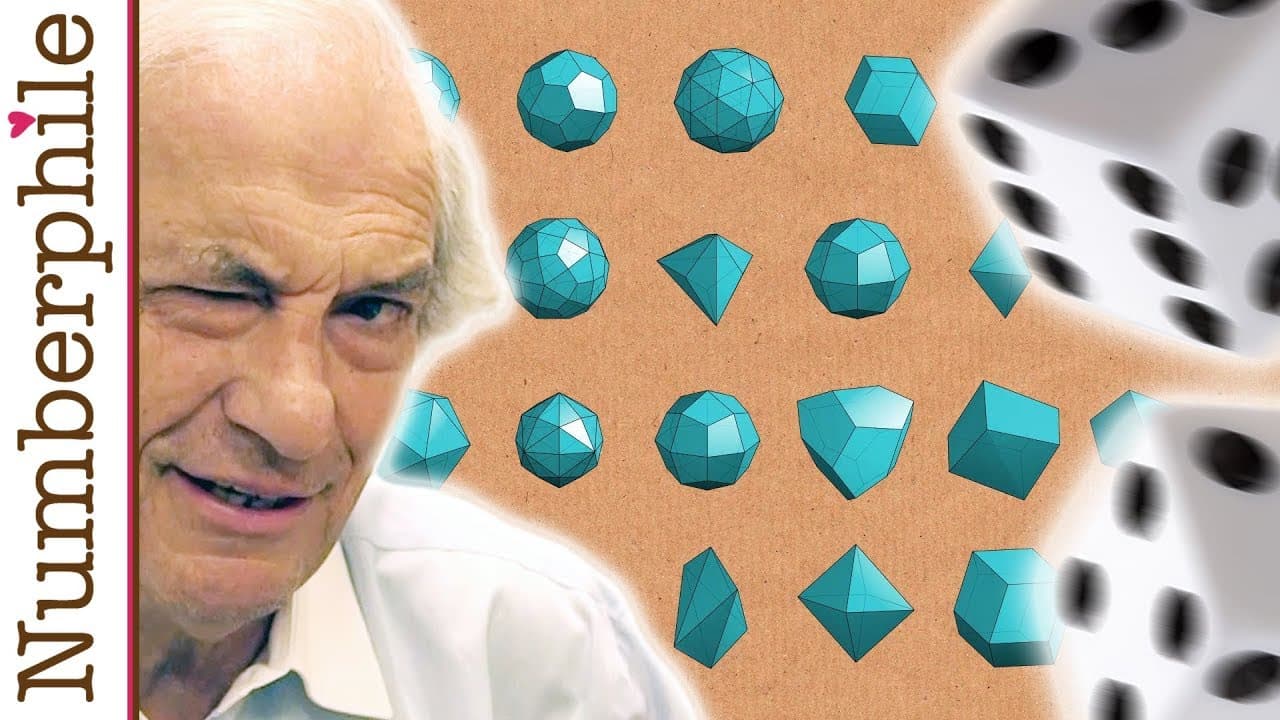
So a cube has perfect symmetry, right? You know what I mean. Every face is the same. And a tetrahedron has perfect symmetry. Okay, there are four faces, and they're all the same. You can ask, and Euclid did, what are all of the symmetric three-dimensional objects? And it turns out there are only five of them. Most people know what a cube is, and a ... Read More
Key Insights
- 🧚 Fair dice exhibit symmetry through their symmetry groups, which determine their fairness.
- 🤣 Physics influences the fairness of dice through factors like how they are rolled and initial conditions upon release.
- 👾 The cube is considered fairer than other dice due to finer partitioning in phase space.
- 🎲 Symmetry and physics combine to determine the fairness and randomness of dice.
- 🎲 Different types of dice exhibit varying degrees of symmetry, influencing their fairness.
- 🧚 The symmetry group of fair dice must act transitively on their faces for them to be considered fair.
- 🧚 Some fair dice have infinite families due to continuous parameters.
Install to Summarize YouTube Videos and Get Transcripts
Explore YouTube Video Summarizer or Get YouTube Transcript Extractor
Questions & Answers
Q: How many three-dimensional objects exhibit perfect symmetry, and what are they?
Only five three-dimensional objects have perfect symmetry: cube, tetrahedron, octahedron, icosahedron, dodecahedron. Each face of these objects is the same.
Q: What defines a fair die, and how does symmetry play a role?
A fair die is one where each face is equally likely to come up. The symmetry group of a die determines its fairness, with transitive symmetry on faces being a key factor.
Q: How does physics influence the fairness of dice?
Physics plays a role in the fairness of dice through factors like initial conditions upon release, angular velocities, and partitioning of phase space. The cube is fairer due to finer partitioning.
Q: What role does symmetry combined with physics play in analyzing fairness?
Symmetry and physics interact to determine the fairness of dice. For example, the cube is fairer due to finer partitioning in phase space, making small changes more impactful than with other dice.
Summary & Key Takeaways
-
Only five three-dimensional objects have perfect symmetry: cube, tetrahedron, octahedron, icosahedron, dodecahedron.
-
The concept of fair dice revolves around symmetry, with physical factors affecting fairness.
-
The symmetry group of fair dice determines their fairness and the number of symmetries plays a key role.
Read in Other Languages (beta)
Share This Summary 📚
Summarize YouTube Videos and Get Video Transcripts with 1-Click
Try YouTube Summary with ChatGPT & Claude or YouTube Transcript Generator
Explore More Summaries from Numberphile 📚





Summarize YouTube Videos and Get Video Transcripts with 1-Click
Try YouTube Summary with ChatGPT & Claude or YouTube Transcript Generator