Talks S2E2 (Vasudev Gupta): Understanding BigBird (Transformers for Longer Sequences)
TL;DR
This analysis explores the Big Bird model, its architecture, implementation, and training process, highlighting its benefits over traditional transformer models.
Transcript
hello everyone and welcome to the new talks today we have with us vasudeva gupta he is a student of mechanical engineering we tech in mechanical engineering in iit madras actually he's doing a dual degree and his course is five years long and he's also going to have an m tech in data science how cool is that plus he is also an active contributor to... Read More
Key Insights
- 💄 Big Bird is a transformer model that addresses limitations in traditional attention matrices, making it more efficient for longer sequences.
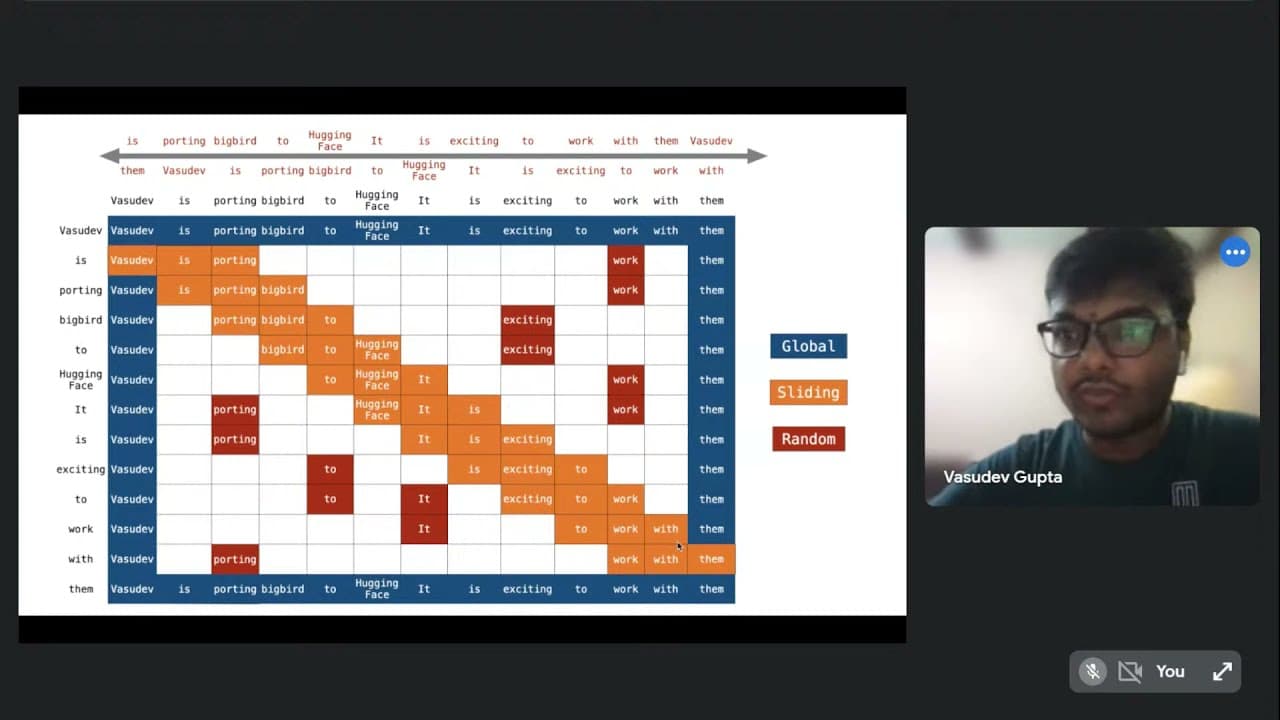
- 🎚️ Categorizing tokens into global, sliding, and random connections allows Big Bird to capture different levels of attention relevance.
- 🤩 The implementation of Big Bird involves multiplying query matrices with key matrices to calculate attention scores and generate token representations.
- 🚫 Big Bird can be trained from scratch by adjusting hyperparameters like the number of random blocks and block size.
Install to Summarize YouTube Videos and Get Transcripts
Explore YouTube Video Summarizer or Get YouTube Transcript Extractor
Questions & Answers
Q: What are the three categories into which tokens are categorized in Big Bird?
In Big Bird, tokens are categorized as global, sliding, or random connections, each serving a unique purpose in capturing attention within a sequence.
Q: How is sliding attention implemented in Big Bird?
Sliding attention involves multiplying query matrices with key matrices to obtain attention scores for nearby tokens, capturing their importance within the sequence.
Q: What is the significance of using randomly chosen tokens in Big Bird?
Random tokens allow Big Bird to attend to a subset of tokens within the sequence, making attention calculation more efficient by reducing complexity.
Q: Are there any limitations to using the Big Bird model?
Some limitations of Big Bird include the need for sequence length to be a multiple of the block size and the unavailability of the etc variant and support for decoder-side models.
Summary & Key Takeaways
-
Vasudeva Gupta, a mechanical engineering student, introduces Big Bird, a transformer model that addresses limitations in complex attention matrices.
-
Big Bird categorizes tokens into global, sliding, and random connections, allowing more efficient attention calculation.
-
The implementation of Big Bird involves multiplying query matrices with key matrices to generate attention scores and representations.
Read in Other Languages (beta)
Share This Summary 📚
Summarize YouTube Videos and Get Video Transcripts with 1-Click
Try YouTube Summary with ChatGPT & Claude or YouTube Transcript Generator
Explore More Summaries from Abhishek Thakur 📚

Summarize YouTube Videos and Get Video Transcripts with 1-Click
Try YouTube Summary with ChatGPT & Claude or YouTube Transcript Generator