Evaluating a Lorentz transformation | Special relativity | Physics | Khan Academy
TL;DR
"Learn how to apply Lorentz Transformations in order to calculate the coordinates of events in different frames of reference."
Transcript
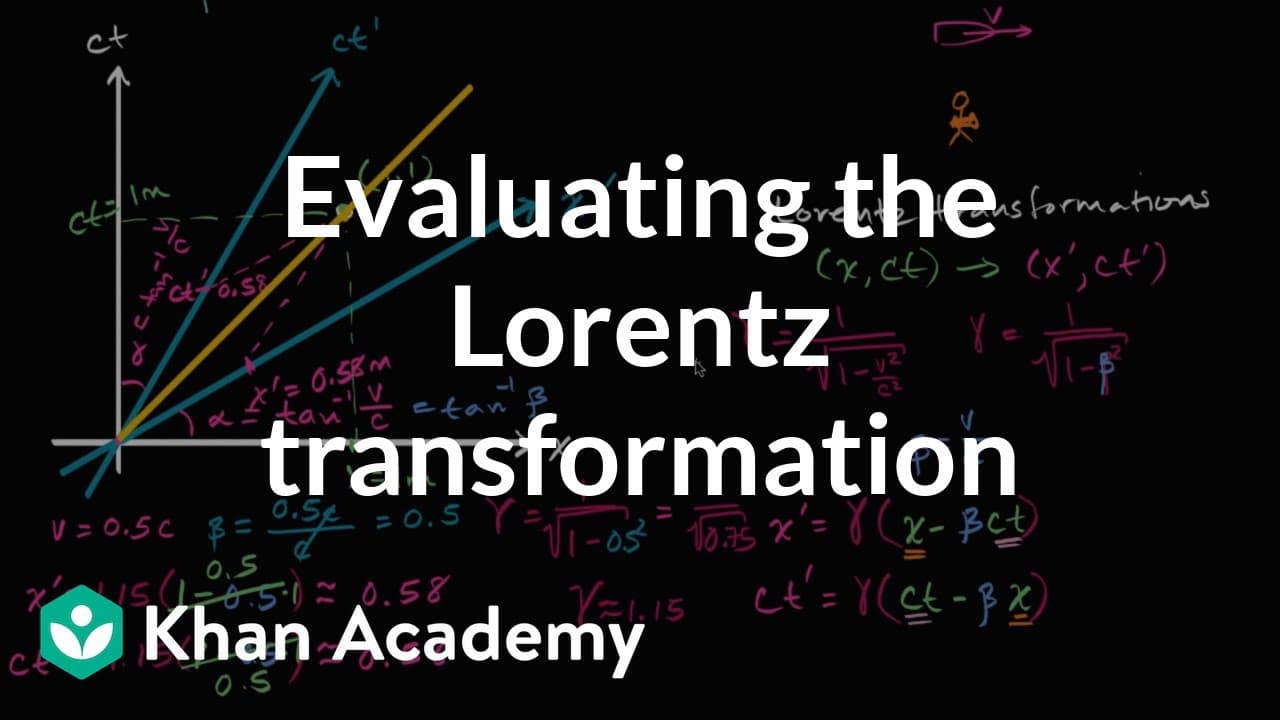
- [Voiceover] Let's now dig a little bit deeper into the Lorentz Transformation. In particular, let's put some numbers here, so that we're, we get a little bit more familiar manipulating and then we'll start to get a little bit more intuition on how this transformation or sometimes it's spoken of in the plural, the transformations behave. So let's ... Read More
Key Insights
- 👻 Lorentz Transformations allow for the calculation of coordinates between different frames of reference.
- 🙂 The Lorentz Factor, derived from beta (the ratio of relative velocity to the speed of light), plays a crucial role in determining the transformations.
- 🙂 The Lorentz Factor approaches 1 for low velocities and diverges for velocities approaching the speed of light.
- 🛀 The transformation of coordinates shows time dilation and length contraction effects.
Install to Summarize YouTube Videos and Get Transcripts
Explore YouTube Video Summarizer or Get YouTube Transcript Extractor
Questions & Answers
Q: What is the Lorentz Factor and how is it calculated?
The Lorentz Factor, denoted as gamma, is calculated as 1 divided by the square root of (1 - beta^2), where beta is the ratio of the relative velocity to the speed of light.
Q: How are the coordinates in the friend's frame of reference determined?
To find the prime coordinates in the friend's frame, multiply the Lorentz Factor by the coordinates in the original frame, subtracting beta times the x-coordinate, and keeping the ct-coordinate unchanged.
Q: What happens to the Lorentz Factor as the relative velocity approaches the speed of light?
As the relative velocity approaches the speed of light, the Lorentz Factor increases significantly, indicating greater time dilation and length contraction effects.
Q: Why is it important to manipulate and experiment with different velocities using Lorentz Transformations?
Manipulating and experimenting with different velocities helps in understanding the behavior of Lorentz Transformations and their implications for length contraction, time dilation, and the nature of space-time.
Summary & Key Takeaways
-
This video explores how to apply Lorentz Transformations using numbers to better understand the behavior and intuition behind them.
-
The scenario focuses on a friend passing by with a relative velocity of half the speed of light.
-
By calculating the Lorentz Factor and using it to determine the coordinates in the friend's frame of reference, the video demonstrates the transformation of coordinates between frames.
Read in Other Languages (beta)
Share This Summary 📚
Summarize YouTube Videos and Get Video Transcripts with 1-Click
Try YouTube Summary with ChatGPT & Claude or YouTube Transcript Generator
Explore More Summaries from Khan Academy 📚



Summarize YouTube Videos and Get Video Transcripts with 1-Click
Try YouTube Summary with ChatGPT & Claude or YouTube Transcript Generator