Should AI Users be Worried? Chat GPT Detectors & How to Bypass them
TL;DR
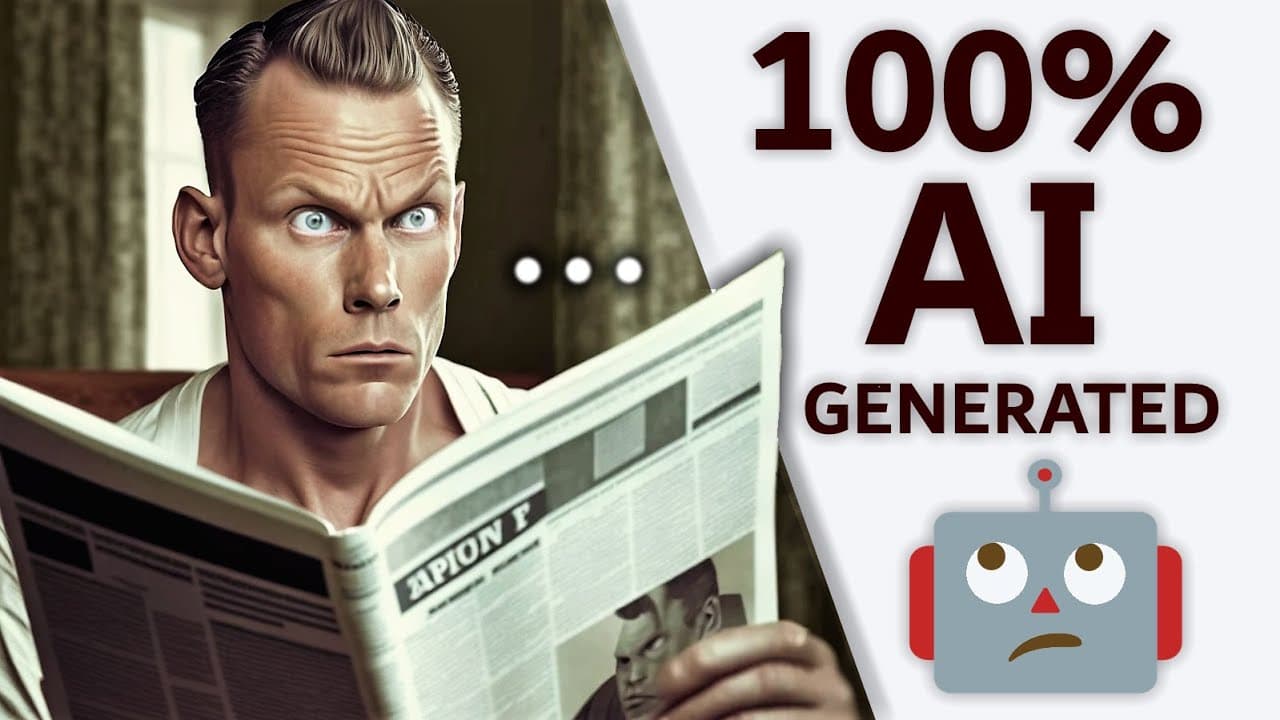
With the increasing popularity of AI-generated content, the need for AI content detectors has emerged, but their reliability is still questionable.
Transcript
AI technology has been absolutely rocketing into the mainstream Stratosphere as of late now your average everyday Joe just kind of knows that AI is a thing and that it exists and that it's new technology sure they might not know as much as you know us weirdo AI tech people but it's definitely becoming more mainstream especially with the release of ... Read More
Key Insights
- 👊 AI technology, particularly chat GPT, has gained significant popularity and disrupted various industries.
- ❓ OpenAI has developed an AI classifier to distinguish between human-written and AI-written text, but its accuracy is limited.
- ❓ AI content detectors, including OpenAI's classifier and the Content at Scale detector, are not entirely reliable and can produce inconsistent results.
- ❓ AI-generated content can easily bypass these detectors through simple editing and rewording.
- 💄 AI content detectors should not be solely relied upon for making critical decisions about the authenticity of written content.
- ✍️ The limitations of AI content detectors pose challenges in effectively identifying AI-generated text, especially in the context of academic writing.
- 👨🔬 Further research and development are necessary to improve the accuracy and reliability of AI content detectors.
Install to Summarize YouTube Videos and Get Transcripts
Explore YouTube Video Summarizer or Get YouTube Transcript Extractor
Questions & Answers
Q: How accurate are AI content detectors in distinguishing between human-written and AI-written text?
AI content detectors, such as OpenAI's classifier, can correctly identify AI-written text around 26% of the time, but they still struggle to reliably detect all AI-generated content. They can falsely label human-written text as AI-generated, posing a challenge in accurately identifying the origin of the text.
Q: Can AI-generated text easily bypass these AI content detectors?
Yes, AI-generated text can easily bypass content detectors through simple editing or tweaking. By making minor modifications, such as rewording sentences, AI-generated content can appear human-written and evade detection by these classifiers.
Q: Are AI content detectors trustworthy for detecting AI-generated content in academia?
AI content detectors, including OpenAI's classifier, are not considered reliable enough for academic purposes. They may incorrectly label human-written content as AI-generated. Thus, caution is advised when using these detectors to determine the authenticity of content in academic settings.
Q: How do AI content detectors compare to each other in terms of accuracy?
Different AI content detectors yield varying results. While OpenAI's detector and the Content at Scale detector display some accuracy, the latter appears to be more reliable in detecting AI-generated content. However, further research and testing are necessary to establish their effectiveness.
Summary & Key Takeaways
-
AI technology, particularly chat GPT, has gained mainstream attention and disrupted various industries by automating tasks previously considered impossible to automate.
-
OpenAI, the company behind chat GPT, has released its own AI classifier to detect whether a body of text is human-written or AI-written.
-
AI content detectors have been developed to address concerns about misinformation campaigns, but their accuracy and reliability remain limited.
Read in Other Languages (beta)
Share This Summary 📚
Summarize YouTube Videos and Get Video Transcripts with 1-Click
Try YouTube Summary with ChatGPT & Claude or YouTube Transcript Generator
Explore More Summaries from MattVidPro AI 📚


Summarize YouTube Videos and Get Video Transcripts with 1-Click
Try YouTube Summary with ChatGPT & Claude or YouTube Transcript Generator