Physics, Kinematics, Free Fall (10 of 12) Final Velocity at Bottom
TL;DR
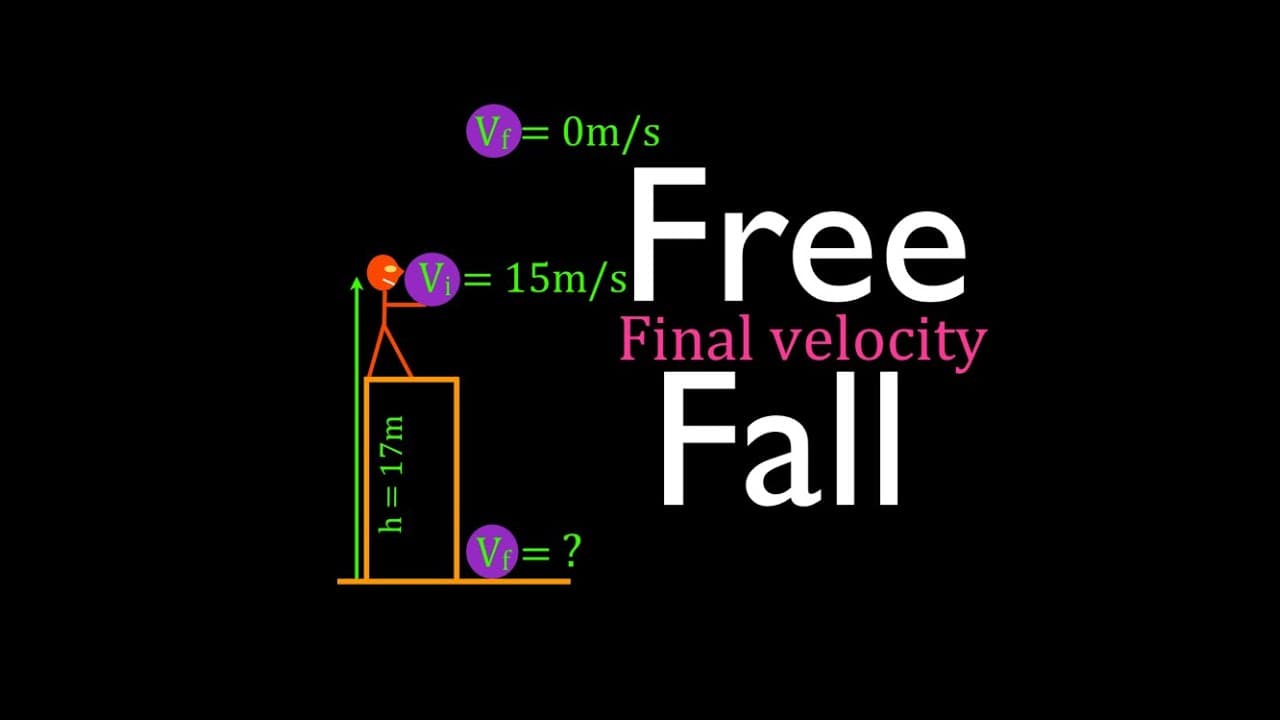
Determine final velocity of an object in freefall, involving kinematic equations and variables.
Transcript
okay in today's video we're gonna go over another problem involving freefall kinematics and this video is part three the final part of a three part series and in this video we're gonna find a final velocity when this object which is projected straight up comes straight back down the final velocity down here at the bottom in part one which you can l... Read More
Key Insights
- 💱 Understanding freefall kinematics involves considering variables like initial velocity, acceleration, and change in height.
- 🖐️ Sign conventions play a vital role in determining the direction of motion in freefall problems.
- 🗯️ Selecting the right kinematic equation based on known variables is crucial for accurate calculations.
- 🧑🏭 Calculation of final velocity in freefall scenarios requires careful consideration of all relevant factors.
- ❓ Kinematic equations offer a systematic approach to solving complex problems in physics.
- ❓ The final velocity of an object in freefall can be accurately determined using mathematical formulas.
- ❓ Practice and familiarity with kinematic equations are essential for mastering problems involving motion.
Install to Summarize YouTube Videos and Get Transcripts
Explore YouTube Video Summarizer or Get YouTube Transcript Extractor
Questions & Answers
Q: What is the key focus of this video on freefall kinematics?
This video centers on calculating the final velocity of an object in freefall after being projected straight up and falling back down.
Q: How are the kinematic variables used to determine the final velocity?
By utilizing known values like initial velocity, acceleration due to gravity, and change in position, the final velocity can be calculated using appropriate kinematic equations.
Q: Why is it crucial to keep track of signs in freefall kinematics problems?
Sign conventions are essential to correctly interpret the direction of motion, especially when dealing with negative changes in height and acceleration in the downward direction.
Q: What steps are involved in solving for the final velocity in this scenario?
The process includes selecting the appropriate kinematic equation, plugging in known values, maintaining sign consistency, and calculating the final velocity using mathematical operations.
Summary & Key Takeaways
-
Part three of the series focuses on finding the final velocity of an object projected straight up and falling back down.
-
Utilizes kinematic equations with known variables like initial velocity, acceleration, and change in height to solve for final velocity.
-
Final velocity is calculated to be 23.6 meters per second for an object projected at 15 meters per second.
Read in Other Languages (beta)
Share This Summary 📚
Summarize YouTube Videos and Get Video Transcripts with 1-Click
Try YouTube Summary with ChatGPT & Claude or YouTube Transcript Generator
Explore More Summaries from Step by Step Science 📚

Summarize YouTube Videos and Get Video Transcripts with 1-Click
Try YouTube Summary with ChatGPT & Claude or YouTube Transcript Generator