Leetcode 1722. Minimize Hamming Distance After Swap Operations
TL;DR
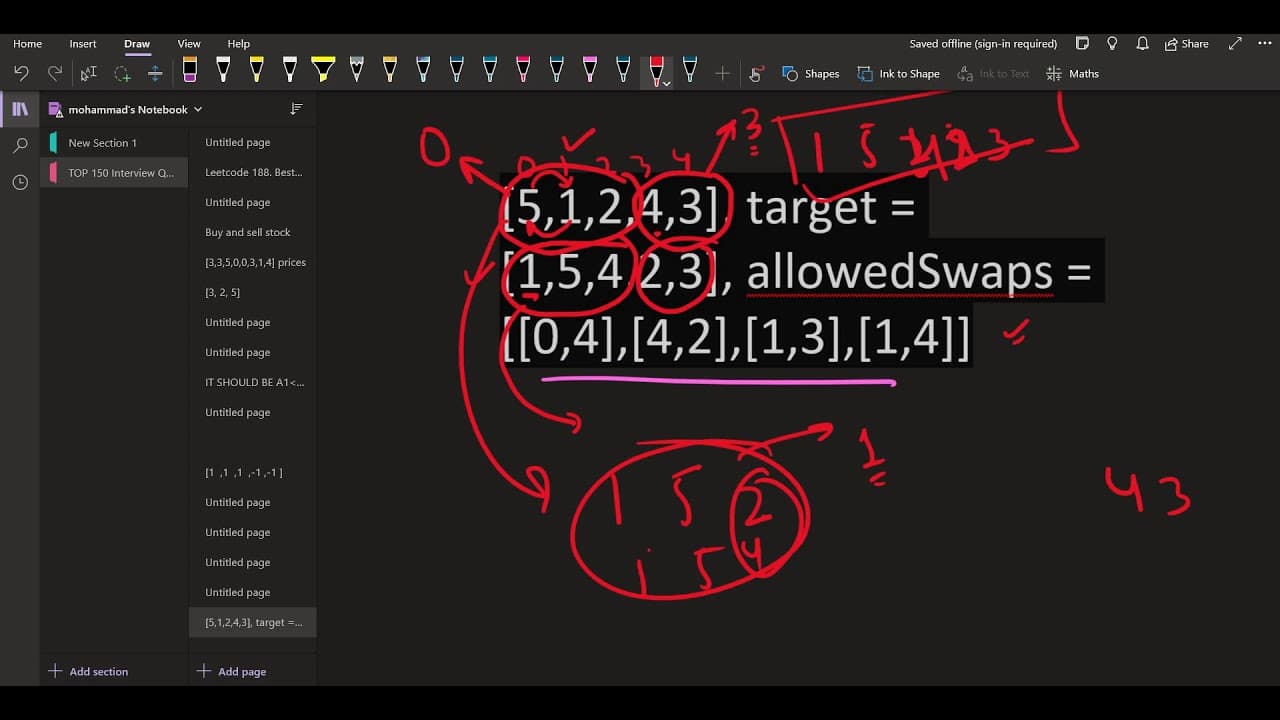
The video explains minimizing Hamming distance between two arrays using allowed swaps.
Transcript
hey there everyone welcome back to lead coding in this video we will be solving the question number three of lead code weekly contest 223 name of the problem is minimize having distance after swipe operations now in this problem we are given two arrays the source array and the target array and we are given another array swaps now each value of the ... Read More
Key Insights
- 🪡 The problem focuses on optimizing the validation of matching arrays by utilizing flexible swaps, which heightens the need for a structured approach.
- 🛟 Understanding the concept of Hamming distance is pivotal, as it serves as the basis for evaluating how closely two arrays correspond.
- 🫰 Efficient data structuring, like using a DSU, is crucial for grouping and managing the dynamic interactions between indices for falling within specified constraints.
- 👻 Iterating through connected components allows for greater flexibility in rearranging elements to minimize differences, demonstrating strategic problem-solving in algorithms.
- 👣 The algorithm primarily relies on mapping occurrences of values from source and target arrays to track mismatches effectively.
- 🫰 The video emphasizes the importance of visualizing swaps and unions to grasp how indices can interchange their values seamlessly during the optimization process.
- ❓ This algorithm exemplifies the broader principles of combinatorial optimization often used in competitive programming scenarios.
Install to Summarize YouTube Videos and Get Transcripts
Explore YouTube Video Summarizer or Get YouTube Transcript Extractor
Questions & Answers
Q: What is the main objective of the problem discussed in the video?
The primary objective is to minimize the Hamming distance between a source array and a target array by performing specific index swaps as defined in the problem. This requires carefully analyzing how values can be shuffled among indices to achieve alignment with the target array, thus minimizing any differences.
Q: How does the Disjoint Set Union (DSU) data structure aid in solving the problem?
The DSU allows us to efficiently manage and group indices that can be swapped based on the provided swaps. By utilizing DSU, we can easily identify connected components or unions of indices, enabling the values within these groups to rotate freely. This facilitates the process of achieving the optimal arrangement necessary for minimizing the Hamming distance.
Q: Can you explain the approach used to count differences after forming unions?
To count differences in each union, the algorithm first records the occurrences of values in both the source and target arrays. After building the mappings, the algorithm compares these counts to compute the differences. By summing the absolute differences divided by two, the total number of mismatches in values across combined indices is calculated, revealing the effective Hamming distance.
Q: What is the time complexity of the solution presented in the video?
The video encourages viewers to consider the time complexity strategically, hinting that it relates to the number of swaps being processed and the union operations linked with them. While exact complexity isn’t provided, it prompts the audience to think critically about how multiple union operations could accumulate in terms of processing time.
Summary & Key Takeaways
-
The problem involves minimizing the Hamming distance between a source array and a target array through a series of allowed index swaps.
-
Viewers learn how to connect indices through swaps using a data structure known as Disjoint Set Union (DSU) to find groups and perform optimized value rotations.
-
The code implementation showcases how to count differences in group values effectively by using a map while manipulating the unions formed by respective swaps.
Read in Other Languages (beta)
Share This Summary 📚
Summarize YouTube Videos and Get Video Transcripts with 1-Click
Try YouTube Summary with ChatGPT & Claude or YouTube Transcript Generator
Explore More Summaries from Fraz 📚


Summarize YouTube Videos and Get Video Transcripts with 1-Click
Try YouTube Summary with ChatGPT & Claude or YouTube Transcript Generator