Ancient Greeks and Persians | World History | Khan Academy
TL;DR
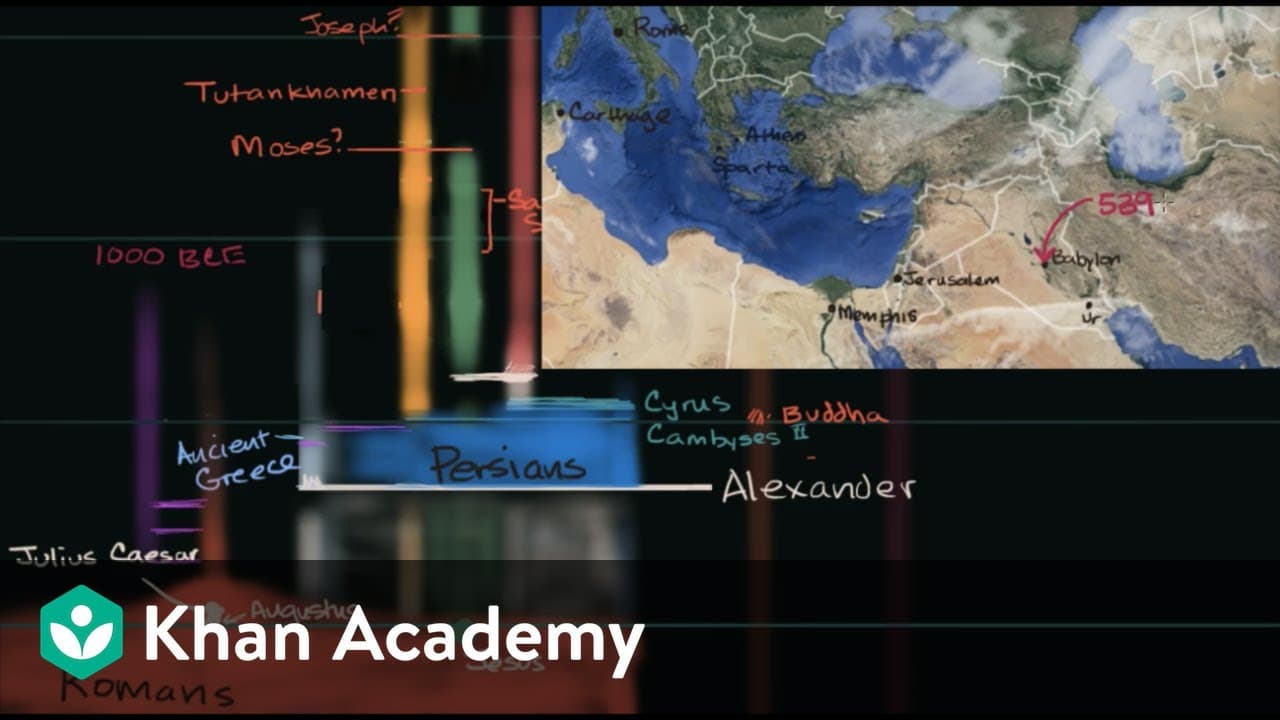
The Persians establish a vast empire, but fail to conquer the Ancient Greeks, leading to the rise of Alexander the Great and the eventual split of his empire.
Transcript
- [Narrator] So where we left off in the last video, we have the Neo-Babylonians, the Chaldean Empire, being conquered by the Persians led by Cyrus the Great. That's in 539 that Cyrus the Great conquers Babylon. And they're able to establish a significant empire. And his successor, Cambyses II, in 525 B.C.E., is able to do something that many of th... Read More
Key Insights
- 🇪🇬 The Persians, under Cyrus the Great and Cambyses II, expanded their empire by conquering Babylon and Egypt.
- ❓ The Ancient Greeks, although not unified, displayed remarkable resistance against Persian conquest.
- 🇬🇷 Philip of Macedon seized the opportunity during the Greek conflicts and conquered most of Greece.
- 💀 Alexander the Great, Philip's son, continued his father's conquests and established an impressive empire that stretched from Greece to India.
- 🥺 Alexander's empire was short-lived after his death, leading to the division of his empire among his generals.
Install to Summarize YouTube Videos and Get Transcripts
Explore YouTube Video Summarizer or Get YouTube Transcript Extractor
Questions & Answers
Q: How did the Persian Empire expand its territory under Cyrus the Great and Cambyses II?
Cyrus the Great conquered the Neo-Babylonian Empire, liberating the Jewish people, while his successor Cambyses II successfully conquered Egypt, adding it to the Persian Empire.
Q: What were the Greco-Persian Wars, and what were some famous events from this conflict?
The Greco-Persian Wars were a series of wars between the Persians and the Ancient Greeks from 499 B.C.E. to 450 B.C.E. One famous event is the Battle of Thermopylae, where 300 Spartans faced a massive Persian army.
Q: Why were the city-states of Greece unable to remain unified?
Despite successfully defending against the Persians, the Greek city-states started fighting each other, leading to the Peloponnesian War between Sparta and Athens.
Q: Who succeeded Philip of Macedon and how did he expand his empire?
Alexander the Great, Philip's son, took over and quickly consolidated power over Greece. He then went on to conquer much of the Persian Empire, including Egypt, the Middle East, and parts of India.
Summary & Key Takeaways
-
The Persian Empire, led by Cyrus the Great and his successor Cambyses II, conquers Neo-Babylonia and Egypt, expanding their empire significantly.
-
The Persians face resistance from the Ancient Greeks, who, despite being a group of city-states, successfully fend off multiple conquest attempts.
-
After the Greeks start fighting amongst themselves in the Peloponnesian War, Philip of Macedon takes advantage and conquers most of Greece. His son, Alexander the Great, becomes a legendary figure as he expands his empire and defeats the Persians.
Read in Other Languages (beta)
Share This Summary 📚
Summarize YouTube Videos and Get Video Transcripts with 1-Click
Try YouTube Summary with ChatGPT & Claude or YouTube Transcript Generator
Explore More Summaries from Khan Academy 📚



Summarize YouTube Videos and Get Video Transcripts with 1-Click
Try YouTube Summary with ChatGPT & Claude or YouTube Transcript Generator