Calculating internal energy and work example | Chemistry | Khan Academy
TL;DR
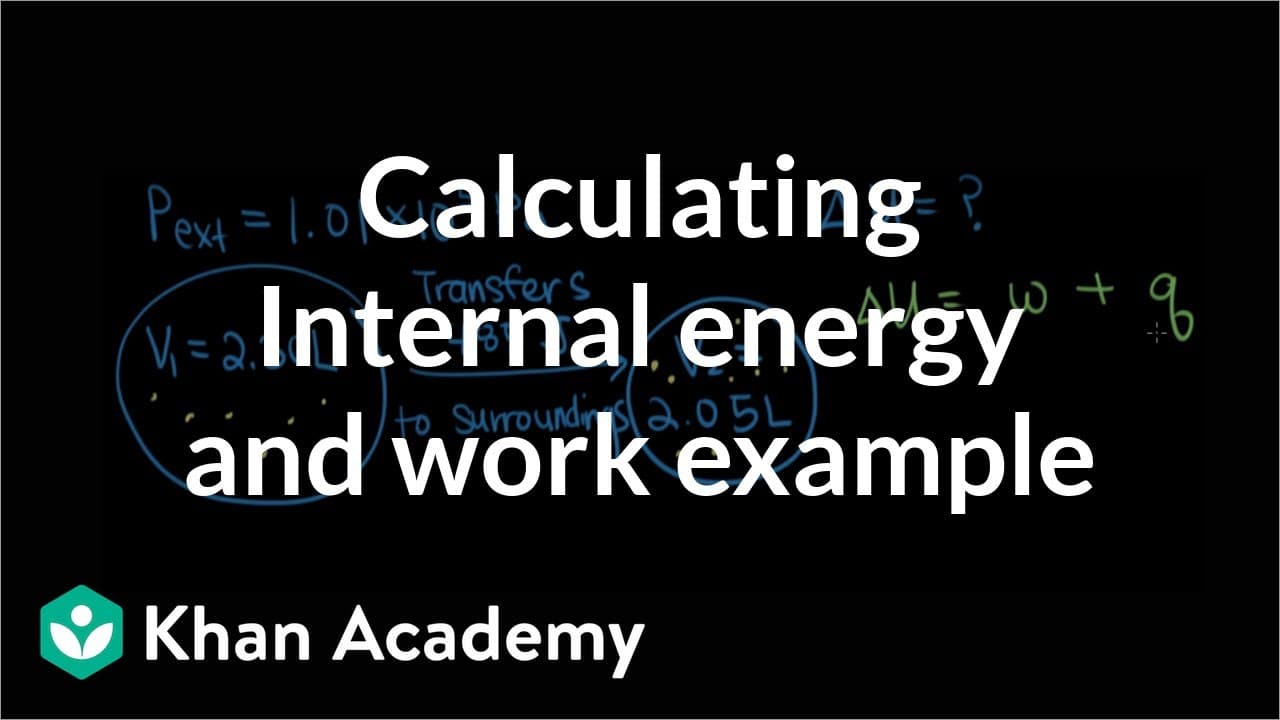
Calculating the change in internal energy and pressure-volume work for a balloon of argon gas transferring heat and changing volume.
Transcript
- [Voiceover] In this video we're gonna do an example problem, where we calculate in internal energy and also calculate pressure volume work. So, we know the external pressure is 1.01 times ten to the 5th pascal, and our system is some balloon, let's say it's a balloon of argon gas, and initially our gas has a volume of 2.3 liters, and then it tran... Read More
Key Insights
- 🥵 The first law of thermodynamics relates the change in internal energy of a system to the work done and heat transfer.
- 🥵 In this example, negative heat transfer indicates energy being transferred from the system to the surroundings.
- 💦 Positive work done suggests that the surroundings did work on the system, increasing the internal energy of the system.
- 🤘 Careful consideration of signs and unit conversions is necessary to ensure accurate calculations in thermodynamic problems.
- 💱 The change in internal energy for the given process is determined to be negative 460 joules.
- 🥵 It is crucial to check the signs of work and heat and ensure that all units match in thermodynamic calculations.
- 💦 The calculation of work involves multiplying the external pressure by the change in volume.
- 🤒 Converting units, such as liters to meters cubed, allows for consistency and compatibility in equations involving different quantities.
Install to Summarize YouTube Videos and Get Transcripts
Explore YouTube Video Summarizer or Get YouTube Transcript Extractor
Questions & Answers
Q: What is the first law of thermodynamics?
The first law of thermodynamics is an energy conservation principle stating that the change in internal energy of a system is equal to the work done on or by the system plus the heat transfer.
Q: Why is the heat transfer (Q) negative in this example?
The heat transfer is negative because the system transfers energy to the surroundings, resulting in a decrease in the system's internal energy.
Q: How is the work done (W) calculated in this example?
The work done is calculated as the product of the external pressure and the change in volume. In this case, it is 1.01 times 10 to the 5th pascals multiplied by the change in volume (2.05 liters - 2.30 liters).
Q: Why is it important to convert units in this problem?
Converting units ensures that all the quantities used in the calculation have the same units (joules in this case), allowing for accurate addition or subtraction. In this example, liters are converted to meters cubed to match the units of pascals.
Summary & Key Takeaways
-
The system is a balloon of argon gas that initially has a volume of 2.3 liters and transfers 485 joules of energy as heat to the surroundings.
-
The final volume of the system is 2.05 liters, and the moles of gas remain unchanged.
-
The first law of thermodynamics is used to calculate the change in internal energy (delta U) by considering the work done and the heat transfer.
Read in Other Languages (beta)
Share This Summary 📚
Summarize YouTube Videos and Get Video Transcripts with 1-Click
Try YouTube Summary with ChatGPT & Claude or YouTube Transcript Generator
Explore More Summaries from Khan Academy 📚



Summarize YouTube Videos and Get Video Transcripts with 1-Click
Try YouTube Summary with ChatGPT & Claude or YouTube Transcript Generator