Judging outliers in a dataset | Summarizing quantitative data | AP Statistics | Khan Academy
TL;DR
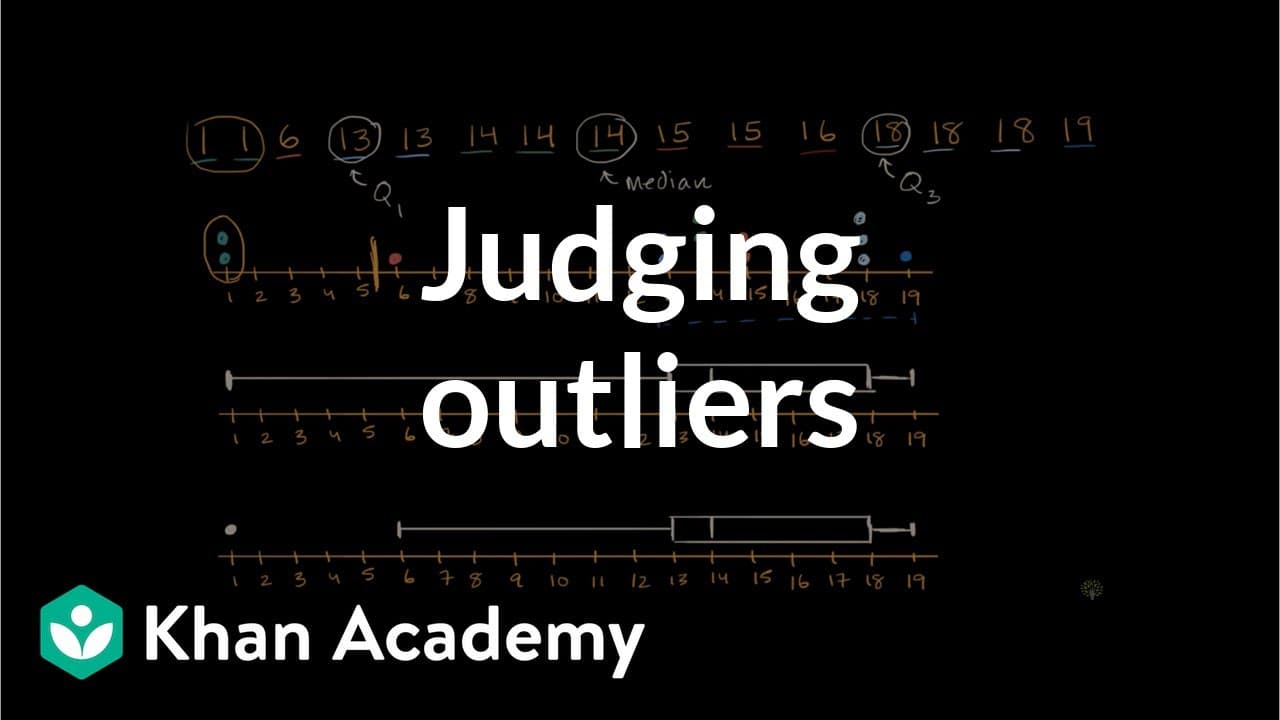
Learn how to identify and analyze outliers in a dataset, and how to draw a box-and-whiskers plot including or excluding outliers.
Transcript
- [Instructor] We have a list of 15 numbers here, and what I want to do is think about the outliers. And to help us with that, let's actually visualize this, the distribution of actual numbers. So let us do that. So here, on a number line, I have all the numbers from one to 19. And let's see, we have two ones. So I could say that's one one and then... Read More
Key Insights
- #️⃣ Outliers can be visually identified by examining the distribution of numbers on a number line.
- 😒 Statisticians use a rule that defines outliers as anything more than 1.5 times the interquartile range outside Q1 and Q3.
- 🧡 The interquartile range provides a measure of the spread of the middle 50% of the data.
- 🍱 Drawing a box-and-whiskers plot can represent the central tendency and spread of the data, either including or excluding outliers.
- 👻 Having a numerical definition for outliers allows for a standardized approach to their identification and interpretation.
- ❓ Outliers can impact data analysis and should be carefully considered in statistical studies.
- 😫 Box-and-whiskers plots are useful tools for visualizing and comparing data sets.
Install to Summarize YouTube Videos and Get Transcripts
Explore YouTube Video Summarizer or Get YouTube Transcript Extractor
Questions & Answers
Q: How can outliers be identified visually in a dataset?
Outliers can be identified visually by examining the distribution of numbers on a number line. Numbers that are significantly further away from the main concentration of data points can be considered outliers.
Q: What is the purpose of having a numerical definition for outliers?
A numerical definition for outliers provides a standardized method of identifying them, removing subjectivity from the analysis. It helps in understanding the distribution of data and identifying extreme values.
Q: How is the interquartile range calculated?
The interquartile range is calculated by subtracting Q1 (the lower quartile) from Q3 (the upper quartile). It provides a measure of the spread of the middle 50% of the data.
Q: How is a box-and-whiskers plot drawn and what does it represent?
A box-and-whiskers plot is drawn using the median, Q1, and Q3 to represent the central tendency and spread of the data. The box represents the interquartile range, and the whiskers extend to the minimum and maximum values.
Summary & Key Takeaways
-
The content discusses how to identify outliers in a dataset using a visual distribution and a statistical rule.
-
The video explains how to calculate the median, Q1, Q3, and the interquartile range.
-
It demonstrates how to draw a box-and-whiskers plot including or excluding outliers to represent the data.
Read in Other Languages (beta)
Share This Summary 📚
Summarize YouTube Videos and Get Video Transcripts with 1-Click
Try YouTube Summary with ChatGPT & Claude or YouTube Transcript Generator
Explore More Summaries from Khan Academy 📚



Summarize YouTube Videos and Get Video Transcripts with 1-Click
Try YouTube Summary with ChatGPT & Claude or YouTube Transcript Generator