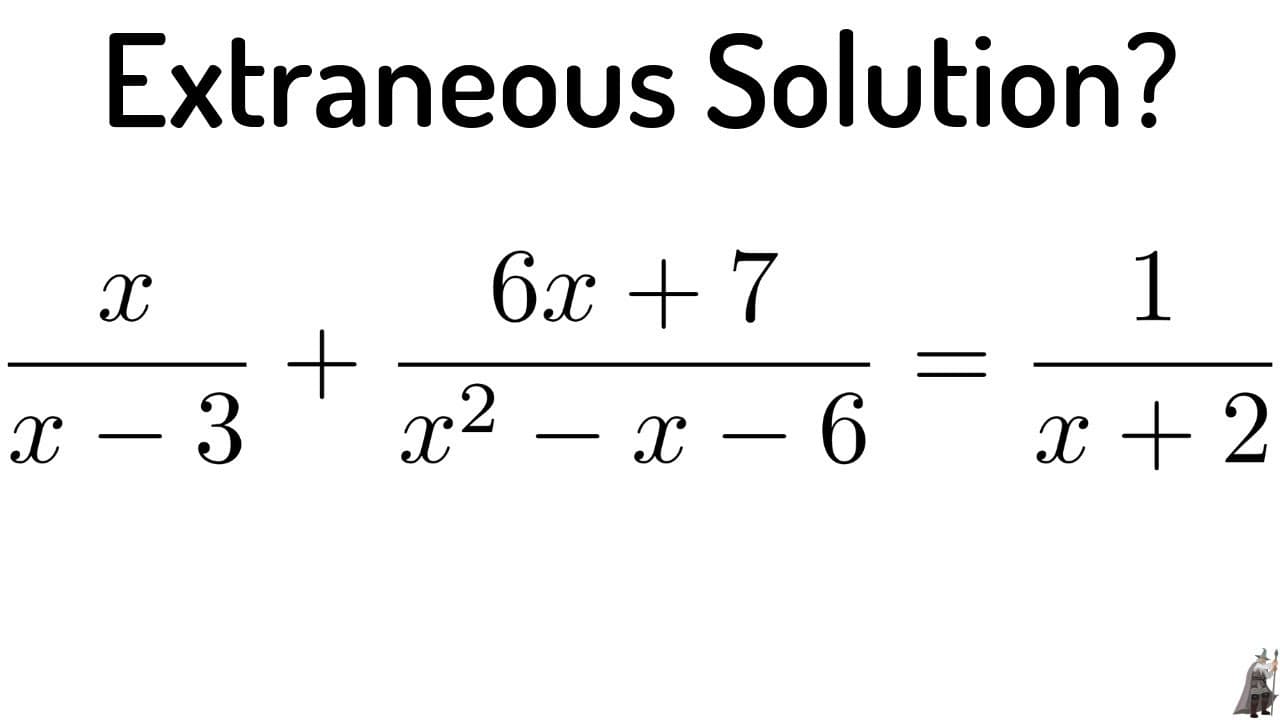
#2. Extraneous Solution to the Rational Equation x/(x - 3) + (6x + 7)/(x^2 - x - 6) = 1/(x + 2)
TL;DR
This video explains how to solve a rational equation, identify extraneous solutions, and provides step-by-step examples.
Transcript
problem number two what would be the extraneous solution that you would obtain when you solve the given equation so we have a rational equation and we're asked for the extraneous solution let's go ahead and write it down so we have x over X -3 plus 6x plus 7 over now this quadratic here x squared minus X minus 6 this should factor and it should alw... Read More
Key Insights
- ❓ Rational equations involve variables in the denominator, requiring careful consideration of potential extraneous solutions.
- 😑 The process of solving rational equations often involves factoring a quadratic equation to simplify the expression.
- ✅ Checking the obtained solutions is crucial to identify any solutions that may not satisfy the original equation.
- 🥺 Extraneous solutions can lead to divisions by zero and are usually identified by substitution and verification.
- 😫 Setting the equation equal to zero and factoring it helps simplify the equation before solving for the variable.
- 🥺 Extraneous solutions can occur when factors of the equation lead to denominators equaling zero.
- ✅ It is essential to solve rational equations systematically by simplifying, factoring, and checking the obtained solutions.
Install to Summarize YouTube Videos and Get Transcripts
Explore YouTube Video Summarizer or Get YouTube Transcript Extractor
Questions & Answers
Q: What is an extraneous solution in the context of solving rational equations?
An extraneous solution is an answer that does not satisfy the original equation when plugged back into it. It often arises when solving rational equations involving variables in the denominator.
Q: How do you identify extraneous solutions in a rational equation?
To identify extraneous solutions, you solve the equation as usual, obtain potential solutions, and then substitute them back into the original equation. If a solution results in a denominator of zero, it is considered extraneous.
Q: What are the steps involved in solving a rational equation?
The steps include factoring the quadratic equation in the rational expression, setting the equation equal to zero, solving for the variable, and checking the obtained solutions for extraneous solutions.
Q: Why do we need to check our answers in solving rational equations?
Checking the obtained solutions is necessary because it helps identify any extraneous solutions that may have been introduced during the solving process. It ensures that the final answers are valid.
Summary & Key Takeaways
-
The video focuses on solving rational equations and specifically addresses the identification of extraneous solutions.
-
The process involves factoring the quadratic equation in the rational expression, solving for the variable, and checking the obtained solutions.
-
Two numbers, in this case 3 and -2, are found to be extraneous solutions because they result in a denominator of zero.
Read in Other Languages (beta)
Share This Summary 📚
Summarize YouTube Videos and Get Video Transcripts with 1-Click
Try YouTube Summary with ChatGPT & Claude or YouTube Transcript Generator
Explore More Summaries from The Math Sorcerer 📚

Summarize YouTube Videos and Get Video Transcripts with 1-Click
Try YouTube Summary with ChatGPT & Claude or YouTube Transcript Generator