Machine Learning Fundamentals: Bias and Variance
TL;DR
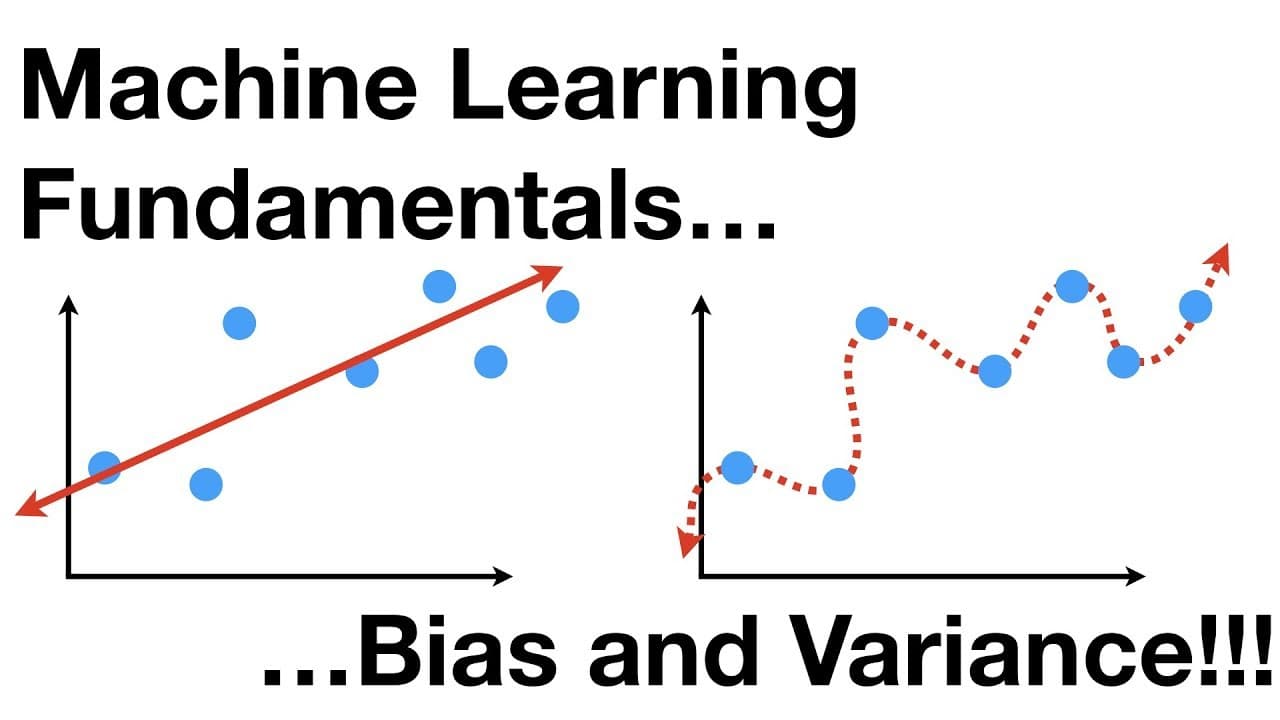
This video explains the concepts of bias and variance in machine learning, using the example of predicting mouse height based on weight.
Transcript
Hurricane Florence came by while I was working on stat quest dark clouds filled the sky but that didn't stop stat quest stand quest hello I'm Josh stormer and welcome to stat quest today we're going to be talking about some machine learning fundamentals bias and variance and they're gonna be clearly explained imagine we measured the weight and heig... Read More
Key Insights
- 🌀 Bias and variance are two important concepts in machine learning. Bias refers to the inability of a model to capture the true relationship between variables, while variance refers to the model's sensitivity to different data sets.
- 💡 Linear regression, a machine learning method, represents a straight line on a graph. It has a relatively large amount of bias because it cannot capture curved relationships between variables.
- 📊 Another machine learning method, represented by a squiggly line, is more flexible and can adapt to curved relationships. It has low bias but high variability, making it difficult to predict how well it will perform with different data sets.
- ♀️ The performance of these models is evaluated by calculating the sums of squares, which measure the distances between the fit lines and the data points. The squiggly line fits the training set better, but the straight line fits the testing set better.
- 🎯 The difference in fits between training and testing sets is known as variance. The squiggly line has high variance, while the straight line has relatively low variance.
- 🔀 Regularization, boosting, and bagging are three commonly used methods for finding the sweet spot between a simple and complex model. They help to balance bias and variance and improve the model's predictive accuracy.
- 🔓 Overfitting occurs when a model fits the training set too well but performs poorly on the testing set. Finding the right balance is crucial to prevent overfitting.
- 🎶 If you enjoyed this StatQuest, consider subscribing for more content. Supporting StatQuest can be done by purchasing original songs. Regularization and boosting will be covered in future StatQuests. Stay tuned!
Install to Summarize YouTube Videos and Get Transcripts
Explore YouTube Video Summarizer or Get YouTube Transcript Extractor
Questions & Answers
Q: What is bias in machine learning?
Bias in machine learning refers to the inability of a learning algorithm to capture the true relationship between variables, resulting in a relatively large amount of error.
Q: What is variance in machine learning?
Variance in machine learning refers to the fluctuations in the algorithm's performance when applied to different datasets, indicating the algorithm's sensitivity to changes in the data.
Q: How does linear regression relate to bias and variance?
Linear regression, as a simple model, has relatively high bias as it cannot capture complex relationships, but it has low variance as it produces consistent predictions across different datasets.
Q: What is the problem with an overfit model in machine learning?
An overfit model fits the training set very well, but it performs poorly on the testing set, indicating a lack of generalization. It has low bias but high variance, making it inconsistent with future data.
Q: What are some methods for finding the balance between bias and variance?
Regularization, boosting, and bagging are commonly used methods to find the sweet spot between simple and complicated models, aiming to reduce both bias and variance.
Q: Why is it important to understand bias and variance in machine learning?
Understanding bias and variance helps in developing appropriate models that generalize well, making accurate predictions on new, unseen data. It allows for better model selection and performance optimization.
Summary & Key Takeaways
-
The video discusses the concept of bias in machine learning, using linear regression as an example.
-
It then introduces the concept of variance, and how it relates to the flexibility of machine learning algorithms.
-
The video concludes by mentioning regularization, boosting, and bagging as methods to find the optimal balance between bias and variance.
Read in Other Languages (beta)
Share This Summary 📚
Summarize YouTube Videos and Get Video Transcripts with 1-Click
Try YouTube Summary with ChatGPT & Claude or YouTube Transcript Generator
Explore More Summaries from StatQuest with Josh Starmer 📚

Summarize YouTube Videos and Get Video Transcripts with 1-Click
Try YouTube Summary with ChatGPT & Claude or YouTube Transcript Generator