2.5 Gravitational Attraction - The Nature of Code
TL;DR
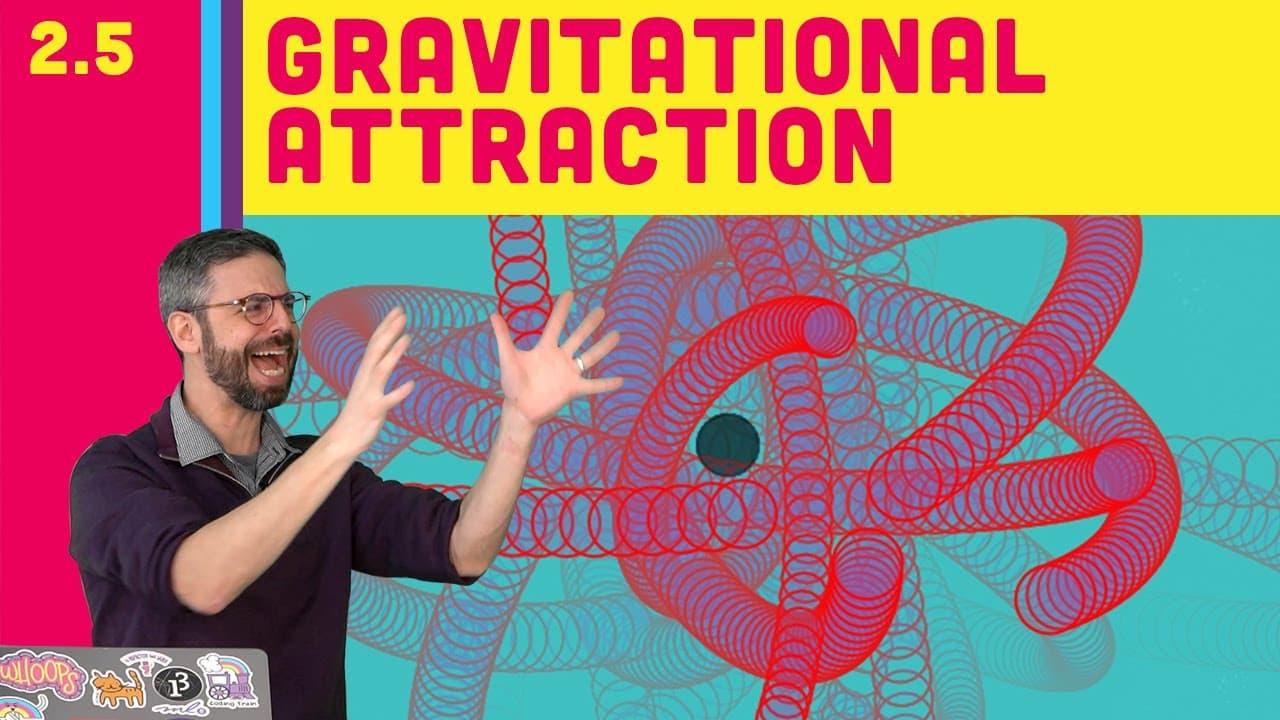
The video demonstrates how to create a P5JS sketch that implements Newton's Law of Universal Gravitation by using an attractor object to exert gravitational force on a mover object.
Transcript
[CHIME] It is time for Newton's law of universal gravitation. So this is the final example that I will be demonstrating as part of chapter 2, although the concept of forces and how they are applied permeate throughout the rest of the videos that I intend to make. But I'm going to wrap up this chapter by looking at the equation for universal gravita... Read More
Key Insights
- ❓ Newton's Law of Universal Gravitation describes the gravitational attraction between objects in the universe.
- ❓ In a P5JS sketch, an attractor object can be used to exert gravitational force on a mover object.
- ❓ The gravitational force is determined by the masses of the objects, the distance between them, and the universal gravitational constant.
- 👻 The implemention of the law in the sketch allows for the exploration of various scenarios, such as multiple attractors and repulsion forces.
- 👥 The P5JS sketch can be further modified to implement group behavior and simulate interactions between multiple objects in a gravitational field.
- ❓ The visual representation of the sketch provides insights into the motion and behavior of objects under the influence of gravitational forces.
- 💆 Tinkering with parameters such as mass, distance, and strength can result in different outcomes and create various visual patterns.
Install to Summarize YouTube Videos and Get Transcripts
Explore YouTube Video Summarizer or Get YouTube Transcript Extractor
Questions & Answers
Q: What is Newton's Law of Universal Gravitation?
Newton's Law of Universal Gravitation states that every object in the universe attracts every other object with a force that is proportional to their masses and inversely proportional to the square of the distance between them.
Q: How is the gravitational force implemented in a P5JS sketch?
In the P5JS sketch, an attractor object is created, which exerts a gravitational force on a mover object. The force is calculated using the formula: force = (mass1 * mass2 * G) / (distance^2), where mass1 and mass2 are the masses of the two objects, G is the universal gravitational constant, and distance is the distance between the centers of the objects. The force is then applied to the mover object.
Q: What is the purpose of the attractor object in the sketch?
The attractor object acts as a fixed entity that attracts other objects towards it. It cannot move or experience forces itself, but it exerts a gravitational force on the mover object, pulling it towards the attractor.
Q: How can the sketch be modified to create repulsion forces instead of attraction forces?
To create repulsion forces, the direction of the force vector can be reversed. This can be done by multiplying the force by -1. This change will cause the mover object to be repelled instead of attracted to the attractor object.
Summary & Key Takeaways
-
The video introduces Newton's Law of Universal Gravitation, which states that every object in the universe attracts every other object with a force proportional to their masses and inversely proportional to the square of the distance between them.
-
The video demonstrates how to create an implementation of this law in a P5JS sketch. It introduces the concepts of an attractor object and a mover object, with the mover experiencing a gravitational force towards the attractor.
-
The video explains the formula used to calculate the gravitational force, which includes the masses of the objects, the distance between them, and the universal gravitational constant.
Read in Other Languages (beta)
Share This Summary 📚
Summarize YouTube Videos and Get Video Transcripts with 1-Click
Try YouTube Summary with ChatGPT & Claude or YouTube Transcript Generator
Explore More Summaries from The Coding Train 📚




Summarize YouTube Videos and Get Video Transcripts with 1-Click
Try YouTube Summary with ChatGPT & Claude or YouTube Transcript Generator