Products
Features
YouTube Video Summarizer
Summarize YouTube videos
Web & PDF Highlighter
Highlight web pages & PDFs
Chat with PDF
Ask any PDF questions with AI
Ask AI Clone
Chat with your highlights & memories
Audio Transcriber
Transcribe audio files to text
Glasp Reader
Read and highlight articles
Kindle Highlight Export
Export your Kindle highlights
Idea Hatch
Hatch ideas from your highlights
Integrations
Obsidian Plugin
Notion Integration
Pocket Integration
Instapaper Integration
Medium Integration
Readwise Integration
Snipd Integration
Hypothesis Integration
Apps & Extensions
Chrome Extension
Safari Extension
Edge Add-ons
Firefox Add-ons
iOS App
Android App
Discover
Discover
Ideas
Discover new ideas and insights
Articles
Curated articles and insights
Books
Book recommendations by great minds
Posts
Essays and notes from readers
Quotes
Inspiring quotes collection
Videos
Curated videos and summaries
Explore Glasp
Glasp Newsletter
Weekly insights and updates
Glasp Talk
Interview series with great minds
Glasp Blog
Latest news and articles
Glasp Use Cases
Learn how others use Glasp
Build & Support
Glasp API
Access Glasp's API for developers
MCP Connector
Connect Glasp to Claude & ChatGPT
Community
Glasp Reddit Community
Students
Student discount and benefits
FAQs
Frequently Asked Questions
AboutPricing
DashboardLog inSign up

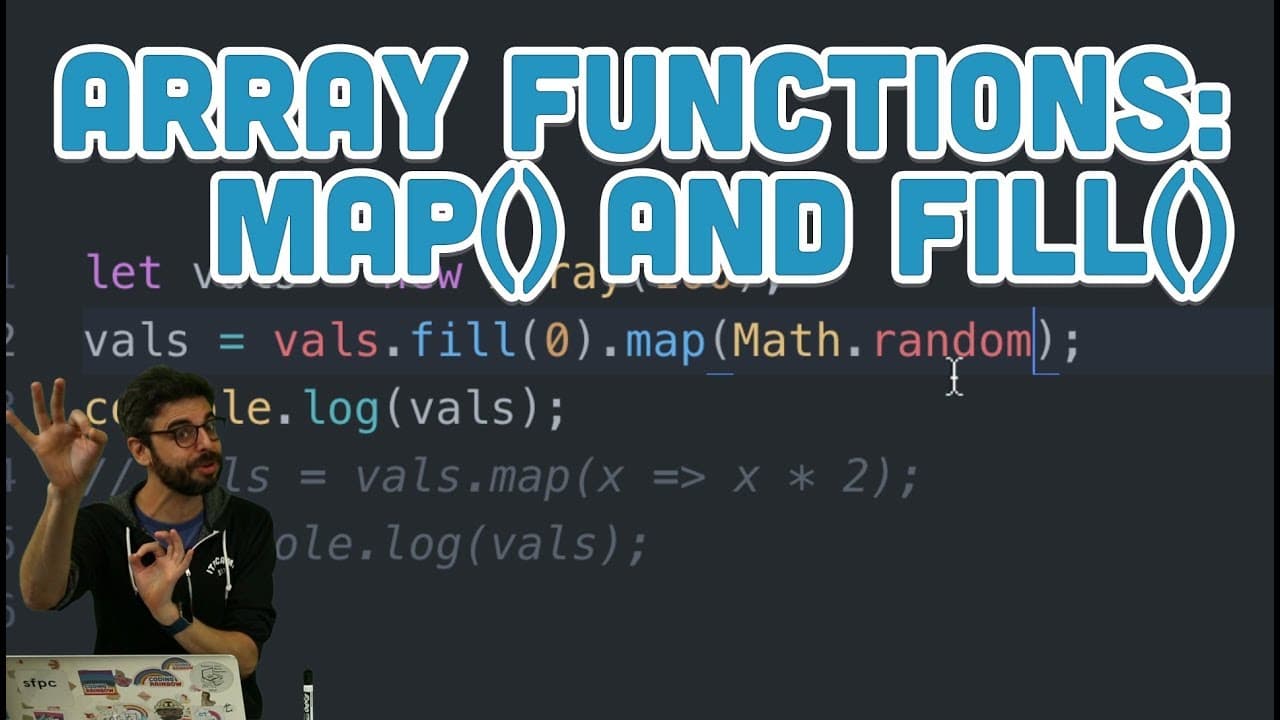
16.6: Array Functions: map() and fill() - Topics of JavaScript/ES6
113.7K views
•
February 20, 2018
by
The Coding Train
YouTube video player
16.6: Array Functions: map() and fill() - Topics of JavaScript/ES6

TL;DR

Higher-order functions in JavaScript allow you to manipulate arrays as a whole, performing operations like mapping and filling.

Transcript

welcome back baby or welcome for the first time who knows this video now I am going to talk about these higher-order functions it's really just kind of me like trying to sound smart make it son fancy these are just functions that it can call on arrays in JavaScript so you might really think of an array as like oh alright it's a list of stuff it's a... Read More

Key Insights

  • 👻 Higher-order functions in JavaScript allow for easy manipulation of arrays without the need for explicit loops.
  • 👶 The map function applies a function to each element of an array, creating a new array with the modified values.
  • ❓ The fill function is used to fill an array with specific values or values generated by a function.
  • 🧡 JavaScript's array object provides a range of built-in higher-order functions that can be used for efficient array manipulation.
  • ✋ Higher-order functions can improve code readability and simplify complex array operations.
  • 👶 It's important to understand the difference between functions that create a new array (like map) and functions that modify the original array (like fill).
  • ✋ Higher-order functions can be combined and chained to perform more complex operations on arrays.

Install to Summarize YouTube Videos and Get Transcripts

Explore YouTube Video Summarizer or Get YouTube Transcript Extractor

Questions & Answers

Q: What are higher-order functions in JavaScript?

Higher-order functions are functions that can be called on arrays in JavaScript, allowing for manipulation of the array as a whole.

Q: How does the map function work?

The map function in JavaScript applies a provided function to each element of an array and returns a new array with the modified values.

Q: Does the map function modify the original array?

No, the map function does not change the values in the original array. It creates a new array with the modified values.

Q: What does the fill function do?

The fill function in JavaScript fills an array with specified values, either a single value or based on a provided function.

Summary & Key Takeaways

  • Higher-order functions in JavaScript allow you to apply a function to every element of an array, creating a new array with the modified values.

  • The map function applies a function to each element of an array and returns a new array with the modified values.

  • The fill function fills an array with specific values, either a single value or based on a provided function.


Read in Other Languages (beta)

English

Share This Summary 📚

Summarize YouTube Videos and Get Video Transcripts with 1-Click

Download browser extensions on:

Try YouTube Summary with ChatGPT & Claude or YouTube Transcript Generator

Explore More Summaries from The Coding Train 📚

Coding Challenge #126: Toothpicks thumbnail
Coding Challenge #126: Toothpicks
The Coding Train
ITP/IMA Winter Show 2019 thumbnail
ITP/IMA Winter Show 2019
The Coding Train
Text Generation using Spell with Nabil Hassein thumbnail
Text Generation using Spell with Nabil Hassein
The Coding Train
ITP/IMA Winter Show 2018 thumbnail
ITP/IMA Winter Show 2018
The Coding Train
9.4: Genetic Algorithm: Looking at Code - The Nature of Code thumbnail
9.4: Genetic Algorithm: Looking at Code - The Nature of Code
The Coding Train
Coding Challenge #116: Lissajous Curve Table thumbnail
Coding Challenge #116: Lissajous Curve Table
The Coding Train

Summarize YouTube Videos and Get Video Transcripts with 1-Click

Download browser extensions on:

Try YouTube Summary with ChatGPT & Claude or YouTube Transcript Generator

Apps & Extensions

  • Chrome Extension
  • Safari Extension
  • Edge Add-ons
  • Firefox Add-ons
  • iOS App
  • Android App

Key Features

  • YouTube Video Summarizer
  • Web & PDF Summarizer
  • Web & PDF Highlighter
  • Chat with PDF
  • Ask AI Clone
  • Audio Transcriber
  • Glasp Reader
  • Kindle Highlight Export
  • Idea Hatch

Integrations

  • Obsidian Plugin
  • Notion Integration
  • Pocket Integration
  • Instapaper Integration
  • Medium Integration
  • Readwise Integration
  • Snipd Integration
  • Hypothesis Integration

More Features

  • APIs
  • MCP Connector
  • Blog & Post
  • Embed Links
  • Image Highlight
  • Personality Test
  • Quote Shots

Company

  • About us
  • Blog
  • Community
  • FAQs
  • Job Board
  • Newsletter
  • Pricing
Terms

•

Privacy

•

Guidelines

© 2026 Glasp Inc. All rights reserved.