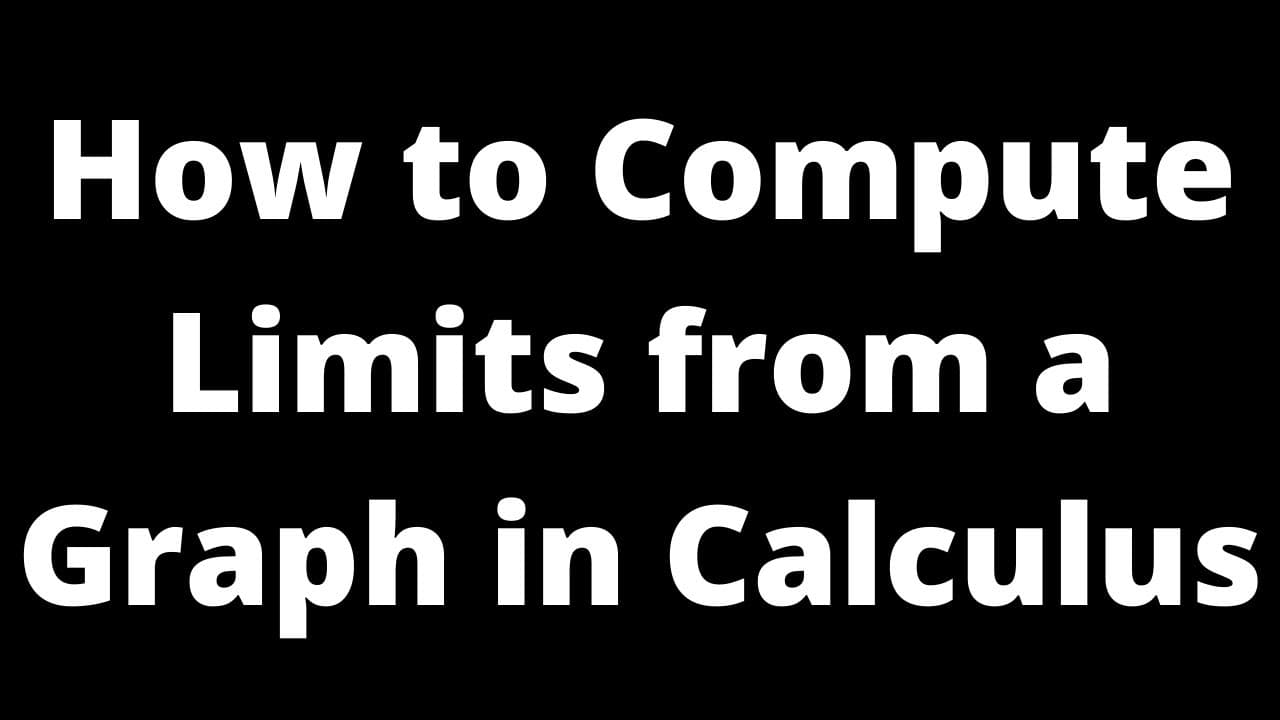
How to Compute Limits from a Graph in Calculus
TL;DR
This video explains how to compute the limit of a function as X approaches zero and introduces the concept of one-sided limits.
Transcript
compute the limit of f of X as X approaches zero as X approaches zero so we want the limit of f of X as X approaches zero so this is tough because I mean it's easy but it's tough because it's tough if you don't get it because there's no work to show so basically X is getting close to zero so when X gets close to zero let's say we have to go from th... Read More
Key Insights
- 😚 Limits in calculus involve determining the value a function approaches as a variable gets close to a specific point.
- ⛔ One-sided limits are used when approaching a limit from either the left or the right side of the variable.
- 😥 When computing limits, focus on the behavior of the function when the variable is close to the specific point rather than the exact value at that point.
- ↔️ If the values of the function approach different numbers from the left and right sides, the limit does not exist.
- 😥 Holes in the graph of a function indicate points where the function is undefined.
Install to Summarize YouTube Videos and Get Transcripts
Explore YouTube Video Summarizer or Get YouTube Transcript Extractor
Questions & Answers
Q: How do you compute the limit of a function as X approaches zero?
To compute the limit, consider the values of the function when X gets close to zero from both the left and right sides. The limit is the same from both sides if the values approach the same number, otherwise, the limit does not exist.
Q: What does one-sided limits indicate?
One-sided limits indicate approaching the limit from either the left or the right side. The minus sign is used to indicate the left side, and the plus sign is used to indicate the right side.
Q: What does it mean if the limit from the left is different from the limit from the right?
If the values of the function approach different numbers from the left and right sides, the limit of the function as X approaches zero does not exist.
Q: How do you interpret a hole in the graph of a function?
When there is a hole in the graph of a function, it indicates that the function is undefined at that specific point. This can be represented by the notation DNA (does not exist) or by leaving the value blank.
Summary & Key Takeaways
-
The video discusses how to compute the limit of a function as X approaches zero by considering the values of the function from the left and right sides.
-
The concept of one-sided limits is introduced, where approaching from the left indicates using a minus sign and approaching from the right indicates using a plus sign.
-
The video emphasizes the importance of focusing on the values of the function when X is close to zero rather than what happens at exactly zero.
Read in Other Languages (beta)
Share This Summary 📚
Summarize YouTube Videos and Get Video Transcripts with 1-Click
Try YouTube Summary with ChatGPT & Claude or YouTube Transcript Generator
Explore More Summaries from The Math Sorcerer 📚


Summarize YouTube Videos and Get Video Transcripts with 1-Click
Try YouTube Summary with ChatGPT & Claude or YouTube Transcript Generator