AI Could Automate Jobs That Require Masters or Doctorate Degrees
TL;DR
AI could automate 60-70% of work hours by 2060.
Transcript
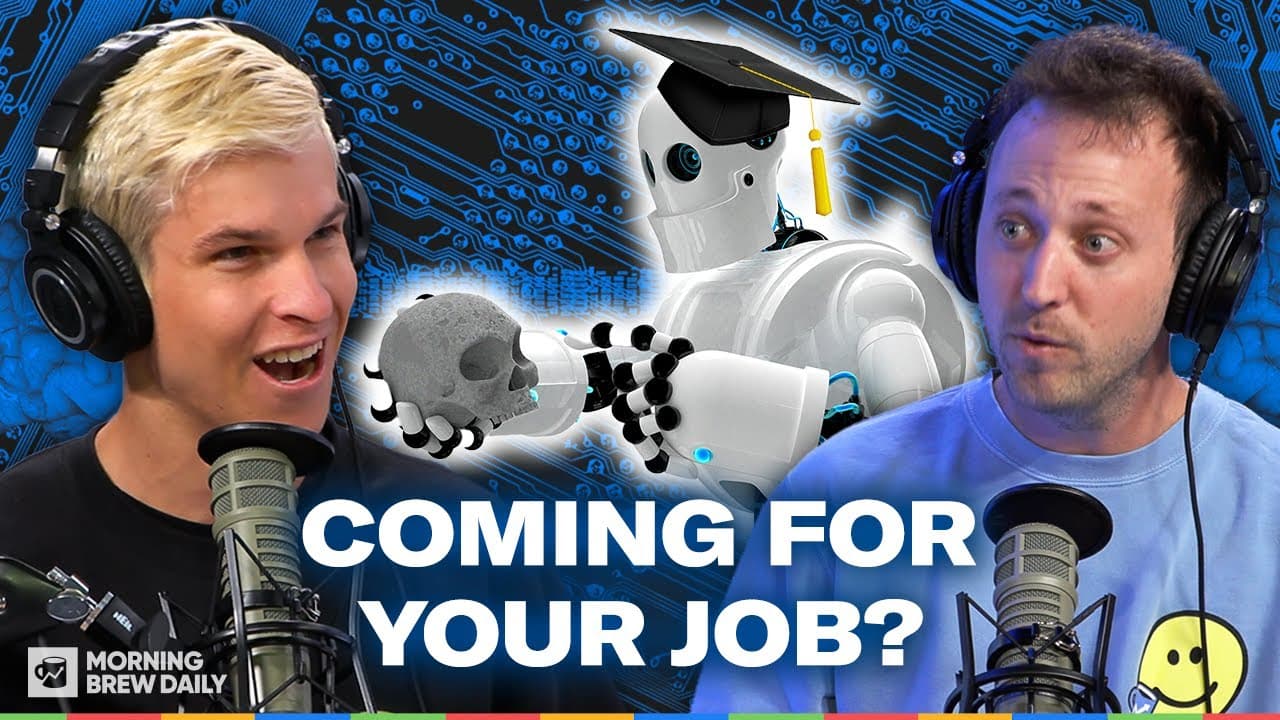
One of the main questions every professional is asking these days is, will I replace my job? And, you know, with chatbots displaying all of these capabilities and processing information and generating human like response to it? It's kind of a reasonable question to ask. So McKinsey to the rescue and I say that kind of ironically, but the consulting... Read More
Key Insights
- Generative AI is predicted to add $4.4 trillion to the global economy, reflecting its potential to significantly boost productivity across various sectors.
- McKinsey's report suggests that 60-70% of work hours could be automated between 2030 and 2060, indicating a substantial shift in job roles and responsibilities.
- Knowledge workers, including those with advanced degrees, are more vulnerable to AI automation compared to previous technological advancements, challenging traditional job security assumptions.
- The report highlights occupations like customer relations, marketing, sales, and software engineering as areas where AI could augment or replace current roles.
- The concept of 'creative destruction' suggests that while AI may eliminate certain jobs, it could also create new opportunities and add overall economic value.
- Companies like JP Morgan are actively hiring for AI-related roles, showcasing the growing demand for skills in AI integration and management.
- Conversely, IBM is slowing hiring for back-office roles, with predictions that 30% of these could be replaced by AI within five years.
- McKinsey's forecasts, while not exact, aim to stimulate discussion and provide guidance for CEOs on workforce structuring in the AI era.
Install to Summarize YouTube Videos and Get Transcripts
Explore YouTube Video Summarizer or Get YouTube Transcript Extractor
Questions & Answers
Q: What is the main economic impact predicted by the McKinsey report?
The McKinsey report predicts that generative AI will add $4.4 trillion to the global economy. This reflects the significant productivity gains AI is expected to bring across various sectors, potentially transforming how economic value is generated and distributed worldwide.
Q: How does the report view the vulnerability of knowledge workers to AI?
The report suggests that knowledge workers, including those with advanced degrees, are more vulnerable to AI automation than in previous technological shifts. This challenges the traditional view that white-collar jobs are secure from automation, signaling a potential restructuring of professional roles.
Q: Which job sectors are highlighted as most likely to be impacted by AI?
The report highlights sectors such as customer relations, marketing, sales, and software engineering as areas where AI could significantly augment or replace existing roles. This reflects AI's potential to handle tasks that were traditionally considered to require human intuition and creativity.
Q: What is 'creative destruction' in the context of AI?
In the context of AI, 'creative destruction' refers to the economic process where technology eliminates certain jobs through automation but simultaneously creates new opportunities and adds overall value to the economy. This concept suggests that while some roles may disappear, new roles will emerge, potentially leading to net job growth.
Q: How are companies like JP Morgan and IBM reacting to AI's rise?
JP Morgan is actively hiring for AI-related roles, indicating a proactive approach to integrating AI into their operations. In contrast, IBM is slowing hiring for back-office roles, with plans to potentially replace 30% of these with AI, reflecting the dual impact of AI on job creation and elimination.
Q: What is the significance of McKinsey's forecasts despite their uncertainty?
McKinsey's forecasts, while not precise, are significant as they stimulate discussion and provide strategic guidance for CEOs and businesses on how to prepare for AI's impact. These predictions help shape workforce planning and encourage consideration of AI's potential to transform industries.
Q: What role does AI play in the concept of 'creative destruction'?
AI plays a central role in 'creative destruction' by potentially automating tasks and eliminating certain jobs, while also creating new opportunities and roles. This dual impact can lead to economic growth and transformation, as AI-driven innovations open up new markets and ways of working.
Q: How does the report's view on AI compare to past technological changes?
The report suggests that AI's impact on knowledge workers is more significant than past technological changes, which primarily affected physical labor. This shift challenges the assumption that white-collar jobs are immune to automation, indicating a broader and deeper impact of AI on the workforce.
Summary & Key Takeaways
-
McKinsey's report forecasts significant productivity gains from AI, potentially adding $4.4 trillion to the global economy. It predicts that 60-70% of work hours could be automated by 2060, with knowledge workers more vulnerable to AI than previous technological changes.
-
The report identifies roles in customer relations, marketing, sales, and software engineering as likely to be impacted by AI. This aligns with the economic concept of 'creative destruction,' where technology eliminates some jobs but creates new opportunities.
-
Companies like JP Morgan are increasing AI-related hires, while IBM is reducing back-office roles, reflecting the dual impact of AI on the job market. McKinsey's predictions, though not precise, aim to guide workforce planning and stimulate discussion on AI's future role.
Read in Other Languages (beta)
Share This Summary 📚
Summarize YouTube Videos and Get Video Transcripts with 1-Click
Try YouTube Summary with ChatGPT & Claude or YouTube Transcript Generator
Explore More Summaries from Morning Brew Daily 📚




Summarize YouTube Videos and Get Video Transcripts with 1-Click
Try YouTube Summary with ChatGPT & Claude or YouTube Transcript Generator