Place value when multiplying and dividing by 10 | Math | 4th grade | Khan Academy
TL;DR
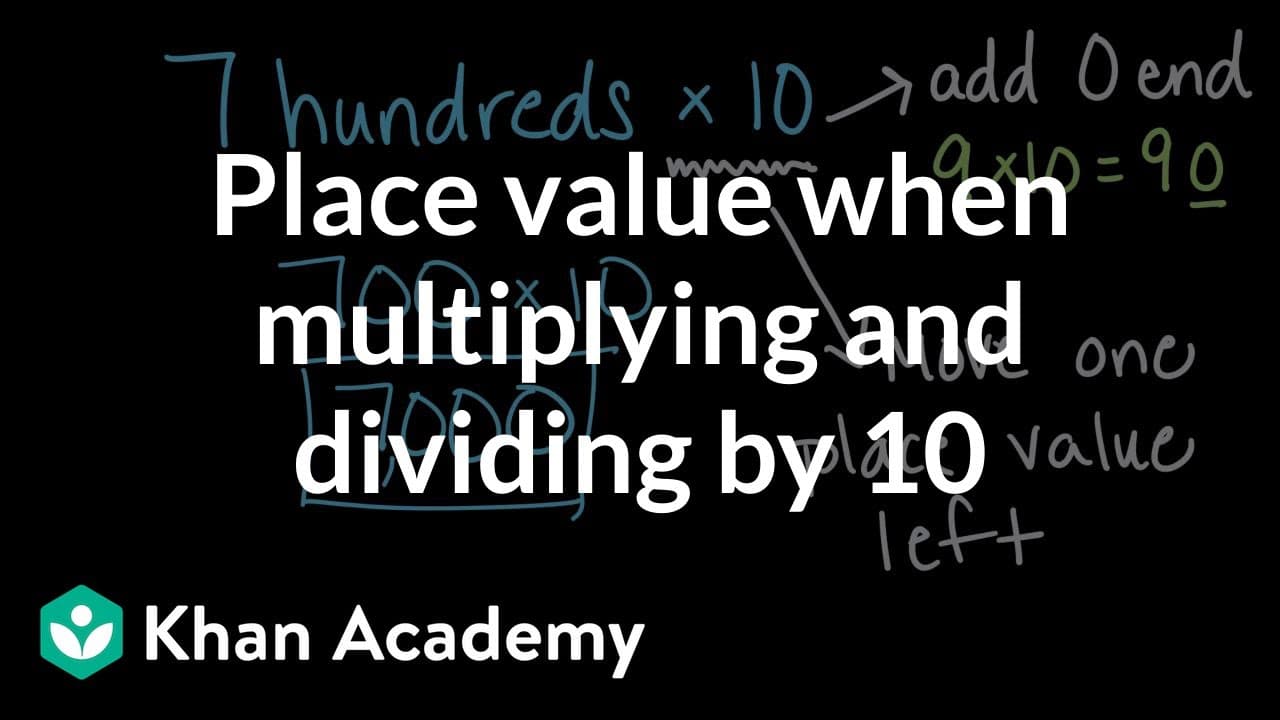
When multiplying by 10, add a zero at the end. When dividing by 10, drop a zero at the end or move one place value to the right.
Transcript
- [Voiceover] What is 7 100s times 10? Well, let's focus first on this times 10 part of our expression. Because multiplying by 10 has some patterns in math that we can use to help us solve. One pattern we can think of when we multiply by 10 is if we take a whole number and multiply it by 10, we'll simply add a zero to the end of our whole number. S... Read More
Key Insights
- ❤️🩹 Multiplying a whole number by 10 is the same as adding a zero to the end or moving each digit one place value to the left.
- ❤️🩹 Dividing a whole number by 10 involves dropping a zero at the end or moving each digit one place value to the right.
- 🥇 Understanding place value is crucial in efficiently multiplying and dividing by 10.
- ✖️ The patterns for multiplying and dividing by 10 are opposite of each other.
- 🥇 Using a place value chart can help visualize the concept of multiplying and dividing by 10.
- ✖️ Multiplying and dividing by 10 is a fundamental skill in basic arithmetic.
- ✖️ Applying the patterns of multiplying and dividing by 10 can simplify calculations.
Install to Summarize YouTube Videos and Get Transcripts
Explore YouTube Video Summarizer or Get YouTube Transcript Extractor
Questions & Answers
Q: How can you multiply a whole number by 10?
One way to multiply a whole number by 10 is to add a zero to the end of the number. For example, 9 x 10 = 90. Another way is to think about moving each digit one place value to the left. For example, 700 x 10 = 7,000.
Q: What is the pattern when multiplying by 10?
The pattern when multiplying by 10 is adding a zero at the end of the whole number. This is equivalent to moving each digit one place value to the left. It can be represented on a place value chart.
Q: How can you divide a whole number by 10?
To divide a whole number by 10, you can drop the zero at the end of the number. For example, 40 ÷ 10 = 4. Alternatively, you can think about moving each digit one place value to the right. For example, 2120 ÷ 10 = 212.
Q: What is the opposite of multiplying by 10?
The opposite of multiplying by 10 is dividing by 10. The patterns for multiplying and dividing by 10 are opposite as well. When multiplying, a zero is added, and when dividing, a zero is dropped at the end of the number.
Summary & Key Takeaways
-
Multiplying a whole number by 10 involves adding a zero to the end of the number. For example, 9 x 10 = 90.
-
When multiplying by 10, you can also think about moving each digit one place value to the left. For example, 700 x 10 = 7,000.
-
Dividing a whole number by 10 involves dropping a zero at the end of the number or moving each digit one place value to the right. For example, 2120 ÷ 10 = 212.
Read in Other Languages (beta)
Share This Summary 📚
Summarize YouTube Videos and Get Video Transcripts with 1-Click
Try YouTube Summary with ChatGPT & Claude or YouTube Transcript Generator
Explore More Summaries from Khan Academy 📚



Summarize YouTube Videos and Get Video Transcripts with 1-Click
Try YouTube Summary with ChatGPT & Claude or YouTube Transcript Generator