Introduction to Database - Programming using JDBC - Java programming Tutorial
TL;DR
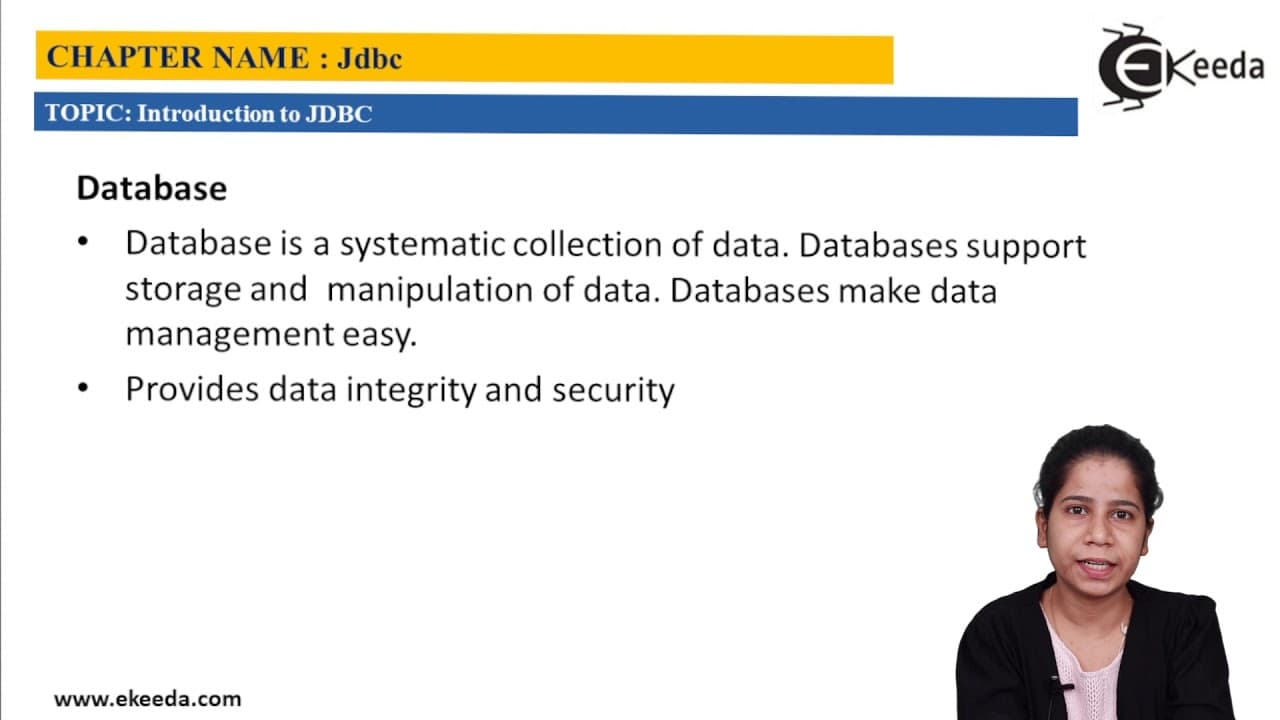
This video provides an introduction to databases and explains the importance of a centralized repository for data storage, integrity, and security.
Transcript
click the bell icon to get latest videos from equator hello friends today we are going to focus on very important topic that is Java database connectivity ok before moving to what is JDBC we have to clarify some basic concepts and that is database related topics so today we are going to focus on what is database then later on we are going to focus ... Read More
Key Insights
- ⚾ Databases are a centralized repository for structured data, offering better data integrity and security compared to file-based storage.
- 👻 They provide storage and manipulation capabilities, allowing the addition, deletion, and modification of data.
- 🏬 Databases enable organizations to maintain consistent and secure access to data by multiple applications and departments.
- 👻 Data-level security in databases allows for fine-grained control over access to specific data elements.
- 🥺 Prior to databases, files were widely used for data storage, but they lacked centralized management, leading to data integrity and security issues.
- ❓ Adoption of databases has improved data management efficiency and reduced duplication of efforts.
- 😒 Relational databases use a tabular format for data representation, with different structures depending on the type of database.
Install to Summarize YouTube Videos and Get Transcripts
Explore YouTube Video Summarizer or Get YouTube Transcript Extractor
Questions & Answers
Q: What is a database and how is it different from a file?
A database is a structured collection of data stored in a centralized repository, while a file is a less organized way to store data. Databases offer better data integrity, security, and accessibility compared to files.
Q: Why is centralized storage important in a database?
Centralized storage allows multiple applications and departments to access, edit, and delete data consistently. This reduces duplication of efforts and minimizes the chances of data inconsistencies.
Q: How do databases ensure data integrity?
Databases maintain data integrity by providing mechanisms such as locking at the row and column levels, which allow secure updates to the data and prevent concurrent access issues.
Q: What advantages does a database offer over files in terms of security?
Databases allow for granular data-level security, providing control over access to specific data elements. With files, it is difficult to implement such fine-grained security measures.
Summary & Key Takeaways
-
Database is a collection of structured data stored in a centralized repository, allowing easy access for multiple applications.
-
Prior to databases, files were used to store data, but this approach led to issues with data integrity and security.
-
Databases provide storage and manipulation capabilities for data management, ensuring data integrity and enabling secure access by different departments.
Read in Other Languages (beta)
Share This Summary 📚
Summarize YouTube Videos and Get Video Transcripts with 1-Click
Try YouTube Summary with ChatGPT & Claude or YouTube Transcript Generator
Explore More Summaries from Ekeeda 📚






Summarize YouTube Videos and Get Video Transcripts with 1-Click
Try YouTube Summary with ChatGPT & Claude or YouTube Transcript Generator