Visualizing derivatives exercise
TL;DR
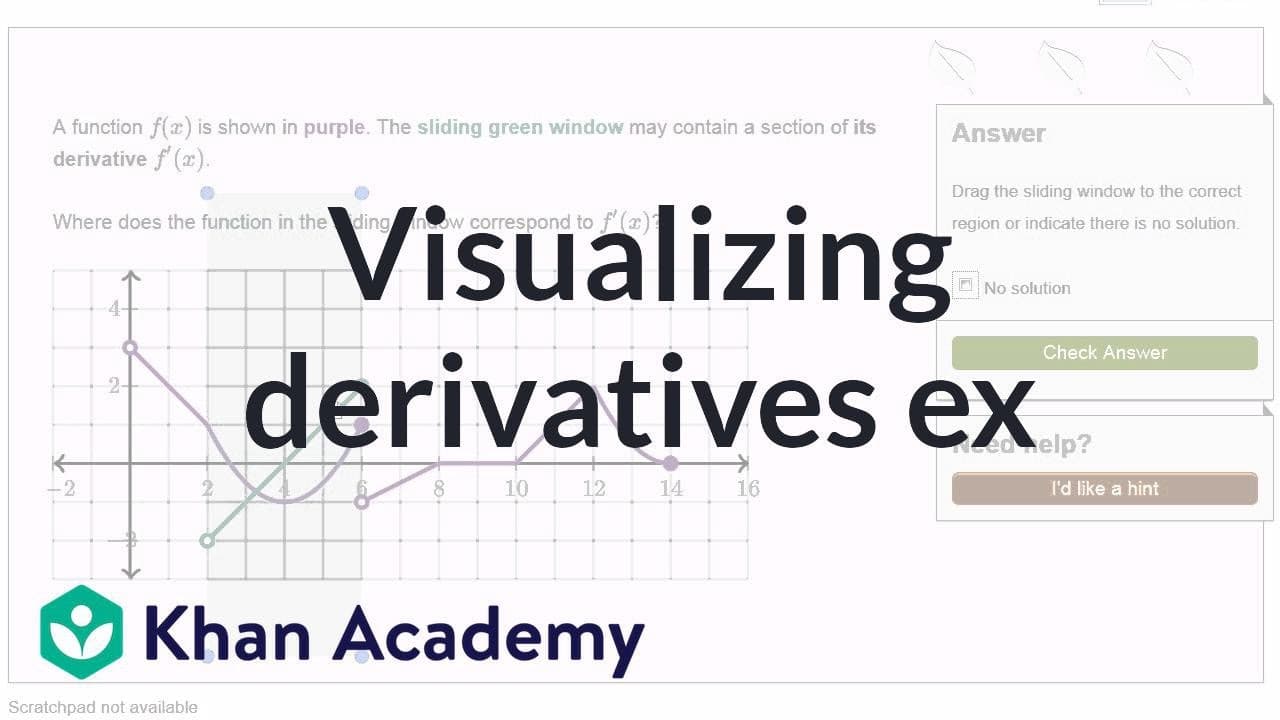
A tutorial explaining how to match a function's derivative with a sliding window to its corresponding antiderivative.
Transcript
The function f of x is shown in green. The sliding purple window may contain a section of an antiderivative of the function, F of x. So, essentially it's saying, this green function, or part of this green function, is potentially the derivative of this purple function. And what we need to do is-- it says, where does the function in the sliding wind... Read More
Key Insights
- 💱 Matching derivatives with antiderivatives involves identifying where slope changes in the derivative correspond to constant slope segments in the antiderivative.
- 🆘 Analyzing the slopes of both the derivative and antiderivative helps determine where they align and where they do not.
- 🔂 It is possible to have multiple segments in the derivative that match a single constant segment in the antiderivative.
- ❓ Not all functions have corresponding derivatives and antiderivatives that align perfectly.
- ❓ The process of matching derivatives and antiderivatives requires careful analysis and visual inspection.
- 😥 Matched segments in the derivative and antiderivative have the same slope values at the corresponding points.
- ❓ Matching derivatives and antiderivatives is a fundamental concept in calculus.
Install to Summarize YouTube Videos and Get Transcripts
Explore YouTube Video Summarizer or Get YouTube Transcript Extractor
Questions & Answers
Q: What is the purpose of matching a function's derivative with a sliding window to its antiderivative?
Matching a function's derivative with its antiderivative helps identify the relationship between slope changes in the original function and the antiderivative. It allows us to determine where the derivative and the antiderivative align.
Q: How can we determine where the sliding window corresponds to the antiderivative?
To determine the correspondence, we analyze the slope changes in both the derivative and antiderivative. A constant positive or negative slope segment in the derivative should match a constant slope segment in the antiderivative.
Q: Are there cases where the derivative and antiderivative do not align?
Yes, there are cases where the derivative and antiderivative do not match up. This occurs when the slopes in the derivative and antiderivative do not have corresponding constant segments.
Q: What should be done if there is no solution for matching the derivative and antiderivative?
If there is no solution for matching the derivative and antiderivative, it means that there is no corresponding segment in the sliding window for the antiderivative. In such cases, we conclude that there is no match.
Summary & Key Takeaways
-
The video explains how to determine where a function's derivative matches up with a sliding window to its antiderivative.
-
By analyzing the slopes of the functions, it is possible to identify where they align and where they do not.
-
The video demonstrates multiple examples of matching derivatives and antiderivatives.
Read in Other Languages (beta)
Share This Summary 📚
Summarize YouTube Videos and Get Video Transcripts with 1-Click
Try YouTube Summary with ChatGPT & Claude or YouTube Transcript Generator
Explore More Summaries from Khan Academy 📚



Summarize YouTube Videos and Get Video Transcripts with 1-Click
Try YouTube Summary with ChatGPT & Claude or YouTube Transcript Generator