Planar motion (with integrals) | Applications of definite integrals | AP Calculus BC | Khan Academy
TL;DR
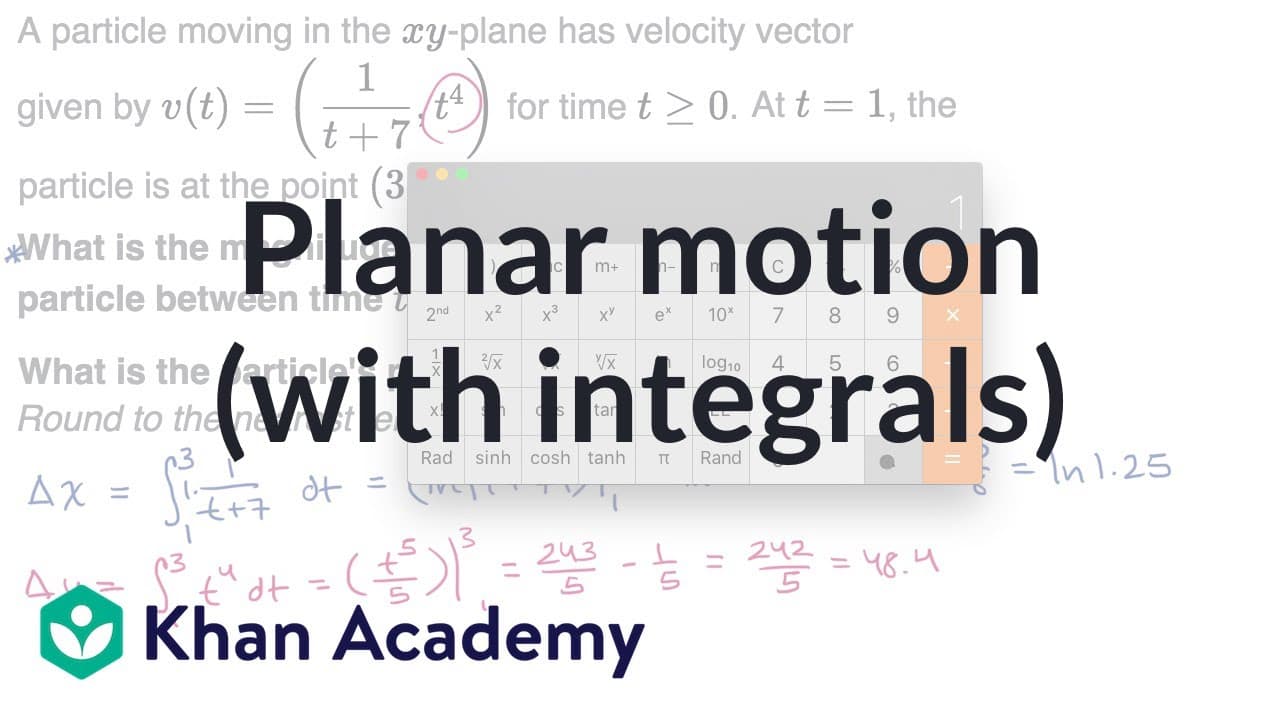
Find the displacement and position of a particle moving in the XY plane using its velocity vectors.
Transcript
- [Instructor] A particle moving in the XY plane has velocity vector given by V of T is equal to all of this business, and so using this notation, it just means that the X component of velocity as a function of the time is one over T plus seven, and the Y component of velocity as a function of time is T to the fourth for time T greater than or equa... Read More
Key Insights
- 🧘 Calculating displacement and position in two dimensions involves finding the change in X and Y separately.
- ❓ The magnitude of the displacement can be found using the Pythagorean theorem.
- 🍳 Breaking up the problem into component dimensions simplifies the calculations.
- 🧘 The position at a given time is obtained by adding the change in X and Y to the initial position.
- 🌥️ The magnitude of the displacement can be larger than the change in X or Y alone.
- 💱 Integration is used to find the change in X and Y.
- 🔨 The Pythagorean theorem is a useful tool for calculating the magnitude of the displacement.
Install to Summarize YouTube Videos and Get Transcripts
Explore YouTube Video Summarizer or Get YouTube Transcript Extractor
Questions & Answers
Q: How is the displacement of a particle moving in two dimensions calculated?
The displacement is found by calculating the change in X and the change in Y separately and then using the Pythagorean theorem to find the magnitude of the displacement.
Q: How is the position of a particle at a given time determined?
The position at a given time is found by adding the change in X and Y to the initial position of the particle.
Q: What is the significance of breaking up the problem into component dimensions?
Breaking up the problem into component dimensions allows us to separately calculate the change in X and Y, making it easier to find the displacement and position of the particle.
Q: Why is the magnitude of the displacement greater than the change in X or Y alone in some cases?
The magnitude of the displacement is greater than the change in X or Y alone because when combining the two, the Pythagorean theorem takes into account the direction of the displacement.
Summary & Key Takeaways
-
A particle in the XY plane has velocity vectors for its X and Y components.
-
The displacement is calculated by finding the change in X and the change in Y separately using integration.
-
The position at a given time can be found by adding the change in X and Y to the initial position.
-
The magnitude of the displacement is obtained using the Pythagorean theorem.
Read in Other Languages (beta)
Share This Summary 📚
Summarize YouTube Videos and Get Video Transcripts with 1-Click
Try YouTube Summary with ChatGPT & Claude or YouTube Transcript Generator
Explore More Summaries from Khan Academy 📚



Summarize YouTube Videos and Get Video Transcripts with 1-Click
Try YouTube Summary with ChatGPT & Claude or YouTube Transcript Generator