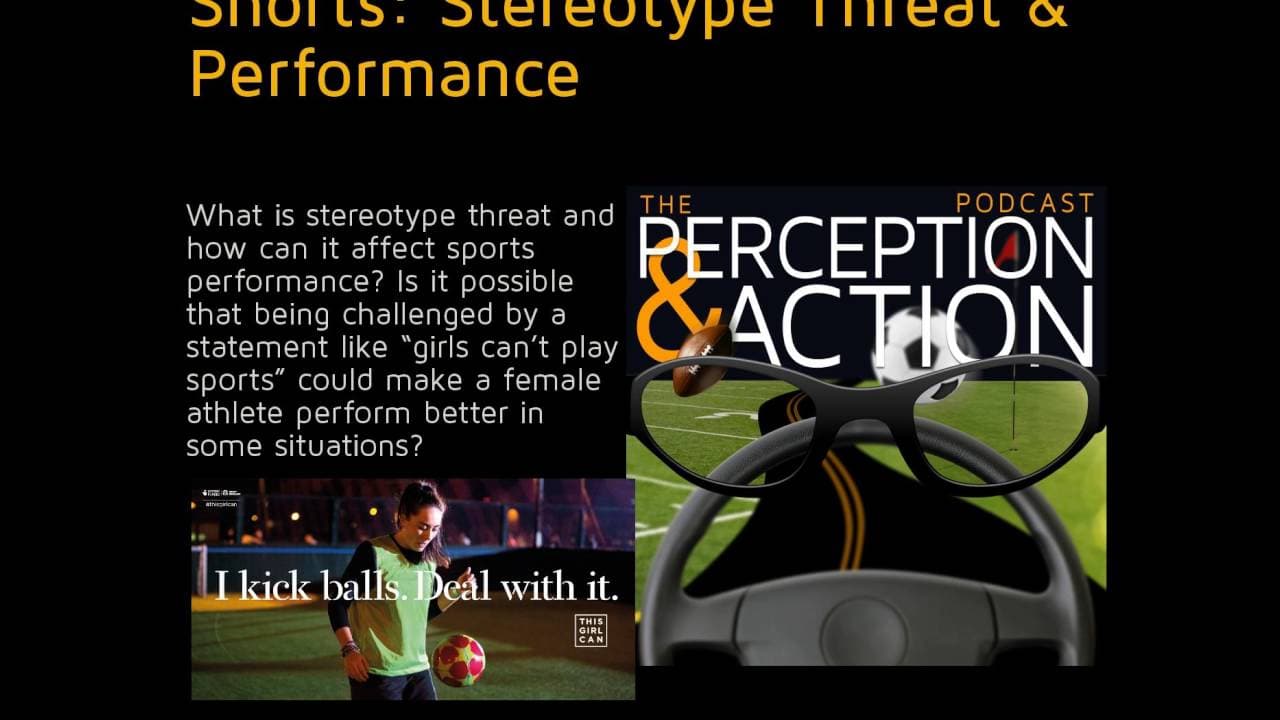
37B – Sports Science Shorts: Stereotype Threat & Performance
TL;DR
Stereotype threat can both hinder and enhance sports performance.
Transcript
today on Sports Science shorts from the perception and action podcast you can't play sports you're just a girl understanding the effects of stereotype threat on performance so it's time for a call to action hi everyone this is Rob Gray from ASU and perception action.com welcome to the perception and action podcast where I discuss how psychological ... Read More
Key Insights
- Stereotype threat refers to the anxiety experienced when one fears confirming a negative stereotype about their social group, impacting performance negatively.
- In sports, stereotype threat can manifest when women are told they are less capable, leading to decreased physical activity and sports participation.
- Research shows stereotype threat causes explicit monitoring, shifting focus inward, rather than distraction, which can impair performance.
- Studies reveal that stereotype threat can affect both men and women, as seen in a golf study where men performed worse under threat.
- Recent studies indicate that stereotype threat might enhance performance for experienced individuals by motivating them to execute their dominant skills.
- Novices under stereotype threat tend to perform worse due to reliance on ineffective strategies, but task design can mitigate this effect.
- For simple tasks requiring minimal learning, stereotype threat has been shown to improve performance by enhancing focus and precision.
- Understanding stereotype threat in sports can help address broader societal issues, such as the underrepresentation of women in competitive sports.
Install to Summarize YouTube Videos and Get Transcripts
Explore YouTube Video Summarizer or Get YouTube Transcript Extractor
Questions & Answers
Q: What is stereotype threat and how does it affect sports performance?
Stereotype threat is the anxiety or concern experienced when individuals fear confirming a negative stereotype about their social group. In sports, it can lead to decreased performance as athletes become overly focused on not confirming the stereotype. This inward focus, known as explicit monitoring, can detract from their ability to perform automatic, skilled actions effectively.
Q: Can stereotype threat affect both men and women in sports?
Yes, stereotype threat can affect both men and women in sports. While much research has focused on women, studies have also shown that men can experience stereotype threat. For example, a study involving male golfers demonstrated that when told women perform better in putting, their performance declined, indicating that stereotype threat can impact any gender.
Q: How might stereotype threat enhance performance in some situations?
Stereotype threat might enhance performance in some situations by motivating individuals to focus and execute their dominant skills effectively. For experienced athletes, the threat can serve as a challenge, prompting them to rely on their well-practiced strategies. This effect has been observed in tasks where the prepotent response is effective, leading to improved performance under threat.
Q: What role does task design play in the effects of stereotype threat?
Task design plays a crucial role in the effects of stereotype threat. For tasks requiring minimal learning and where novices can perform well from the start, stereotype threat can enhance performance by increasing focus and precision. Conversely, for complex tasks requiring skill acquisition, novices under threat may perform worse due to reliance on ineffective strategies.
Q: What are some examples of stereotype threat in sports?
Examples of stereotype threat in sports include women being told they are less capable in sports like basketball or golf. Such stereotypes can lead to decreased performance as athletes become preoccupied with not confirming the stereotype. Studies have shown stereotype threat affecting performance in golf, soccer, tennis, and basketball, highlighting its widespread impact across sports.
Q: How does stereotype threat relate to societal issues in sports?
Stereotype threat relates to societal issues in sports by contributing to the underrepresentation of women in competitive sports. The anxiety and decreased performance caused by stereotype threat can discourage participation and perpetuate gender disparities. Understanding and addressing stereotype threat can help create more inclusive and equitable sports environments, encouraging broader participation.
Q: What strategies can mitigate the negative effects of stereotype threat?
Strategies to mitigate the negative effects of stereotype threat include creating supportive environments that emphasize individual abilities over group stereotypes, providing positive role models, and designing tasks that minimize reliance on stereotypes. Encouraging self-affirmation and fostering a growth mindset can also help individuals focus on their potential rather than perceived limitations.
Q: What future research directions are suggested for stereotype threat in sports?
Future research on stereotype threat in sports could explore the long-term effects on participation and performance, investigate interventions to reduce its impact, and examine how different sports contexts influence the threat. Additionally, studying diverse populations and considering cultural factors can provide a more comprehensive understanding of stereotype threat and inform strategies to promote inclusivity in sports.
Summary & Key Takeaways
-
Stereotype threat, a psychological phenomenon where individuals fear confirming negative stereotypes about their group, can significantly affect sports performance. It often leads to explicit monitoring, where athletes focus inward, which can impair performance in skilled tasks. However, recent research suggests that it might also enhance performance in certain contexts.
-
In sports, stereotype threat is prevalent, particularly affecting women's participation and performance. Studies show that when women are reminded of negative stereotypes, their performance often declines. However, for experienced athletes, stereotype threat can sometimes enhance performance by motivating them to execute their dominant skills effectively.
-
Research has expanded our understanding of stereotype threat, showing it affects both men and women in various sports contexts. While novices typically perform worse under threat, experienced athletes might improve. Task design plays a crucial role in determining whether stereotype threat will hinder or enhance performance, offering insights for addressing gender disparities in sports.
Read in Other Languages (beta)
Share This Summary 📚
Summarize YouTube Videos and Get Video Transcripts with 1-Click
Try YouTube Summary with ChatGPT & Claude or YouTube Transcript Generator
Explore More Summaries from Rob Gray 📚

Summarize YouTube Videos and Get Video Transcripts with 1-Click
Try YouTube Summary with ChatGPT & Claude or YouTube Transcript Generator