Advanced Calculus Delta Epsilon Limit Proof with Trig Function
TL;DR
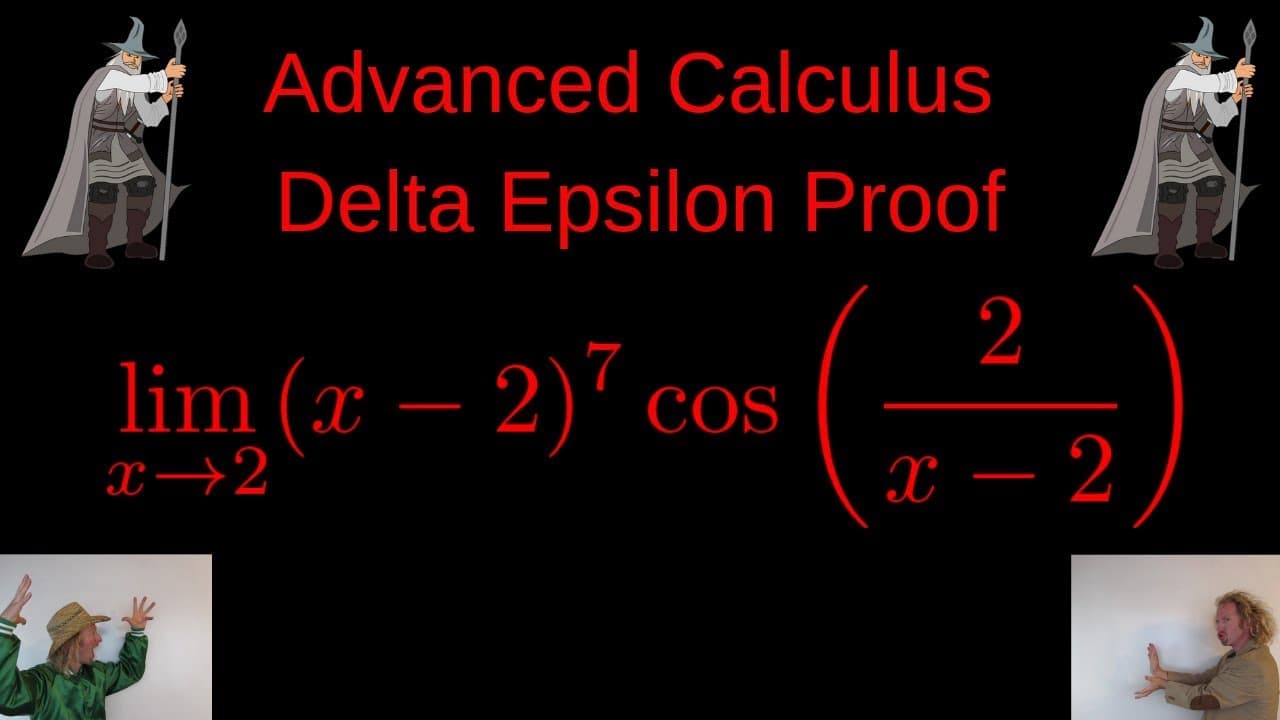
This video explains how to use the Delta Epsilon proof to calculate a limit, specifically the limit as X approaches 2, which is equal to zero.
Transcript
hey what's up YouTube this problem really proved that this limit as X approaches two is equal to zero so this is pretty easy to do with the squeeze theorem but let's let's go ahead and give a Delta Epsilon proof just for a little bit more rigor I mean it's the same thing very similar proof so let's go through it so recall recall first what it means... Read More
Key Insights
- ⛔ The Delta Epsilon proof is a rigorous method used to verify limit calculations in mathematical analysis.
- ⛔ The formal definition of a limit states the conditions that must be satisfied for a specific limit to exist.
- ❓ In the Delta Epsilon proof, the challenge is to find a suitable value for Delta that ensures the desired result.
Install to Summarize YouTube Videos and Get Transcripts
Explore YouTube Video Summarizer or Get YouTube Transcript Extractor
Questions & Answers
Q: What is the purpose of the Delta Epsilon proof in limit calculations?
The Delta Epsilon proof provides a rigorous and precise method to verify limit calculations, ensuring their accuracy and reliability. It is a fundamental tool in mathematical analysis.
Q: How does the formal definition of a limit relate to the Delta Epsilon proof?
The formal definition states that for every epsilon greater than zero, there exists a delta greater than zero such that for all X within a specific range (X - C is less than Delta), the distance between f(X) and L is less than epsilon. The Delta Epsilon proof aims to find such a delta that satisfies these conditions.
Q: How is the Delta value determined in the proof?
The value of Delta is determined by working through the scratch work and inequalities, ultimately finding a suitable expression for Delta that leads to the desired result. In this case, Delta is chosen to be the seventh root of epsilon.
Q: Why is the seventh root used in the proof?
The seventh root is used because the inequality involving X - 2 raised to the seventh power simplifies when Delta is chosen as the seventh root of epsilon. This simplification allows for the cancellation of terms and ultimately proves that the limit is equal to zero.
Summary & Key Takeaways
-
The video introduces the concept of the Delta Epsilon proof and its importance in calculating limits.
-
The presenter explains the formal definition of a limit and how it relates to the Delta Epsilon proof.
-
The video demonstrates a step-by-step process to prove that the limit as X approaches 2 is equal to zero using the Delta Epsilon proof.
Read in Other Languages (beta)
Share This Summary 📚
Summarize YouTube Videos and Get Video Transcripts with 1-Click
Try YouTube Summary with ChatGPT & Claude or YouTube Transcript Generator
Explore More Summaries from The Math Sorcerer 📚



Summarize YouTube Videos and Get Video Transcripts with 1-Click
Try YouTube Summary with ChatGPT & Claude or YouTube Transcript Generator