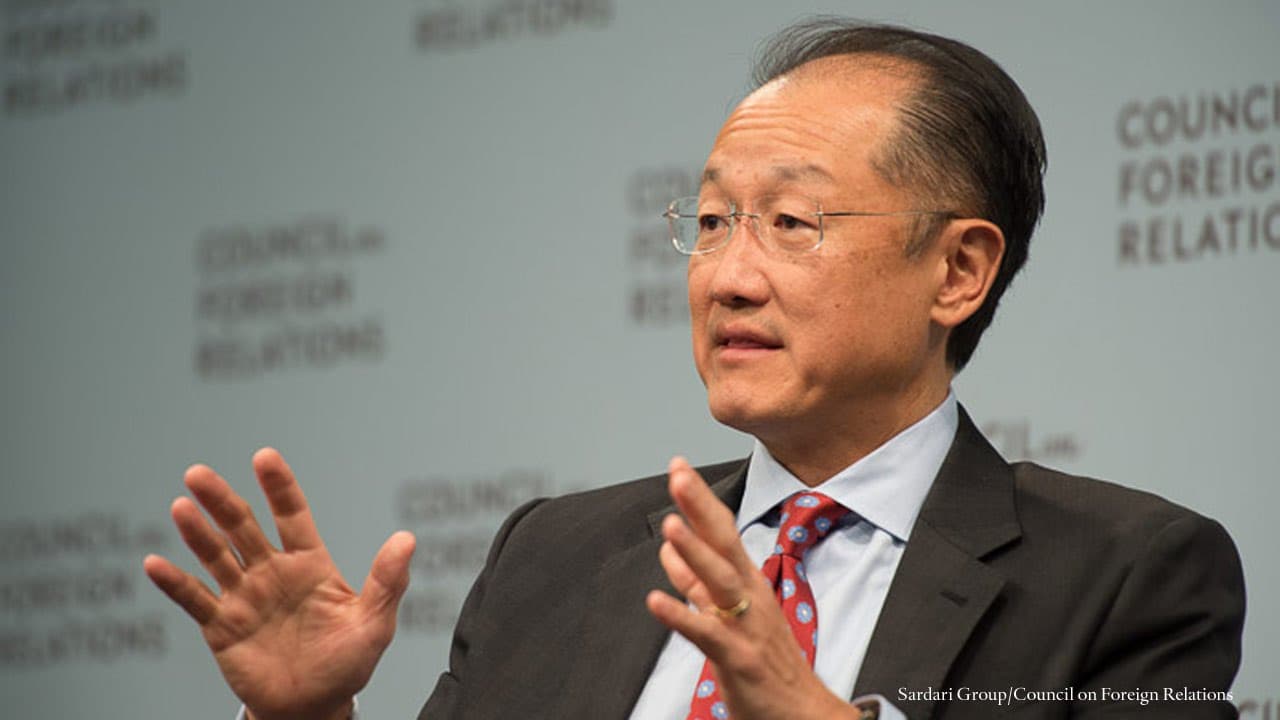
World Bank President Jim Yong Kim on Economic Development and the Paris Climate Agreement
TL;DR
Jim Yong Kim discusses the World Bank's climate change strategy.
Transcript
TERCEK: Welcome, everyone. Good afternoon. We're delighted to be here today at the Council on Foreign Relations, where we have the opportunity to discuss with President Kim of the World Bank the next steps for international climate action. Dr. Jim Kim became the 12th president of World Bank in 2012 after a career in development and medicine. He ser... Read More
Key Insights
- Jim Yong Kim emphasizes the critical role of economic policy in mobilizing a global response to climate change, highlighting the need for a coordinated approach to achieve zero net emissions by 2100.
- The World Bank's climate strategy includes binding agreements, policy packages for decarbonization, financial packages for innovative financing, and coalitions of stakeholders to drive climate action.
- Jim Yong Kim stresses the importance of carbon pricing as a necessary step towards zero net emissions, using the example of British Columbia's successful carbon tax mechanism.
- The World Bank advocates for investments in renewable energy, energy efficiency, and infrastructure upgrades, emphasizing the need for resilient development to protect against climate risks.
- Removing harmful fossil fuel subsidies is highlighted as a crucial step, with examples from countries like Brazil and Indonesia showing successful subsidy phase-outs benefiting the poor.
- The World Bank is leveraging its financial capabilities to catalyze investments in climate-friendly projects, using instruments like green bonds and the Climate Investment Funds.
- Jim Yong Kim highlights the importance of partnerships with private enterprises, cities, and civil society organizations in driving climate action and achieving economic transformation.
- The World Bank is committed to integrating climate and disaster risk considerations into its projects, aiming to support countries in implementing their climate commitments and achieving sustainable development goals.
Install to Summarize YouTube Videos and Get Transcripts
Explore YouTube Video Summarizer or Get YouTube Transcript Extractor
Questions & Answers
Q: What is the World Bank's stance on carbon pricing?
The World Bank strongly advocates for carbon pricing as a necessary step towards zero net emissions. Jim Yong Kim highlights the example of British Columbia, where a carbon tax mechanism has successfully reduced emissions while providing tax benefits. Carbon pricing is seen as a way to make pollution more expensive and incentivize efficiency and clean production.
Q: How does the World Bank plan to address fossil fuel subsidies?
The World Bank emphasizes the importance of removing harmful fossil fuel subsidies, which primarily benefit the better-off while doing little for the poor and the environment. Jim Yong Kim cites examples from Brazil, Indonesia, and Mexico, where subsidy phase-outs have been successful when combined with improved safety nets and targeted cash transfers.
Q: What role do partnerships play in the World Bank's climate strategy?
Partnerships with private enterprises, cities, and civil society organizations are crucial to the World Bank's climate strategy. Jim Yong Kim highlights the importance of these coalitions in driving action forward, as they help align interests and pave the way for wider agreements. The World Bank aims to leverage these partnerships to support clients and achieve economic transformation.
Q: How is the World Bank leveraging financial instruments for climate action?
The World Bank is leveraging financial instruments like green bonds and the Climate Investment Funds to catalyze investments in climate-friendly projects. Jim Yong Kim mentions that about $35 billion in green bonds has been issued, reflecting strong demand from investors. The World Bank aims to use its financial capabilities to support transformative projects and optimize climate outcomes.
Q: What is the World Bank's approach to renewable energy investments?
The World Bank is committed to supporting renewable energy investments as part of its climate strategy. Jim Yong Kim emphasizes the need for scaling up renewable energy, developing carbon capture and sequestration technology, and upgrading electricity grids to achieve higher efficiency. The World Bank aims to support energy access for all and increase investment in renewables.
Q: How does the World Bank address climate and disaster risks in its projects?
The World Bank integrates climate and disaster risk considerations into its projects to ensure resilient development. Jim Yong Kim mentions that the World Bank is introducing climate and disaster screening in its lending for the poorest countries and developing multi-sectoral adaptation plans. This approach aims to protect investments and achieve climate resilience.
Q: What are the World Bank's views on economic management and climate change?
Jim Yong Kim emphasizes that effective economic management can play a significant role in addressing climate change. He highlights the importance of aligning incentives, establishing a price on carbon, and removing harmful subsidies to drive market systems towards climate targets. The World Bank aims to support countries in managing their economies to achieve decarbonization and sustainable development.
Q: How does the World Bank plan to support developing countries in achieving climate goals?
The World Bank aims to support developing countries by providing financial and technical assistance to achieve climate goals. Jim Yong Kim emphasizes the need for policy packages that address decarbonization, resilience, and adaptation. The World Bank also focuses on leveraging public development funds and climate finance to catalyze investments and support country-led climate actions.
Summary & Key Takeaways
-
Jim Yong Kim, President of the World Bank Group, discusses the importance of economic policy in addressing climate change, emphasizing the need for a global response to achieve zero net emissions by 2100. He outlines the World Bank's strategy, which includes binding agreements, policy packages, financial incentives, and partnerships to drive climate action.
-
The World Bank's climate strategy focuses on carbon pricing, renewable energy investments, energy efficiency, and infrastructure upgrades. Jim Yong Kim highlights the importance of removing harmful fossil fuel subsidies and leveraging financial instruments like green bonds to catalyze investments in climate-friendly projects.
-
Jim Yong Kim emphasizes the role of partnerships with private enterprises, cities, and civil society organizations in driving climate action. The World Bank is committed to integrating climate and disaster risk considerations into its projects, supporting countries in implementing their climate commitments and achieving sustainable development goals.
Read in Other Languages (beta)
Share This Summary 📚
Summarize YouTube Videos and Get Video Transcripts with 1-Click
Try YouTube Summary with ChatGPT & Claude or YouTube Transcript Generator
Explore More Summaries from Council on Foreign Relations 📚

Summarize YouTube Videos and Get Video Transcripts with 1-Click
Try YouTube Summary with ChatGPT & Claude or YouTube Transcript Generator