Bounce Rate
TL;DR
Bounce rate measures the number of users who visit a website and leave immediately, indicating content quality, UX/UI, and expectation mismatch.
Transcript
hello students this is your course on content marketing in this video on measuring content marketing performance we're going to talk about bounce rate bounce rate is yet another uh key performance indicator or a measurement metric which is used uh for uh tracking the number of users who visit your website and leave almost immediately after viewing ... Read More
Key Insights
- ☠️ Bounce rate is a crucial metric for measuring content marketing performance.
- 🎨 It reflects content quality, UX/UI design, and expectation matching.
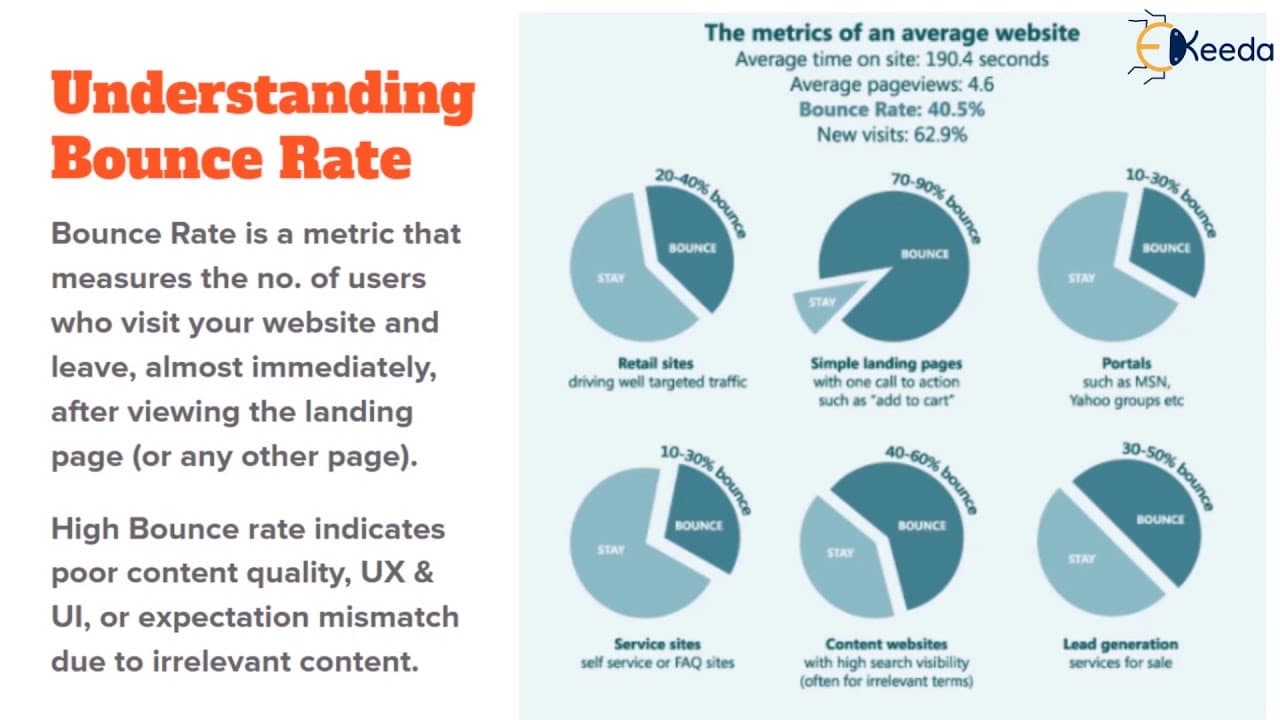
- 😘 Bounce rates differ based on website types, with retail sites having lower normals compared to content-focused websites.
- 🤯 Websites with high bounce rates often have lower click-through rates and affect ad campaign success.
- ☠️ Improving content quality and website design can help reduce bounce rates.
- ☠️ Bounce rate measurements can be misleading if not considered in conjunction with other metrics.
- ☠️ Google Analytics and other tools allow easy measurement of bounce rates for websites.
Install to Summarize YouTube Videos and Get Transcripts
Explore YouTube Video Summarizer or Get YouTube Transcript Extractor
Questions & Answers
Q: What is bounce rate and why is it important for content marketing?
Bounce rate measures the percentage of visitors who leave a website without interacting further. It is crucial for content marketing as it indicates content quality, UX/UI, and expectation matching.
Q: How does bounce rate impact ad campaigns and CTR?
Websites with high bounce rates tend to have lower click-through rates (CTR) and affect the success of subsequent ad campaigns. A high bounce rate indicates poor content relevance and user experience.
Q: What is considered a normal bounce rate for different types of websites?
Normal bounce rates vary depending on the industry and website type. Retail sites may have 20-40% bounce rates, while landing pages or simple pages with unclear calls to action can experience 70-90% bounce rates.
Q: How can content marketers reduce bounce rates?
Content marketers can lower bounce rates by improving content quality, ensuring clear messaging, enhancing UX/UI design, and aligning content with user expectations. Regular content review and optimization are necessary.
Summary & Key Takeaways
-
Bounce rate is a key performance indicator that tracks the number of users who visit a website and quickly leave.
-
It reflects content quality, UX/UI, and whether there is an expectation mismatch.
-
Understanding the factors causing a high bounce rate requires reviewing and improving content and website design.
Read in Other Languages (beta)
Share This Summary 📚
Summarize YouTube Videos and Get Video Transcripts with 1-Click
Try YouTube Summary with ChatGPT & Claude or YouTube Transcript Generator
Explore More Summaries from Ekeeda 📚






Summarize YouTube Videos and Get Video Transcripts with 1-Click
Try YouTube Summary with ChatGPT & Claude or YouTube Transcript Generator