Linear Queue using Link List Part 5 Display Operation
TL;DR
This video teaches how to display a queue and introduces the concept of linear queues.
Transcript
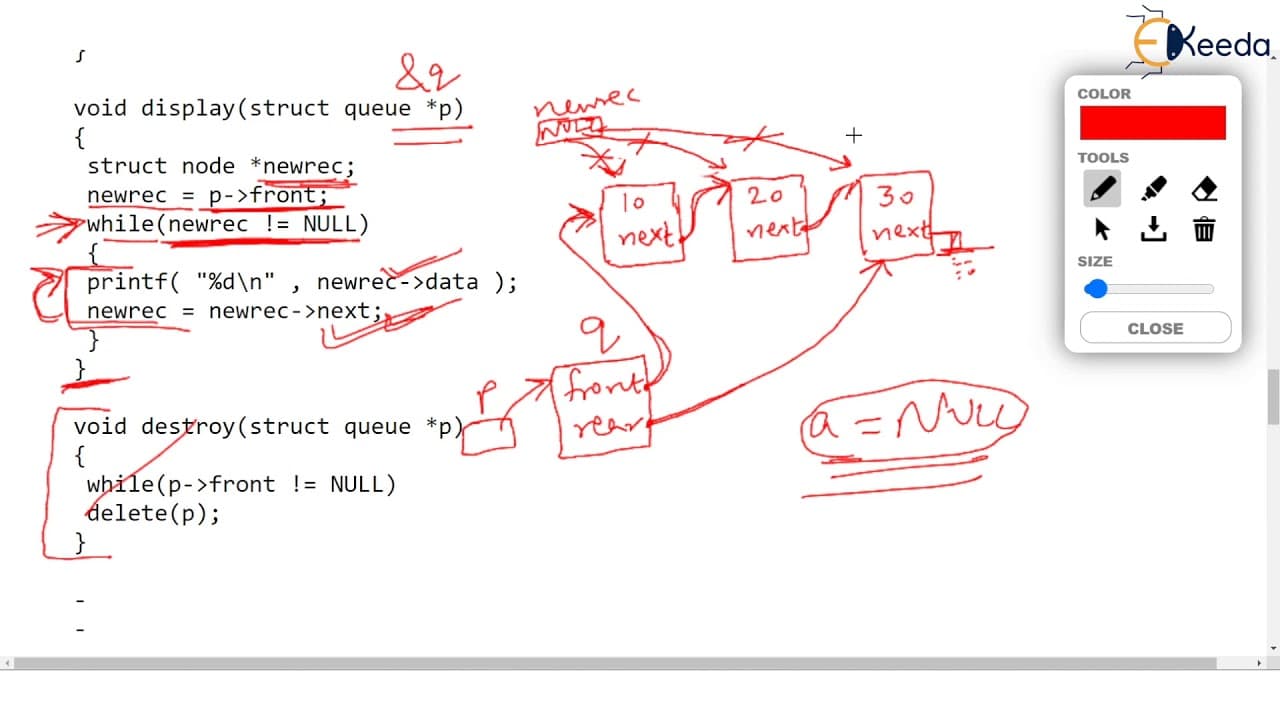
hello dear students in this video we will learn how to display a queue in this queue drawn on the right hand side of the screen we have three nodes storing 10 20 30 10 being the front so front pointer is pointing to that 10 and rear pointer is pointing to the node which stores 30. of course if you are asked what is the data stored in this queue you... Read More
Key Insights
- 👣 The display function in a queue implementation iterates through the nodes using a temporary pointer, printing the data in each node.
- 🏃 The destroy function can be used to delete all nodes in the queue and make it empty, but caution should be exercised when using it.
- ❓ The front and rear pointers are updated linearly during insertion and deletion operations in a linear queue implementation.
Install to Summarize YouTube Videos and Get Transcripts
Explore YouTube Video Summarizer or Get YouTube Transcript Extractor
Questions & Answers
Q: How does the display function work in a queue implementation?
The display function uses a temporary pointer to iterate through each node in the queue. It starts by pointing to the front, and then uses printf to print the data in the node. After printing, the pointer is updated to point to the next node using aro next. This process is repeated until the pointer becomes null.
Q: What happens if the queue becomes empty during the display function?
If the queue becomes empty while executing the display function, the pointer will become null, and the while loop will terminate. This ensures that the function stops when there are no more valid nodes to display.
Q: Why is the destroy function used in the code?
The destroy function is used to delete all the nodes in the queue, effectively making the queue empty. However, the video explains that using destroy in practice can be dangerous, as it deletes all nodes at once. It is included in the code for completeness but may not be necessary for every scenario.
Q: How is the front and rear of the queue updated during insertion and deletion operations?
During insertion, the rear pointer is updated to point to the newly inserted node. The rear advances linearly as new nodes are inserted. During deletion, the front pointer is updated to point to the next node, effectively removing the front node. This linear advancement of front and rear is why this implementation is called a linear queue.
Summary & Key Takeaways
-
The video demonstrates how to display a queue by iterating through each element using a temporary pointer.
-
The display function prints the data stored in each node, starting from the front and moving towards the rear.
-
The implementation includes additional functions for inserting, deleting, and destroying nodes in the queue.
Read in Other Languages (beta)
Share This Summary 📚
Summarize YouTube Videos and Get Video Transcripts with 1-Click
Try YouTube Summary with ChatGPT & Claude or YouTube Transcript Generator
Explore More Summaries from Ekeeda 📚






Summarize YouTube Videos and Get Video Transcripts with 1-Click
Try YouTube Summary with ChatGPT & Claude or YouTube Transcript Generator