Introduction to trigonometric substitution
TL;DR
Learn how to evaluate an indefinite integral by using a trigonometric substitution, specifically when dealing with the square root of four minus x squared in the denominator.
Transcript
- [Voiceover] Let's say that we want to evaluate this indefinite integral right over here. And you immediately say hey, you've got the square root of four mins X squared in the denominator, you could try to use substitution, but it really doesn't simplify this in any reasonable way. How do you tackle this? And an insight that you might have is well... Read More
Key Insights
- 👉 The square root of four minus x squared can be related to the non-hypotenuse side of a right triangle in the Pythagorean theorem.
- 🙃 The trigonometric functions sine and cosine can be used to relate the sides of the right triangle to the square root expression.
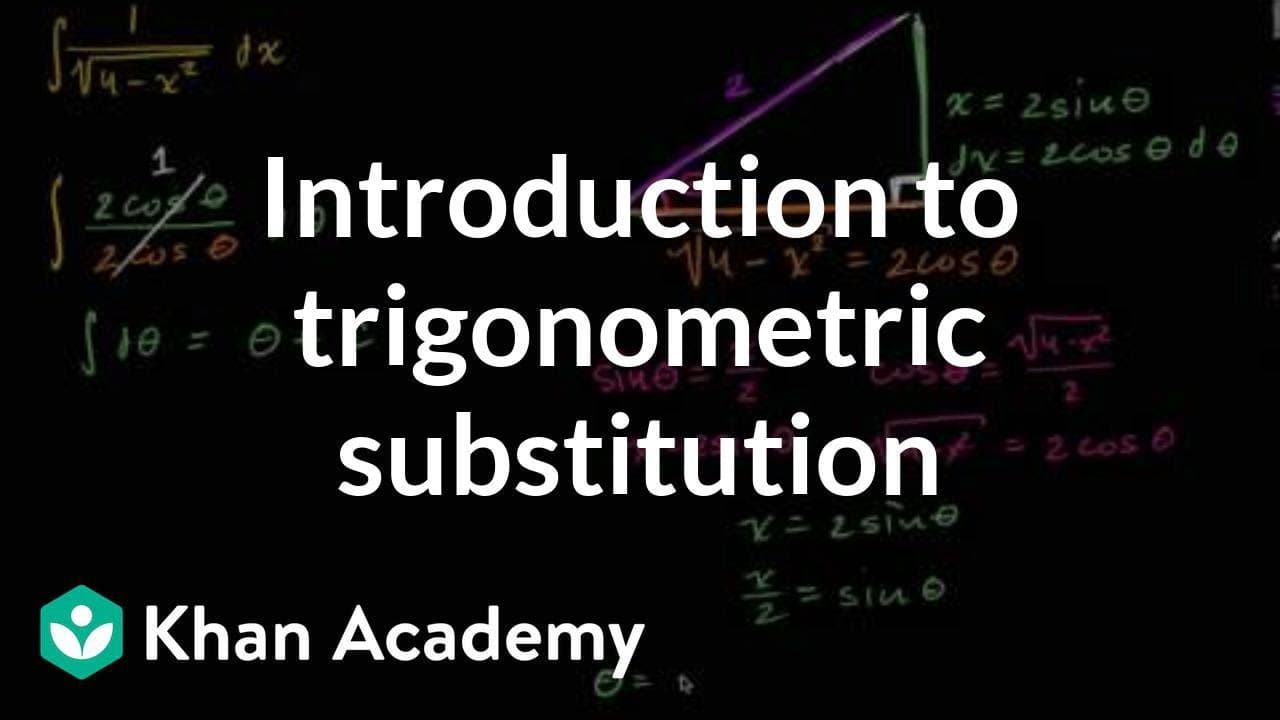
- 😑 Making the substitution x = 2sin(theta), the expression in the integral simplifies to 2cos(theta).
- ☺️ It is important to consider the domain restrictions for x and theta to ensure the validity of the substitution and the resulting integral.
- 🪘 Dividing by cosine theta is permissible as long as cosine theta is not zero, which is assured by the domain restrictions on theta.
Install to Summarize YouTube Videos and Get Transcripts
Explore YouTube Video Summarizer or Get YouTube Transcript Extractor
Questions & Answers
Q: How can a trigonometric substitution simplify the evaluation of an indefinite integral?
By substituting x with two sine theta, the expression in the integral simplifies to two cosine theta d theta, making it easier to evaluate.
Q: How do we determine the domain for the substitution?
The domain for the substitution is determined by the restriction that x must be greater than -2 and less than 2, which implies -1 < sine theta < 1. Therefore, theta must be between -pi/2 and pi/2.
Q: Why is it important for cosine theta to not equal zero?
Dividing by cosine theta is allowed as long as cosine theta is not zero, as having a zero in the denominator would result in an undefined expression. In this case, theta is restricted to be between -pi/2 and pi/2, where cosine theta is always positive and not equal to zero.
Q: Can this trigonometric substitution be applied to other indefinite integrals?
Yes, this substitution can be applied to other integrals with a similar denominator of the square root of four minus x squared, simplifying the expression and allowing for easier evaluation.
Summary & Key Takeaways
-
The video demonstrates how to evaluate an indefinite integral by using a trigonometric substitution.
-
It discusses the insight of relating the square root of four minus x squared to the Pythagorean theorem.
-
By substituting x with two sine theta and simplifying the expression, the integral can be evaluated as theta + C.
Read in Other Languages (beta)
Share This Summary 📚
Summarize YouTube Videos and Get Video Transcripts with 1-Click
Try YouTube Summary with ChatGPT & Claude or YouTube Transcript Generator
Explore More Summaries from Khan Academy 📚



Summarize YouTube Videos and Get Video Transcripts with 1-Click
Try YouTube Summary with ChatGPT & Claude or YouTube Transcript Generator