Parallax in observing stars | Cosmology & Astronomy | Khan Academy
TL;DR
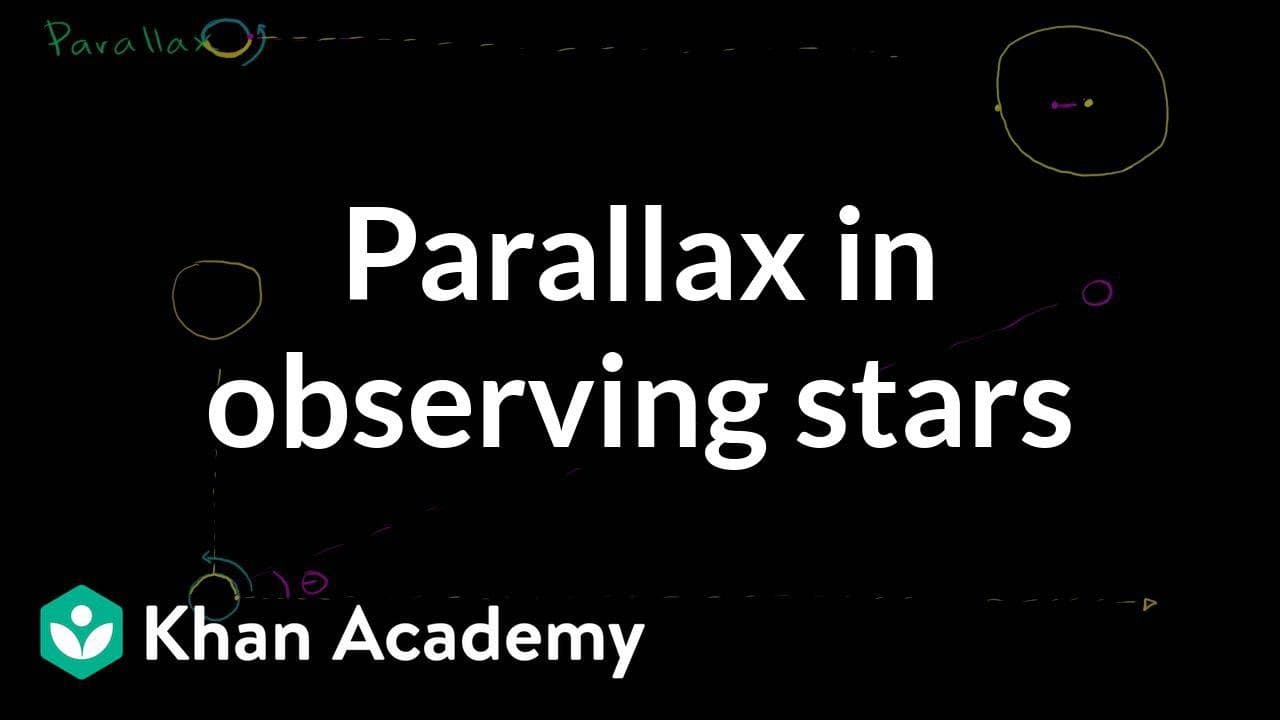
Parallax is the apparent change in position of an object based on a different line of sight, and it can be used to measure the distances of nearby stars.
Transcript
What I want to do in this video is explain what parallax actually is, and then try to visualize what the parallax would be like in the context of observing relatively nearby stars. And then in the next video, we're going to think about how we can use the parallax of nearby stars to figure out how far they actually are away from us. So parallax real... Read More
Key Insights
- 🫥 Parallax is the apparent change in position of an object based on a different line of sight.
- 🤩 When observing stars, parallax can be used to measure their distances from Earth.
- 🤩 By measuring the change in angle of a star over time, astronomers can calculate its distance using trigonometry.
- 👻 Parallax measurements provide a baseline distance between the Earth and the Sun, allowing for the calculation of stellar distances.
- 🤩 The apparent position of a star relative to the straight up direction can shift as the Earth orbits the Sun.
- 🔯 The maximum distance of a star from the straight up direction occurs at two points in the year, known as the points of maximum parallax.
- 🔯 These points are of particular interest for measuring the parallax angle and calculating a star's distance.
Install to Summarize YouTube Videos and Get Transcripts
Explore YouTube Video Summarizer or Get YouTube Transcript Extractor
Questions & Answers
Q: What is parallax?
Parallax refers to the apparent change in position of an object when viewed from different perspectives. It can be observed when objects are viewed from different distances and result in the perception of relative motion.
Q: How does parallax relate to nearby stars?
In the case of observing nearby stars, parallax can be used to determine their distances. By measuring the apparent change in angle of a star at different points in the year, astronomers can calculate its distance from the Earth.
Q: How is parallax measured?
Parallax is measured by observing an object at different points in time and noting the apparent change in its position. For stars, astronomers measure the angular shift of a star's position relative to background stars as the Earth orbits the Sun.
Q: How can parallax be used to determine stellar distances?
By measuring the change in angle of a nearby star at different points in the year, astronomers can calculate the baseline distance between the Earth and the Sun. This information, along with the measured parallax angle, allows them to calculate the star's distance using trigonometry.
Summary & Key Takeaways
-
Parallax is the apparent change in position of something based on a different line of sight, such as the movement of objects when observing them from different distances.
-
In the context of observing nearby stars, parallax can be used to determine their actual distances from us.
-
By measuring the apparent change in angle of a star at different points in the year, it is possible to calculate its distance.
Read in Other Languages (beta)
Share This Summary 📚
Summarize YouTube Videos and Get Video Transcripts with 1-Click
Try YouTube Summary with ChatGPT & Claude or YouTube Transcript Generator
Explore More Summaries from Khan Academy 📚



Summarize YouTube Videos and Get Video Transcripts with 1-Click
Try YouTube Summary with ChatGPT & Claude or YouTube Transcript Generator