How to Show a Limit with More Than One Variable Does Not Exist
TL;DR
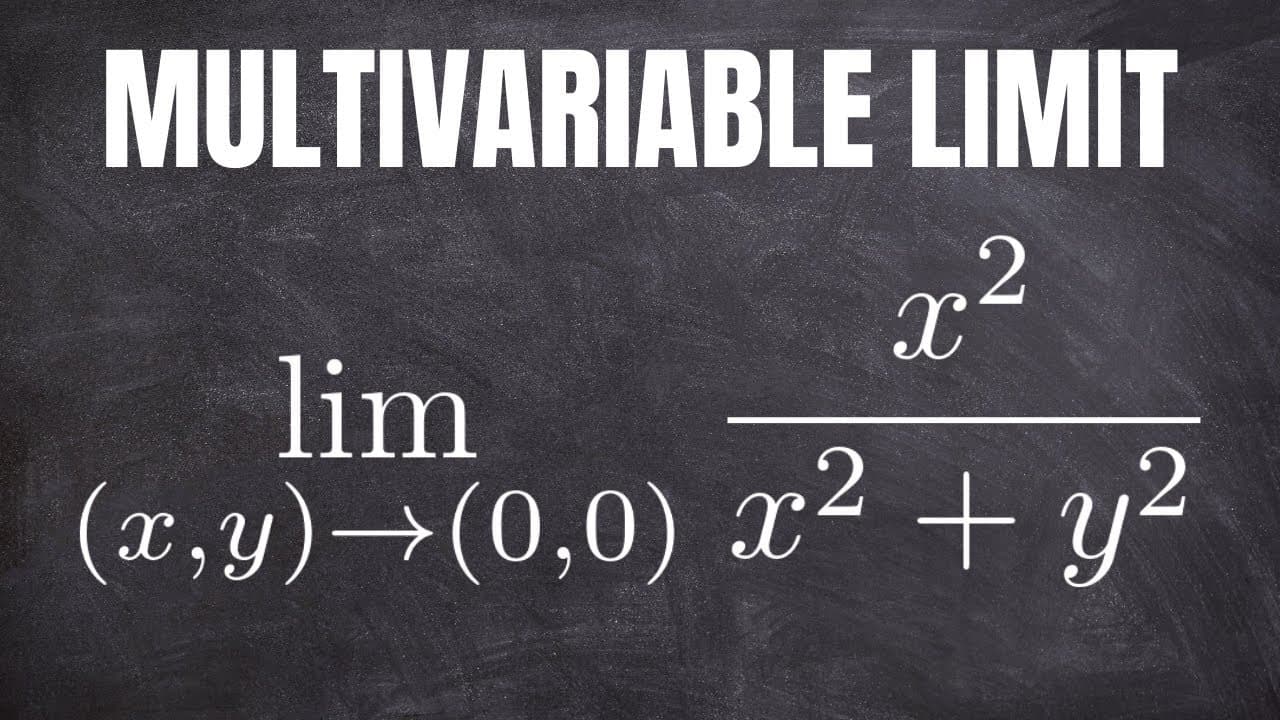
The limit does not exist when x and y approach 0 in the given function.
Transcript
hi in this problem we have a limit we have x y approaching 0 0 and the function is x squared over x squared plus y squared let's go ahead and work through it solution in order for a limit to exist must be equal to the same value no matter which way we approach so i am thinking that this limit is not going to exist because we can approach from diffe... Read More
Key Insights
- ⛔ Limits in calculus determine the value a function approaches when one or more variables approach a specific value.
- 💼 In this case, the limit does not exist because approaching from different directions gives different results.
- ⛔ Approaching from the y-axis yields a limit of 0, while approaching from the x-axis gives a limit of 1.
- ⛔ The existence of a limit requires the function to approach the same value regardless of the approach direction.
- ❣️ The function x squared over x squared plus y squared represents a relationship between two variables, x and y.
- ❣️ By setting x or y equal to 0, we can analyze the limit from specific directions.
- ❣️ The graphical representation of the problem helps visualize the limit approaches from the x-axis and y-axis.
Install to Summarize YouTube Videos and Get Transcripts
Explore YouTube Video Summarizer or Get YouTube Transcript Extractor
Questions & Answers
Q: What is the function being analyzed for its limit?
The function is x squared over x squared plus y squared.
Q: Why does the limit not exist in this problem?
The limit does not exist because approaching from different directions (x-axis and y-axis) gives different answers.
Q: What is the limit when approaching from the y-axis?
When approaching from the y-axis (with x=0), the limit is 0.
Q: What is the limit when approaching from the x-axis?
When approaching from the x-axis (with y=0), the limit is 1.
Summary & Key Takeaways
-
The limit of x squared over x squared plus y squared does not exist because approaching from different directions results in different answers.
-
When approaching from the y-axis (with x=0), the limit is 0.
-
When approaching from the x-axis (with y=0), the limit is 1.
Read in Other Languages (beta)
Share This Summary 📚
Summarize YouTube Videos and Get Video Transcripts with 1-Click
Try YouTube Summary with ChatGPT & Claude or YouTube Transcript Generator
Explore More Summaries from The Math Sorcerer 📚


Summarize YouTube Videos and Get Video Transcripts with 1-Click
Try YouTube Summary with ChatGPT & Claude or YouTube Transcript Generator