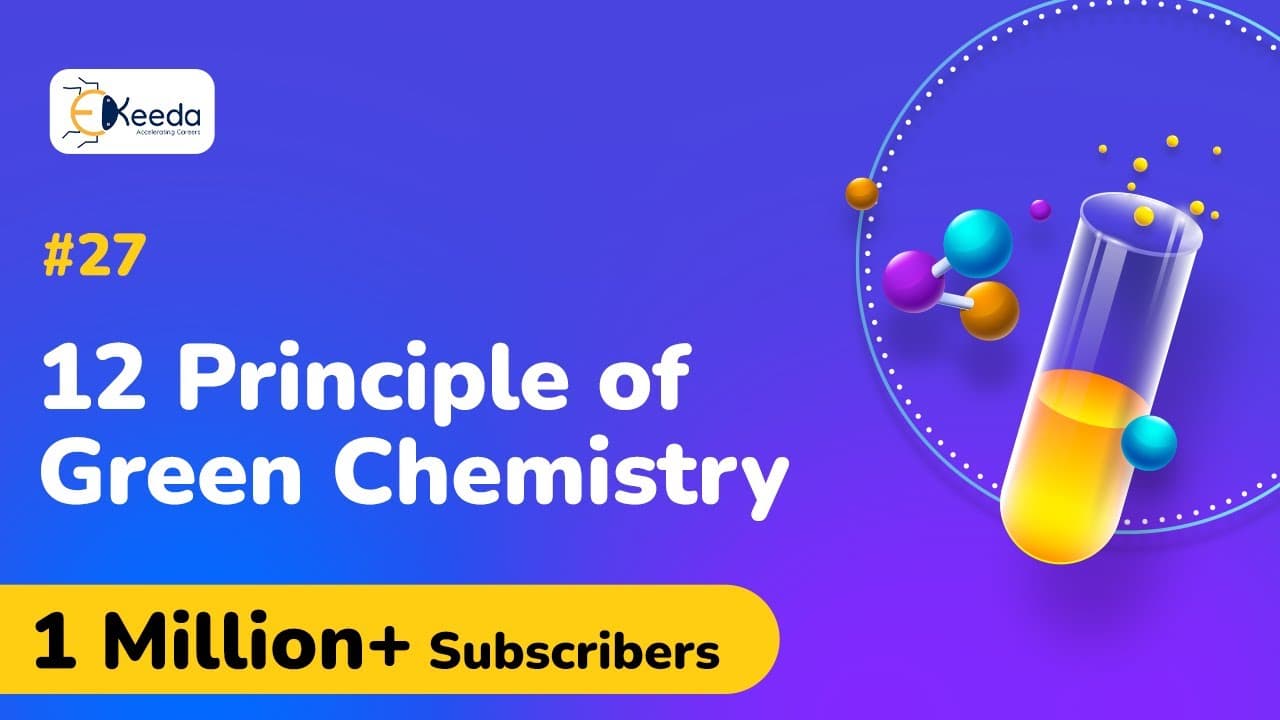
12 Principle Of Green Chemistry
TL;DR
Learn about the 12 principles of green chemistry, which aim to create a greener world by preventing waste, using safer chemicals, and promoting renewable resources.
Transcript
hello students in this session i am going to teach you the 12 principles of green chemistry so in 1994 an american scientist paul coined these 12 principles of green chemistry and he made sure that these 12 principles will help us making the entire globe a greener place so let us see his principles in detail the first one is prevent waste now this ... Read More
Key Insights
- 💚 Preventing waste is an important principle in green chemistry, aiming to minimize or eliminate useless by-products.
- 😒 Designing safer chemical products promotes the use of effective products with little to no toxicity.
- 🚱 Using renewable feedstocks instead of depleting resources helps reduce reliance on non-renewable energy sources.
- 😒 The use of catalysts instead of stoichiometric reagents helps minimize waste and increase efficiency in chemical reactions.
- 😒 Designing chemicals to be easily degradable after use and analyzing in real-time to prevent pollution are crucial in green chemistry.
- 💚 Maximizing energy efficiency and using safer solvents and reaction conditions further contribute to green practices.
Install to Summarize YouTube Videos and Get Transcripts
Explore YouTube Video Summarizer or Get YouTube Transcript Extractor
Questions & Answers
Q: What is the first principle of green chemistry?
The first principle of green chemistry is to prevent waste by designing chemical reactions that minimize or eliminate useless by-products. This helps to reduce environmental impact and promote sustainability.
Q: How can chemicals and products be designed to be safer for human health and the environment?
Chemicals and products can be designed to be safer by minimizing toxicity to humans and the environment. This involves using chemicals that are effective but have little to no toxicity, reducing the risk of harmful effects on living organisms.
Q: Why is it important to use renewable feedstocks in chemical reactions?
Using renewable feedstocks helps reduce reliance on depleting resources such as fossil fuels. Renewable feedstocks, such as solar energy, wind energy, and agricultural products, are sustainable and have a lesser impact on the environment compared to non-renewable resources.
Q: What is the benefit of using catalysts instead of stoichiometric reagents?
Catalysts can be used multiple times and help minimize waste in chemical reactions. Unlike stoichiometric reagents, which are used in excess and work only once, catalysts can be reused, reducing the need for additional reagents and generating less waste.
Summary & Key Takeaways
-
The 12 principles of green chemistry were established by an American scientist in 1994 to promote environmentally friendly practices in chemical reactions.
-
The first principle is to prevent waste by designing chemical reactions to minimize or eliminate useless by-products.
-
Designing safer chemical products is the second principle, focusing on creating effective products with little to no toxicity.
-
Hazardous chemical synthesis should be designed to minimize toxicity to humans and the environment, while using renewable feedstocks is encouraged to reduce reliance on depleting resources.
-
The use of catalysts instead of stoichiometric reagents helps minimize waste, as catalysts can be reused multiple times.
-
Avoiding chemical derivatives and designing chemicals to be fully effective and easily degradable after use are key principles of green chemistry.
-
Increasing energy efficiency and using safer solvents and reaction conditions are emphasized, as well as real-time analysis to prevent pollution.
-
The final principle is to minimize the potential for accidents by designing chemicals and their forms to reduce the risk of explosions, fires, and releases to the environment.
Read in Other Languages (beta)
Share This Summary 📚
Summarize YouTube Videos and Get Video Transcripts with 1-Click
Try YouTube Summary with ChatGPT & Claude or YouTube Transcript Generator
Explore More Summaries from Ekeeda 📚

Summarize YouTube Videos and Get Video Transcripts with 1-Click
Try YouTube Summary with ChatGPT & Claude or YouTube Transcript Generator